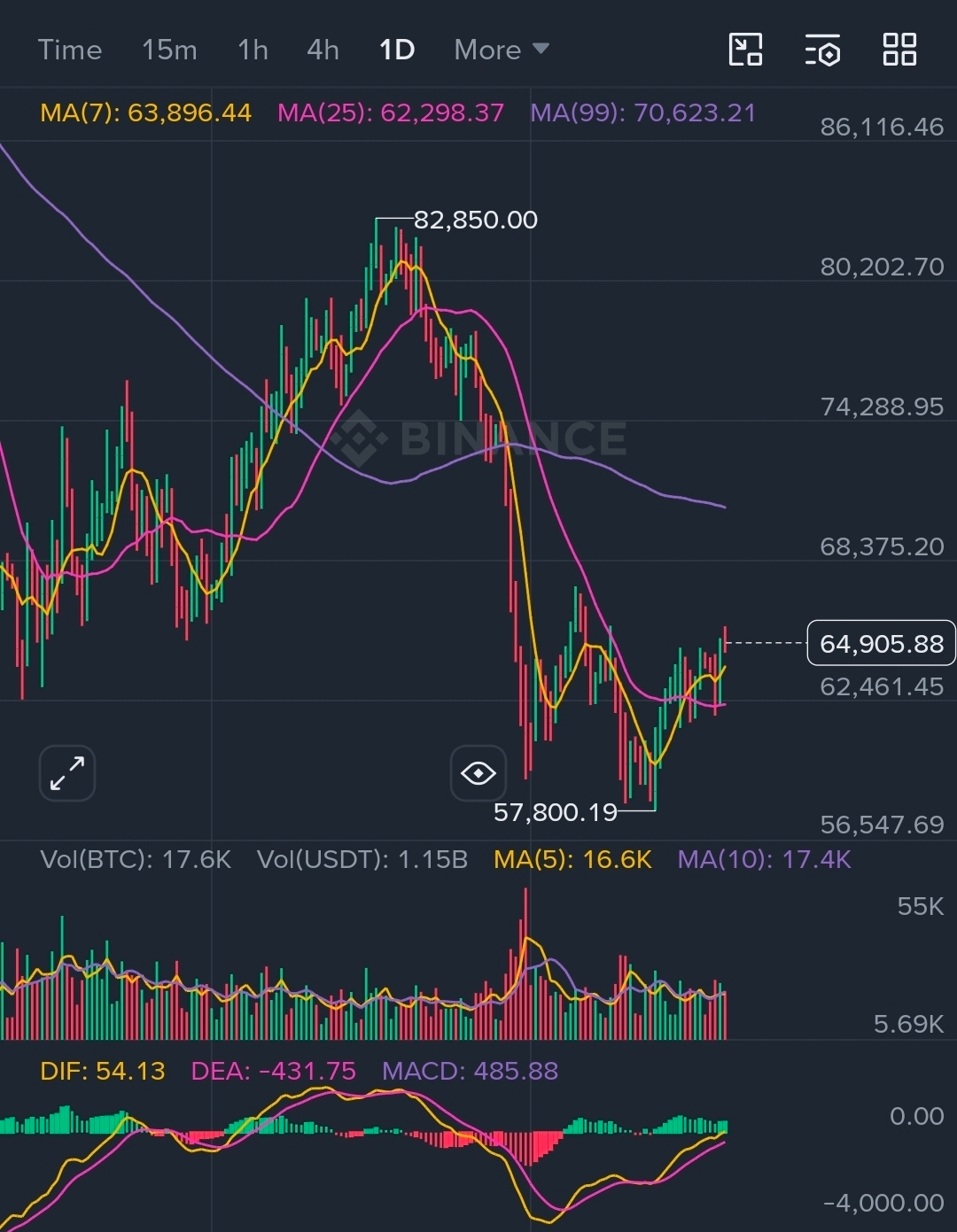
#BitcoinHoldsThreeWeekHighAt$65K
Bitcoin pushing back toward $65,000 caught everyone's attention. Most timelines immediately turned into the usual debate: Is this the beginning of the next rally or just another fake breakout?
I think that's the wrong question.
Price is the most visible signal in crypto, but it's often the least informative one. What interests me far more is the infrastructure underneath the move. A price can change in seconds, but the conditions that allow capital to stay in the market usually take weeks or months to develop.
When I look at Bitcoin trading around a three-week high, I don't immediately become bullish. Instead, I ask what kind of market is capable of sustaining that valuation.
The answer isn't simply "more buyers than sellers." Markets are far more complicated than that.
Liquidity has to absorb aggressive buying without breaking market structure. Exchanges need enough depth to process large orders without causing abnormal slippage. Custodians must continue securing billions of dollars without operational failures. Settlement systems have to keep functioning smoothly even during periods of volatility. Every one of these layers quietly determines whether a rally is resilient or fragile.
That's why I believe infrastructure deserves more attention than candles.
One thing I've learned after watching multiple market cycles is that price often creates an illusion of certainty. When Bitcoin rises, people naturally assume confidence is increasing. But confidence built on leverage behaves very differently from confidence built on genuine capital inflows.
Those two situations may produce nearly identical price charts, yet they carry completely different risks.
This is where market structure becomes far more interesting than market direction.
If higher prices are supported by healthier liquidity, stronger institutional participation, and disciplined risk management, then the move gains structural credibility. If the same price is being driven primarily by speculative leverage, then the market becomes increasingly sensitive to even small shocks.
The difference isn't visible from the chart alone.
Another question I keep asking myself is whether the ecosystem has actually become stronger since Bitcoin last traded around these levels.
Have exchanges improved their risk engines?
Have custody solutions become more resilient?
Has cross-chain liquidity become more efficient?
Have institutional settlement systems reduced operational risk?
If the answer is yes, then today's $65K represents a fundamentally different environment from previous rallies. The price may be similar, but the foundation supporting it has evolved.
That's an important distinction because financial systems rarely fail at the surface. They usually fail where users aren't looking.
History shows that markets don't collapse simply because prices become expensive. They struggle when hidden assumptions suddenly stop holding true. Liquidity disappears. Counterparties fail. Risk models break under stress. Infrastructure that looked reliable during calm conditions reveals weaknesses during volatility.
This is why I try not to celebrate price milestones too quickly.
A healthy Bitcoin market isn't one that reaches another headline number. It's one that continues functioning smoothly when fear replaces optimism.
To me, that's the real stress test.
The next phase for Bitcoin won't be decided solely by whether it trades above or below $65K. It will depend on whether the surrounding infrastructure has matured enough to support larger pools of capital without introducing new systemic vulnerabilities.
Price attracts attention.
Infrastructure determines durability.
💬 Discussion
If Bitcoin eventually reaches new all-time highs, what will matter more: stronger demand from investors, or stronger market infrastructure capable of absorbing that demand without creating new systemic risks?