
It was one of those ordinary market mornings where nothing really felt new. I opened the charts almost out of habit, checked a few watchlists, skimmed a few AI-token headlines, and expected the usual cycle of loud claims, recycled narratives, and short-lived attention. Then NEWT appeared through a quiet suggestion rather than a massive campaign.
At first, I treated it like another AI-adjacent token trying to borrow momentum from a hot sector. That has become the default defense mechanism after spending enough years in crypto: assume the narrative is stronger than the product until the structure proves otherwise.
But Newton Protocol did make me pause.
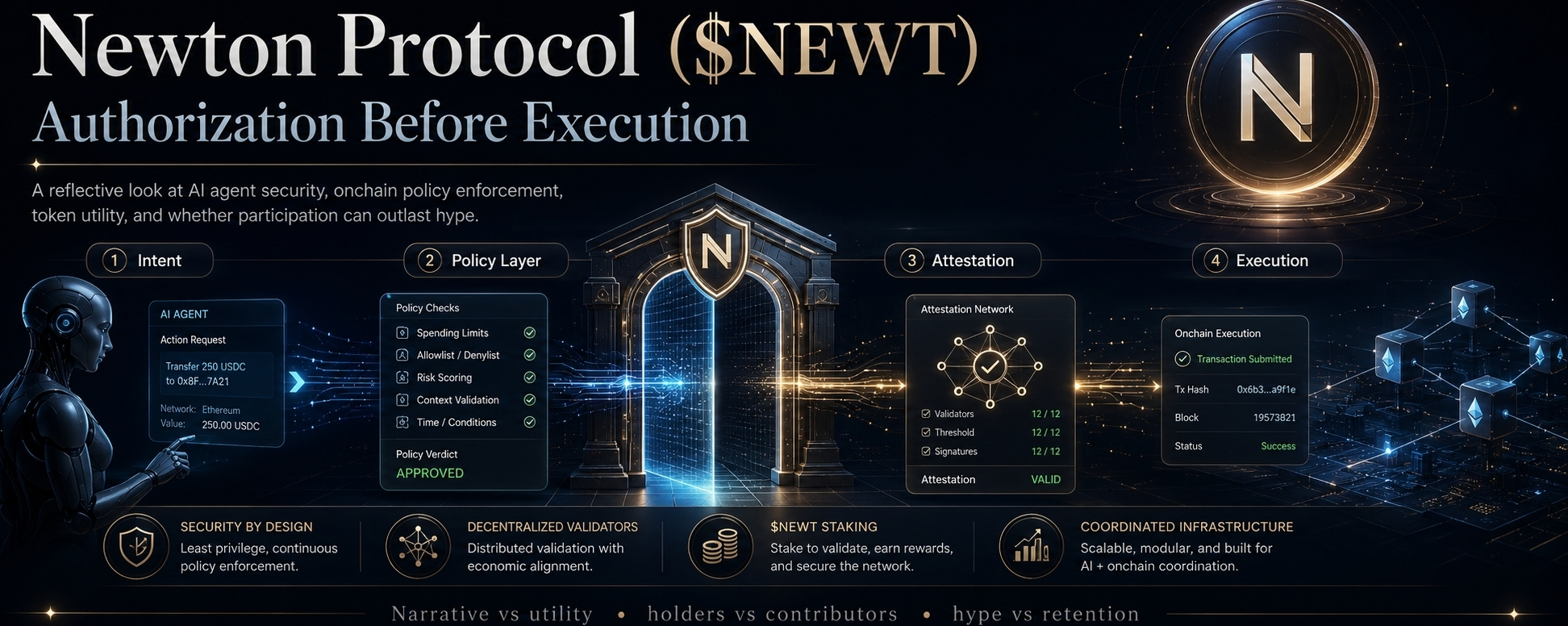
Not because of the price move, and not because “AI + crypto” is automatically exciting. That phrase has already been stretched too thin. What stood out was the project’s focus on authorization before execution. Newton is positioning itself around a serious idea: before automated systems, AI agents, or onchain applications move capital, there should be a verifiable policy layer deciding whether that action should be allowed.
That distinction matters. A lot of crypto infrastructure still thinks in terms of settlement: move the asset, record the event, analyze the result afterward. Newton is trying to sit one step earlier in the flow, between intent and execution. In simple terms, it asks: should this transaction be allowed to happen at all?
That is a more serious question than most market narratives admit.
For me, the interesting part is not whether Newton can attract attention during an AI cycle. Attention is cheap in crypto. The harder question is whether the network can create enough internal usage that the token becomes more than a speculative receipt. That means looking beyond visibility and asking whether developers, operators, validators, policy creators, vault curators, users, and stakers have real reasons to stay involved after the first wave of excitement cools.
Newton’s identity is fairly clear from the available material: it is not simply an AI chatbot project, and it is not just another automation token. It is trying to become an authorization layer for onchain finance, especially where autonomous agents, DeFi vaults, institutional capital, and compliance-sensitive workflows require rules that are enforced rather than merely promised.
Its core workflow appears to revolve around policies, intents, tasks, attestations, operators, and smart-contract verification. A user or application submits an intent, operators evaluate that intent against a policy, and the result is returned as a verifiable attestation that a smart contract can check before allowing execution.
This is where Newton becomes more interesting than a standard “AI agent” narrative. Most agent discussions focus on what the agent can do. Newton focuses more on what the agent is allowed to do. That sounds less glamorous, but in finance it may be more important. An agent with unrestricted wallet permissions is not innovation; it is risk with a nicer interface.
Good infrastructure often begins with boring constraints.
The ecosystem design has several layers. Developers write policies. Users or applications submit transaction intents. Operators evaluate those intents. Validators and stakers help secure the network. The broader design connects policy enforcement, external data, cryptographic attestations, and decentralized operator participation.
That is not a simple consumer product. It is infrastructure, and infrastructure usually grows slower than narratives. This creates both opportunity and risk. The opportunity is that if Newton becomes useful inside actual DeFi workflows, especially vault management, automated agents, and institutional compliance, its value could come from repeated system usage rather than social attention. The risk is that the architecture may be too complex for many developers who prefer faster, simpler, and less restrictive environments.
Newton’s Mainnet Beta gives the project something more concrete to discuss. The protocol is no longer just a theoretical idea. It is being framed around policy enforcement for onchain transactions, with integrations and data partners helping support rules around vaults, risk, collateral, and automated execution.
That combination is important because a policy engine is only as reliable as the data it reads. If a vault rule depends on collateral prices, risk ratings, depeg conditions, or counterparty risk, then weak data turns enforcement into theater. The stronger model is one where raw market data, risk intelligence, and enforceable smart-contract logic work together.
This is also where I separate narrative from utility. The narrative says “AI agents need guardrails.” That sounds good, but it is still only a story. Utility begins when a real protocol, vault, DAO, or institution uses those guardrails because they reduce operational risk, improve auditability, or unlock a workflow that was previously too dangerous to automate.
Newton’s vault-related direction is especially worth watching. If a vault curator can manage assets while every action is checked against predefined risk policies, that changes the trust model. Instead of relying only on human discretion or post-event review, the system can enforce rules before capital moves.
That is a useful design choice. The best infrastructure does not always demand that users migrate into an entirely new world. Sometimes it wins by fitting into the workflows people already use, while making those workflows safer or more verifiable.
Now, the token side deserves a more skeptical reading.
$NEWT is presented as the native utility and governance token of Newton Protocol. Its stated roles include staking for protocol security, paying network fees, supporting authorization-related actions, participating in model or agent registration, and eventually helping govern the direction of the ecosystem.
On paper, that is a reasonable utility map. But in crypto, “token utility” is often where good writing hides weak demand. The question is not whether the token has assigned roles. The question is whether those roles create organic, recurring demand that is stronger than emissions, incentives, and unlock pressure.
Staking can support security, but staking alone does not prove product-market fit. Fee payments can matter, but only if enough users and protocols generate meaningful transaction volume. A model registry can create a marketplace effect, but only if developers actually list useful agents and operators actually serve them. Governance can matter, but only if governance controls decisions worth caring about and is not merely symbolic.
Newton’s supply structure also deserves careful reading. The project has a fixed token supply, with part of the supply circulating at launch and the rest distributed across community, ecosystem, treasury, team, investor, and development categories over time.
That is neither automatically good nor automatically bad. Long vesting can reduce immediate pressure, but future unlocks still matter. Community allocation can support growth, but it can also become a subsidy machine if not tied to durable usage. Internal allocations can align builders, but they also require trust that the project will use resources efficiently.
In a mature analysis, tokenomics are not judged by percentages alone. They are judged by whether emissions, unlocks, fees, staking, and actual demand converge into a sustainable system.
The staking model is another area where the future matters more than the headline. Newton’s validator system is expected to expand in phases, moving from more controlled participation toward broader decentralization over time. Early network rewards can help bootstrap security, but the important transition is from incentive-funded participation to fee-supported participation.
That transition is the key. Early rewards can attract participants, but they do not prove retention. The stronger signal would be seeing validators and stakers remain because the network generates meaningful fees, not because temporary incentives are attractive. In other words, conviction increases when the system pays participants from usage, not just from allocation.
Governance also needs time. Newton’s long-term roadmap includes progressive decentralization, community decision-making, and governance over ecosystem direction. That is a reasonable ambition, but “progressive decentralization” should be measured, not assumed. The signals to watch are proposal quality, voter distribution, treasury transparency, meaningful community participation, and whether governance actually controls important protocol parameters.
This is where many projects lose me. They build holders before contributors. They build noise before retention. They build a token before proving that the token coordinates something essential. Newton has a more serious internal structure than many AI-themed projects, but the burden of proof remains.
What would build conviction?
First, real policy evaluation volume. Not just signups, not just demo transactions, not just campaign activity. Repeated evaluations from real applications would matter more than social impressions. If users, vaults, agents, and protocols continue generating policy checks after early incentives fade, that would be a meaningful signal.
Second, stronger third-party integrations. Newton becomes more credible if independent vault curators, DeFi protocols, DAOs, and wallet providers integrate it because they need enforceable policy checks. Announcements are useful, but production dependency is stronger.
Third, fee-based security. A protocol becomes more sustainable when fees from actual usage begin to support operators, validators, and stakers. Foundation rewards can bootstrap participation, but they cannot be the long-term story. If Newton’s own activity starts funding network security, that would be a much cleaner sign of internal value creation.
Fourth, operator decentralization. Since Newton’s security model involves operators evaluating policies and producing attestations, the composition and behavior of the operator set matter. Real confidence depends on how decentralized, reliable, and accountable the live system becomes.
Fifth, developer retention. A project like Newton needs builders who are willing to learn the policy model, write rules, integrate SDKs, work with data inputs, and connect authorization checks into applications. That is not casual participation. If developers return after the first hackathon or grant program ends, that would say more than any short-term trading volume.
What creates caution?
The first caution is complexity. Newton is solving a real problem, but the solution is not lightweight. Policy engines, cryptographic attestations, external data, operator consensus, privacy layers, slashing conditions, and onchain verification all introduce moving parts. For high-value institutional or vault use cases, that complexity may be acceptable. For smaller teams, it may feel like overhead.
The second caution is the market’s preference for simpler stories. Many traders still reward visible AI branding more than invisible infrastructure. Newton’s value proposition is not as instantly digestible as “AI bot that trades for you.” It is closer to “policy enforcement before automated capital movement.” That is more durable if adopted, but harder to market.
The third caution is current utility versus future utility. Some parts of the vision, especially broader decentralization, advanced privacy, and large-scale agent authorization, still need to be judged by production reality. The right stance is patience, not blind confidence.
The fourth caution is the difference between holders and contributors. A large holder base can create liquidity and attention, but it does not necessarily create a network. Newton’s long-term health depends more on operators running infrastructure, developers writing policies, vaults enforcing rules, users issuing permissions, and stakers securing the system. A token can trade actively while the underlying network remains thin. That distinction should never be ignored.
The fifth caution is incentive distortion. If early growth is mostly driven by rewards, airdrops, campaigns, or speculative staking, then activity can disappear when the reward curve changes. Sustainable protocols eventually need participants who stay because the product solves a costly problem.
This is why I would not analyze $NEWT as a simple chart story. The chart can show momentum, exhaustion, accumulation, or short-term risk, but those signals are only surface-level. For a project like Newton, the more important question is whether the protocol becomes embedded in workflows where authorization is not optional.
If an AI agent controls capital, if a vault curator manages institutional deposits, if a DAO automates treasury execution, or if a regulated entity needs proof that a transaction passed defined rules, then Newton’s category starts to make sense.
But that category still has to earn adoption.
The strongest version of Newton is a world where onchain automation cannot scale without enforceable permissions. In that world, NEWT is not just a trading asset; it becomes part of the coordination layer for security, fees, registry participation, and governance.
The weaker version is a familiar crypto pattern: strong architecture, impressive terminology, early traction, but not enough recurring demand to survive beyond incentives and market attention.
My personal view is measured. Newton is one of the more structurally interesting projects inside the AI-agent and DeFi-infrastructure conversation because it focuses on permission, enforcement, and verifiability rather than pure automation. That makes it more serious than many narrative-driven tokens.
But seriousness does not remove execution risk. It only makes the project worth watching with better questions.
The signals that matter most are not daily price movement, social volume, or how aggressively people repeat the AI narrative. The signals that matter are policy evaluations, real integrations, fee generation, active operator participation, developer retention, governance maturity, and whether users continue to rely on Newton when there is no immediate reward for doing so.
That is where real value gets tested.
Early excitement can make almost anything look alive. Meaningful participation after the excitement fades is different. If Newton can keep developers building, operators validating, vaults enforcing, users authorizing, and stakers securing the system after the first wave of attention passes, then the project’s internal value will become easier to take seriously.
Until then, the right posture is not hype and not dismissal. It is selective observation.
