

The Prepare phase finished.
The policy still hadn't been evaluated.
That was the first place I stopped reading the authorization flow.
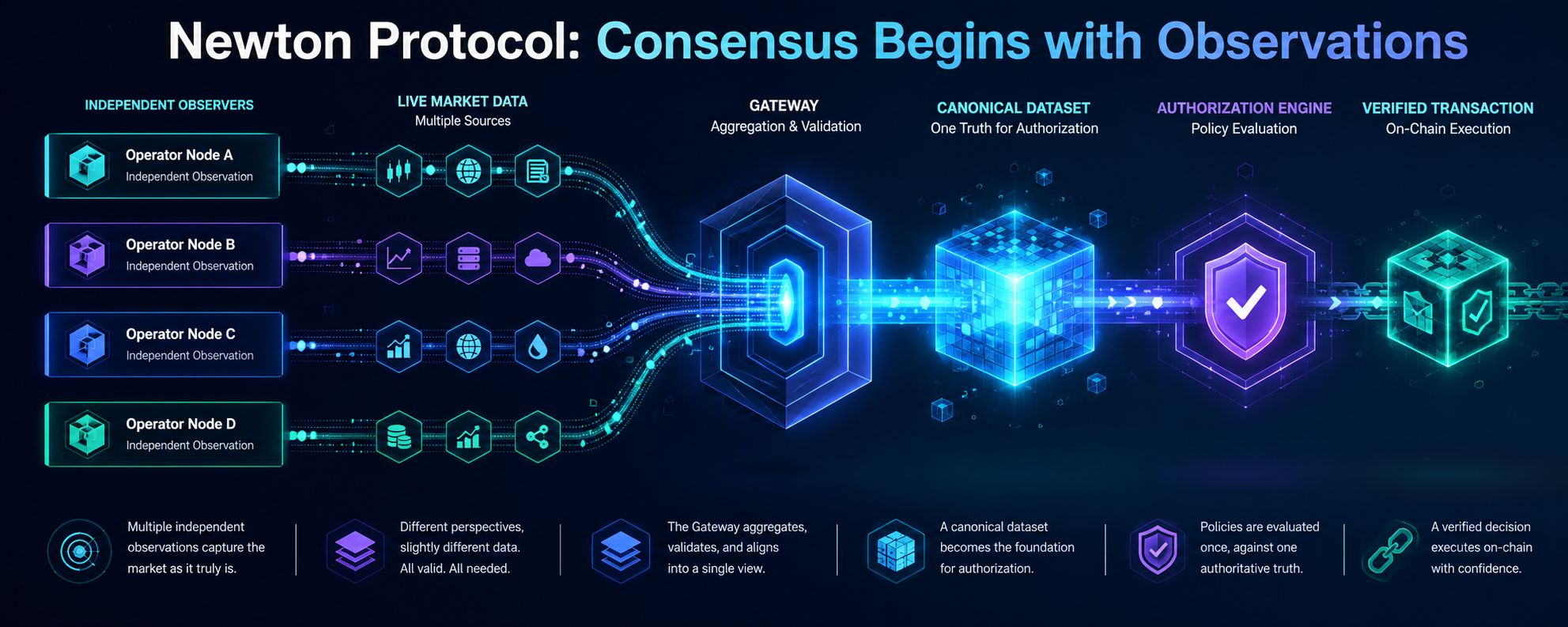
Every operator had already collected the data the policy depended on. Price feeds. Risk scores. Identity and compliance inputs. Each operator observed current conditions through its own network path.
I read that section again.
The observations weren't guaranteed to match.
Price feeds update continuously. Network latency differs. External data changes while operators are still collecting it. Two operators can ask the same question and receive slightly different answers.
The policy couldn't run yet.
A BLS aggregate signature only works if every signing operator produces the same evaluation result. Different inputs produce different conclusions. Different conclusions can't become one authorization.
The disagreement wasn't about the policy.
It was about the facts the policy was being asked to evaluate.
That's why reconciliation comes before evaluation.
Newton's Gateway computes median-based consensus across numeric fields in operator responses to produce a single canonical dataset. Only then does the Evaluate phase begin, with every operator executing the same deterministic policy against the same inputs.
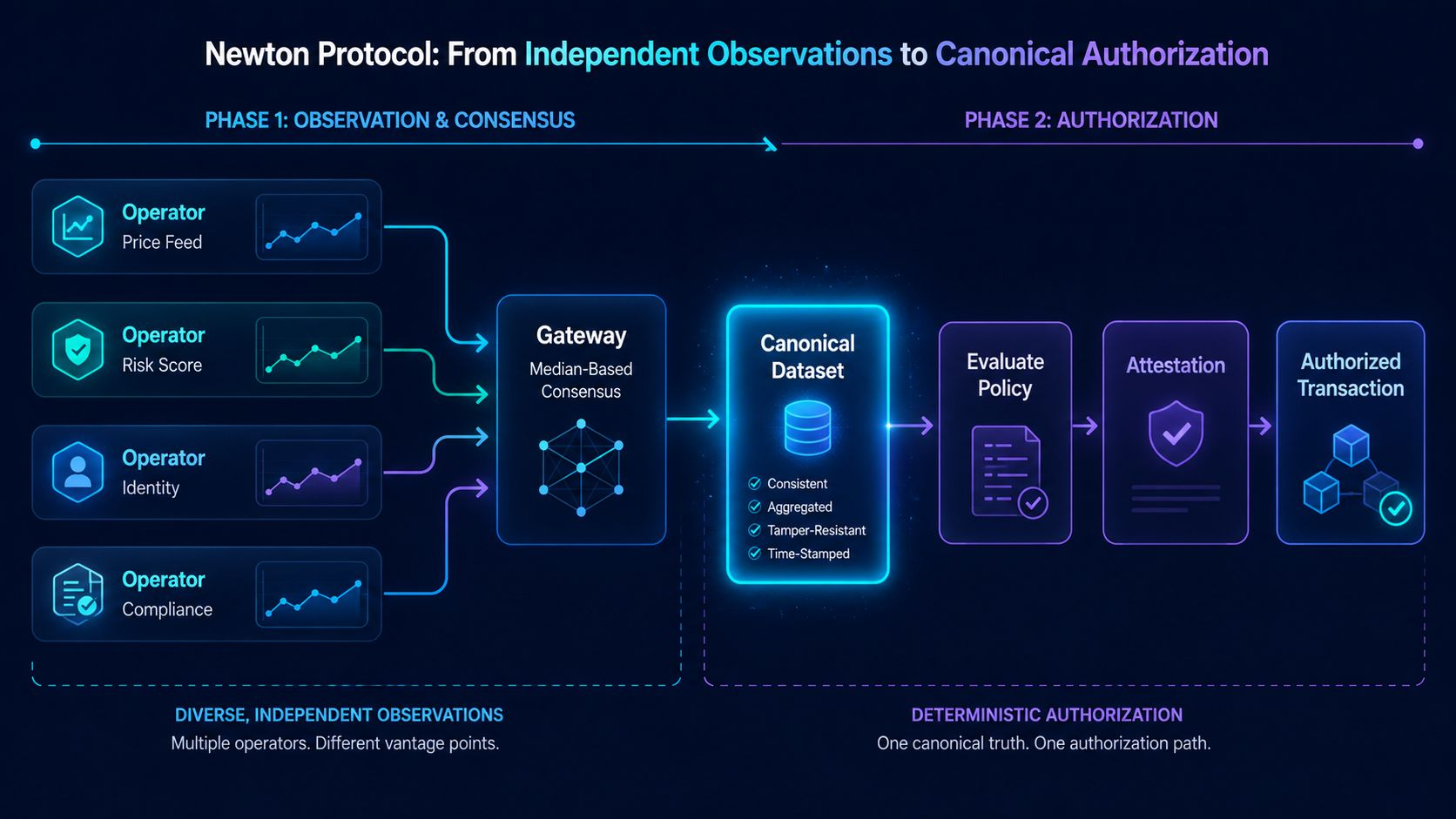
Consensus doesn't begin with signatures.
It begins with observations.
The authorization isn't built from one operator's observation.
It's built from the canonical dataset the operator set collectively agreed to evaluate.
By the time a signature exists, the reconciliation has already happened.
The final attestation proves that a quorum of operators evaluated one policy against one canonical dataset and independently reached the same result.
That wasn't the part I kept thinking about.
Markets continue moving.
Operators continue observing.
Consensus freezes one shared view long enough for deterministic authorization to happen.
The mechanism is documented.
The interesting part isn't.
Mainnet Beta will show what happens when oracle updates, network latency, and operator connectivity drift just enough to test the assumptions the reconciliation process was built on.
$NEWT only becomes interesting to me if the canonical dataset remains a trustworthy foundation for authorization, not only when operators agree easily, but when real production conditions force the reconciliation process to earn that agreement.
The signatures prove operators reached the same decision.
Mainnet Beta will show how often they first had to reconcile the same set of facts.