
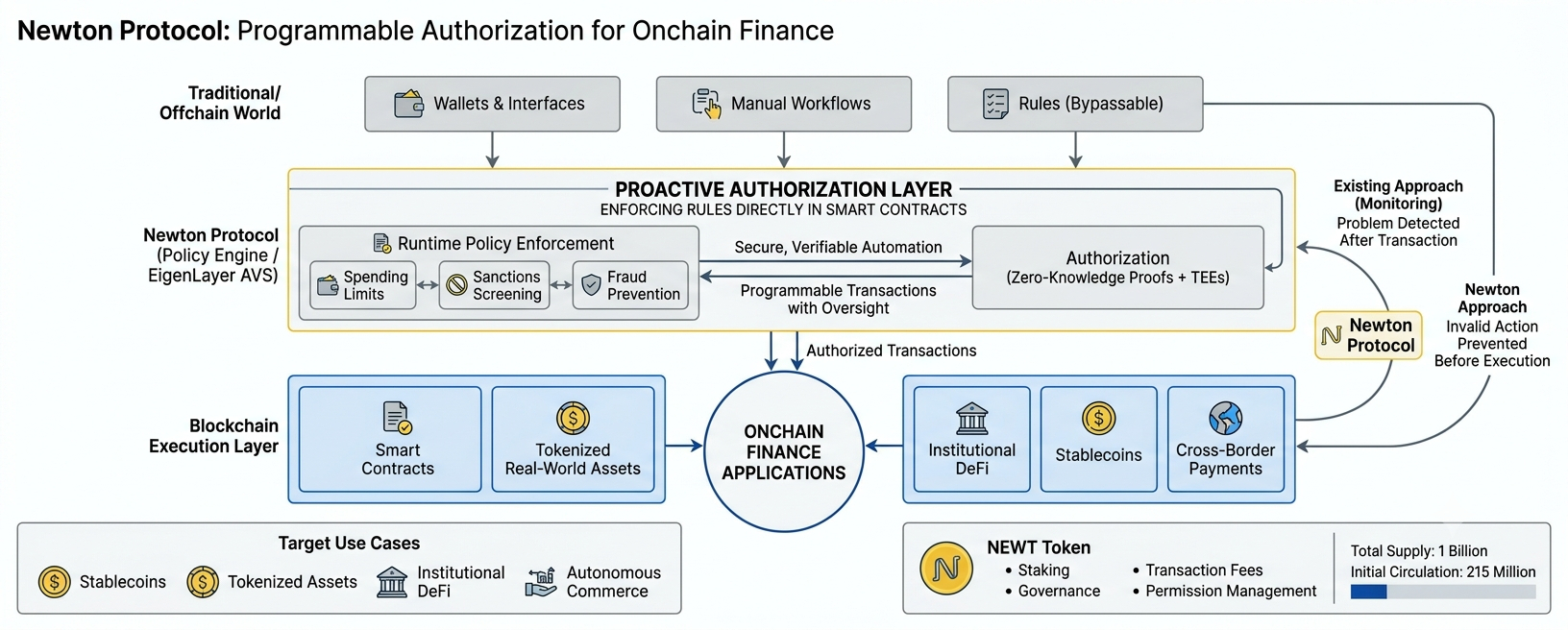
Most blockchain infrastructure focuses on transaction execution, while the rules governing those transactions often remain offchain in wallets, interfaces, or manual workflows that can be bypassed. Newton's core thesis is that blockchain systems need an authorization layer alongside an execution layer. It is designed as a policy engine for onchain transaction authorization, built as an EigenLayer AVS, with the objective of enforcing rules such as spending limits, sanctions screening, and fraud prevention directly within smart contracts.
This approach is becoming increasingly relevant as the crypto industry evolves beyond simple token launches. Capital is steadily moving toward stablecoins, tokenized real-world assets, institutional DeFi, and AI-driven automation, all of which require stronger controls, compliance mechanisms, and risk management. Newton aims to address this need by positioning itself as an authorization layer for onchain finance, combining trusted execution environments with zero-knowledge proofs to enable secure, verifiable automation while allowing programmable transactions without sacrificing oversight.
One of Newton's strongest advantages is the clarity of its design philosophy. Rather than relying on monitoring systems that detect problems after transactions occur, the protocol seeks to prevent unauthorized or invalid actions before execution. This proactive approach is particularly meaningful in decentralized finance, where security audits and monitoring tools cannot eliminate runtime risks. The protocol is built around runtime policy enforcement, ensuring predefined rules remain active while applications are operating instead of only being checked beforehand.
Its target use cases also align with several of crypto's fastest-growing sectors, including stablecoins, tokenized assets, cross-border payments, institutional decentralized finance, and autonomous digital commerce. These markets demand policy controls such as spending restrictions, sanctions compliance, and fraud prevention. While these features may not generate the same excitement as speculative narratives, they represent essential infrastructure if blockchain technology is to support mainstream financial applications.
The token model reflects this utility-focused approach. NEWT serves as the network's native token for staking, transaction fees, governance, and permission management. The protocol has a fixed maximum supply of one billion tokens, with approximately 215 million entering circulation at launch. Token allocation is divided between community-focused distribution and internal allocations, emphasizing ecosystem participation while maintaining resources for long-term development. Ultimately, however, the token's long-term value will depend more on network adoption and sustained usage than on token ownership alone.
There are also indications that the ecosystem is gradually expanding. Recent development efforts have focused on mainnet progress, authorization-layer architecture, vault security controls, and integrations with identity verification solutions. These developments suggest the team is actively building practical infrastructure rather than relying solely on theoretical concepts. Even so, early technical progress should not be confused with widespread adoption. The key challenge remains attracting developers, applications, and users who are willing to integrate authorization-based security into their workflows.
The risks are equally clear. Newton operates in a highly competitive infrastructure sector where multiple projects are pursuing similar goals around compliance, automation, security, and account abstraction. Its success depends not only on technical reliability but also on ease of integration, developer experience, governance efficiency, and compatibility across multiple blockchain ecosystems. Even a technically strong protocol can struggle if adoption barriers remain high or if existing alternatives continue to satisfy most market needs.
Market sentiment toward NEWT currently appears cautious rather than strongly bullish. Although the token recently experienced a short-term rebound toward $0.0523, the broader trend still reflects significant weakness and fading momentum following earlier declines. This suggests that current price movements are driven more by short-term positioning than long-term conviction. For infrastructure projects like Newton, sustainable value is ultimately determined by real network activity, ecosystem growth, integrations, and consistent demand rather than temporary market speculation.
Overall, Newton Protocol presents a credible solution to an increasingly important problem in blockchain infrastructure. Its focus on programmable authorization, policy enforcement, and secure automation addresses practical challenges that become more significant as institutional and enterprise adoption expands. Whether the project succeeds over the long term will depend less on its technical vision and more on its ability to execute, attract developers, build meaningful integrations, generate sustained usage, and demonstrate measurable real-world utility. In the infrastructure sector, long-term success belongs to protocols that consistently deliver practical value rather than relying on narrative alone.