
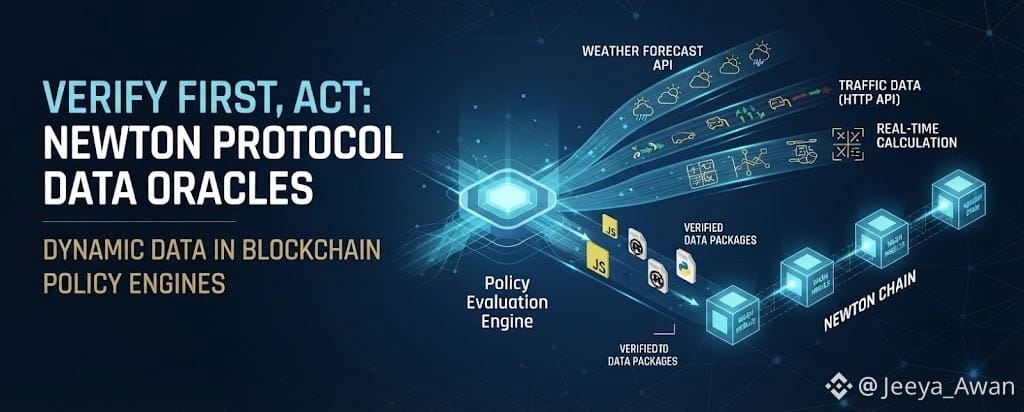
I have a simple habit whenever I explore a new blockchain application. Before interacting with it, I spend a few minutes reading how it actually works behind the scenes. Most people focus on the interface, but I always become curious about what happens before a transaction is approved. That curiosity is exactly what led me to @NewtonProtocol .
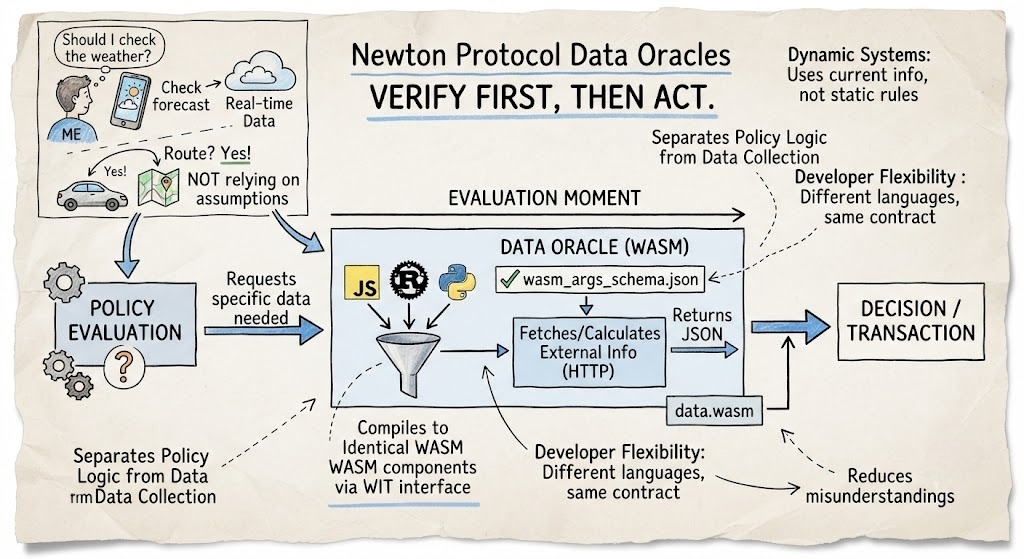
While learning about its architecture, I came across the concept of Data Oracles. At first, I thought an oracle was simply another service sending price feeds to a blockchain. The more I read, the more I realized Newton approaches the idea differently. Instead of relying on fixed information, it allows WebAssembly components to fetch or calculate external data exactly when a policy evaluation happens.
That immediately reminded me of something I do almost every day. Before leaving home, I never rely on assumptions. If the weather looks uncertain, I check the forecast. If I'm traveling somewhere unfamiliar, I confirm the route instead of trusting yesterday's traffic conditions. I make decisions using fresh information rather than outdated guesses.
Newton's Data Oracles gave me the same impression.
Rather than expecting policies to work with static information, they can request exactly the data they need during evaluation. The oracle receives structured inputs through wasm_args, performs calculations or retrieves external information through HTTP if necessary, and returns JSON that immediately becomes available to the Rego policy as data.wasm. I found this design surprisingly elegant because it separates policy logic from the process of collecting data.
Another detail I appreciated was the flexibility for developers. Some developers enjoy JavaScript, others are more productive with Rust or Python. Instead of forcing everyone into one programming language, Newton lets all of them compile into identical WASM components using the same WIT interface. That means teams can work with familiar tools while producing interchangeable data oracles.
As someone who spends time experimenting with developer documentation, I know how valuable that consistency becomes. Different languages no longer create fragmented ecosystems because everything eventually follows the same contract.
I also liked how input validation is handled. Defining a wasm_args_schema.json means everyone understands exactly what information the oracle expects before execution begins. That reduces misunderstandings and makes integrations much cleaner.
Reading through this documentation changed how I look at policy engines. I used to think policies were only collections of predefined rules. Now I understand they can become dynamic systems that evaluate current information at the exact moment a decision matters.
The more I explore Newton Protocol, the more it feels like its philosophy matches how I already make decisions in daily life. I rarely trust assumptions when better information is available. I verify first, then act. Seeing that same mindset reflected through Data Oracles and policy evaluation is one of the reasons I've continued following Newton's progress.
