
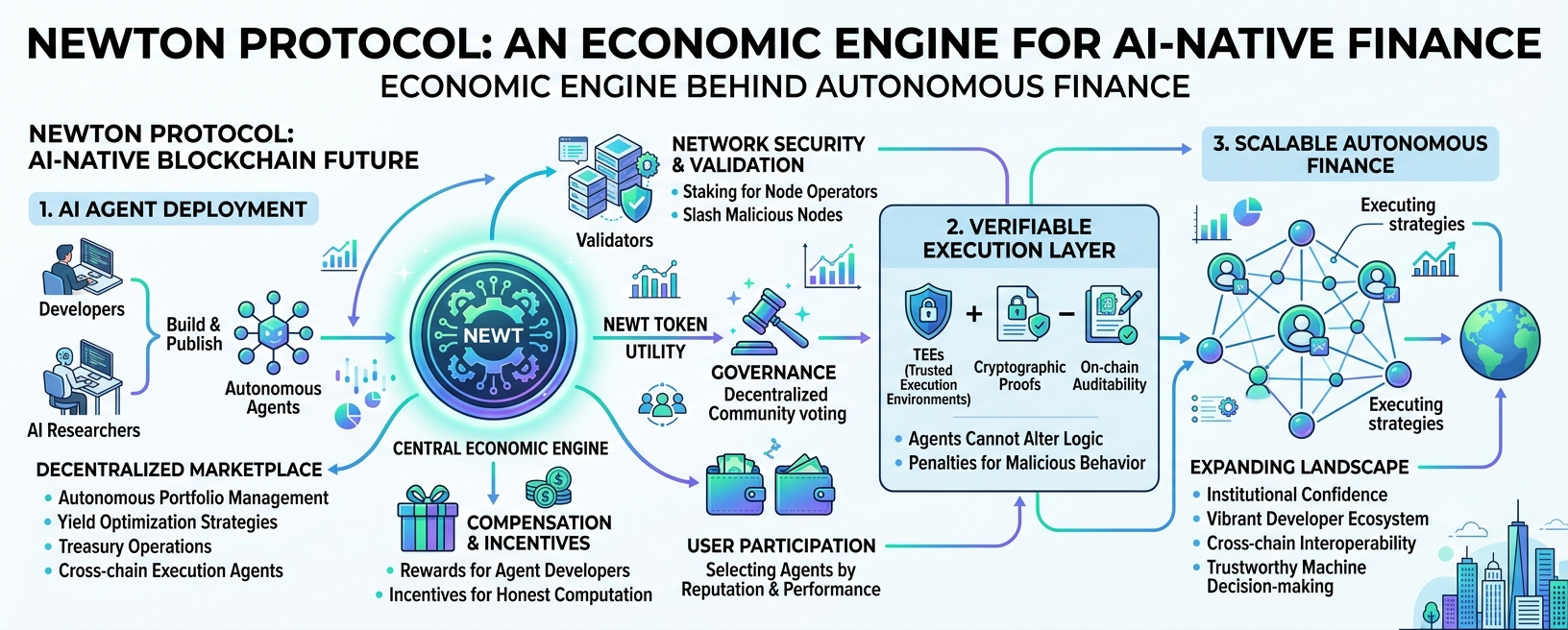
Blockchain Future Every successful blockchain is built on an invisible contract between technology and economics. The code secures the network, but incentives determine whether it thrives or fades into irrelevance. Newton Protocol (NEWT) approaches this challenge with a distinctive premise: if artificial intelligence is destined to manage digital assets, execute financial strategies, and coordinate decentralized applications, then AI itself requires a trust framework that is transparent, verifiable, and economically aligned.
Rather than treating AI as a standalone feature, Newton Protocol embeds it into a decentralized marketplace where developers, validators, and users participate in a shared economy. AI developers can publish autonomous agents capable of portfolio management, yield optimization, treasury operations, or cross-chain execution. Users retain control over permissions while selecting agents based on reputation, performance, and security instead of blind trust. This transforms AI from a centralized service into a competitive open market where quality is rewarded through network incentives.
The NEWT token sits at the center of this ecosystem. It is designed to secure the protocol through staking, incentivize validators responsible for verifying AI execution, compensate developers building intelligent agents, and facilitate governance as the network evolves. Such a multi-layered utility model aims to create demand beyond speculation, linking token value to real protocol activity. Nevertheless, sustainability depends on continuous user adoption, active developers, and meaningful transaction volume rather than token mechanics alone.
Security remains one of the protocol's defining economic considerations. Newton combines Trusted Execution Environments (TEEs) with cryptographic verification to ensure AI agents cannot secretly alter execution logic. This reduces reliance on trust while preserving privacy and auditability. The model also introduces accountability: malicious behavior can be penalized economically, aligning validator incentives with honest computation. In theory, this architecture creates an environment where automation scales without sacrificing decentralization.
Looking ahead, Newton Protocol enters a rapidly expanding landscape where AI and blockchain are converging. Projects focused on autonomous agents, decentralized compute, and machine intelligence are competing to define the infrastructure of the next internet. Rather than competing solely on AI capability, Newton differentiates itself by emphasizing verifiable execution and permissioned automation—two characteristics that become increasingly valuable as AI systems begin controlling larger pools of digital capital.
Its future, however, depends on more than technical innovation. Success will require a vibrant developer ecosystem, sustainable token economics, cross-chain interoperability, institutional confidence, and continuous security improvements. The protocol must prove that decentralized AI can outperform centralized alternatives not only in transparency but also in speed, cost efficiency, and user experience. History shows that elegant architectures alone rarely determine winners; ecosystems, network effects, and developer adoption often become the decisive factors.
Viewed from a broader perspective, Newton Protocol represents a philosophical shift as much as a technological one. It asks whether intelligence itself can become decentralized—whether autonomous software can participate in financial systems under rules enforced by mathematics instead of corporations. If that vision succeeds, blockchain evolves from a ledger of transactions into a coordination layer for autonomous digital actors.
The coming years will reveal whether Newton becomes foundational infrastructure or one competitor among many in the AI-crypto movement. Yet its significance already extends beyond its token. It contributes to an emerging narrative in which blockchain is no longer merely a record of ownership but a framework for trustworthy machine decision-making. In that sense, Newton Protocol is not simply building another Layer-2; it is exploring the economic architecture of a future where humans increasingly delegate execution to intelligent software while retaining cryptographic guarantees over trust, accountability, and control.