
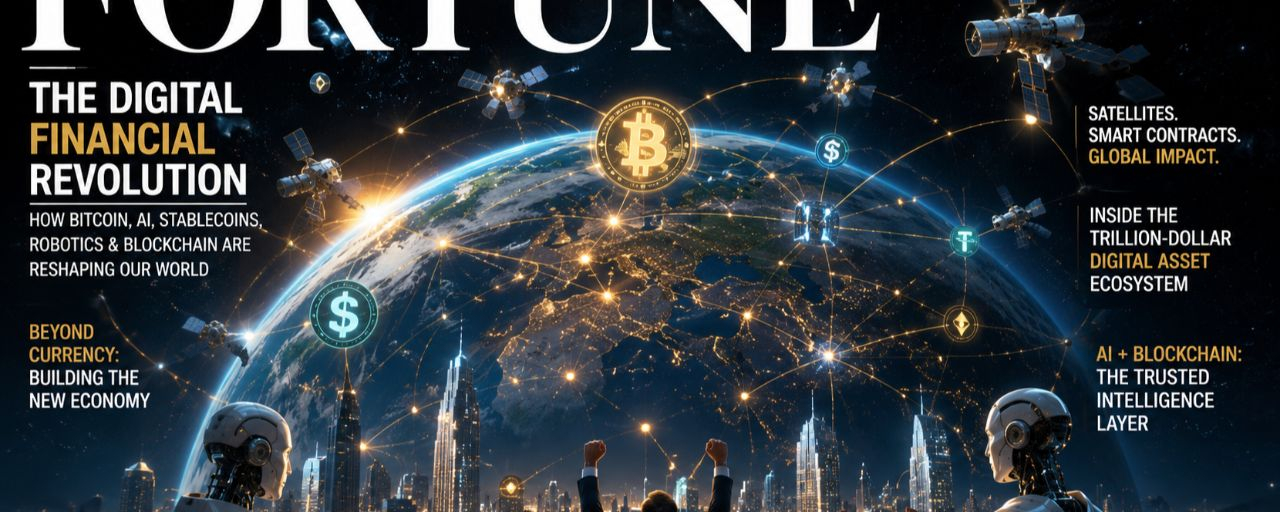
For years, the crypto industry has been defined by competition.
Bitcoin versus Ethereum.
Layer 1 versus Layer 2.
Centralized finance versus decentralized finance.
But the next chapter of blockchain may not be about one technology replacing another.
Instead, it could be about convergence.
Blockchain, artificial intelligence, robotics, cloud computing, and digital payments are beginning to complement one another rather than compete.
Bitcoin continues to serve as the foundation of the digital asset market. Its scarcity, decentralization, and global recognition make it a core holding for many long-term investors and institutions.
Ethereum remains the leading platform for decentralized applications, supporting everything from decentralized finance to tokenized assets and on-chain identity.
Meanwhile, emerging networks continue experimenting with new approaches.
High-performance chains are improving transaction speed and user experience, making blockchain applications more practical for everyday use.
At the same time, stablecoins have quietly become one of the most widely adopted blockchain products. They facilitate payments, trading, remittances, and decentralized finance while reducing the volatility associated with many cryptocurrencies.
Artificial Intelligence is adding another layer of transformation.
AI systems generate insights, automate processes, and accelerate innovation.
Blockchain provides transparency, verifiable ownership, and decentralized coordination.
Together, these technologies can support entirely new digital economies.
Robotics further expands this vision.
Autonomous machines may one day exchange value, verify identities, and coordinate services through blockchain-based systems without constant human intervention.
This combination could influence industries such as manufacturing, healthcare, transportation, logistics, agriculture, and smart cities.
Institutional investors are paying increasing attention to projects with practical applications rather than short-term narratives.
Metrics such as developer activity, network usage, ecosystem growth, security, and sustainable revenue models are becoming more important than social media excitement alone.
This reflects the broader maturation of the crypto industry.
Innovation is shifting toward infrastructure.
Infrastructure creates adoption.
Adoption creates long-term value.
Short-term market volatility will always exist.
Prices will continue moving with liquidity, macroeconomic conditions, and investor sentiment.
However, history shows that technologies solving meaningful problems tend to endure.
The future of crypto will likely be shaped by collaboration between industries rather than isolated breakthroughs.
Investors who recognize these converging trends may be better positioned to understand where the digital economy is heading next.
The biggest opportunity may not come from choosing one winning technology.
It may come from understanding how they all work together to build the future.
$BTC $ETH $SEI $USDT $USDC $TAO $FET $RNDR $BNB
#Crypto #Bitcoin #Blockchain #ArtificialIntelligence #FutureFinance

In a next-generation innovation lab, economists, AI engineers, robotics specialists, and blockchain developers collaborate around holographic financial systems, transforming complex data into intelligent solutions. Their fusion of technology and human expertise is shaping the future of global finance, automation, and digital innovation.