
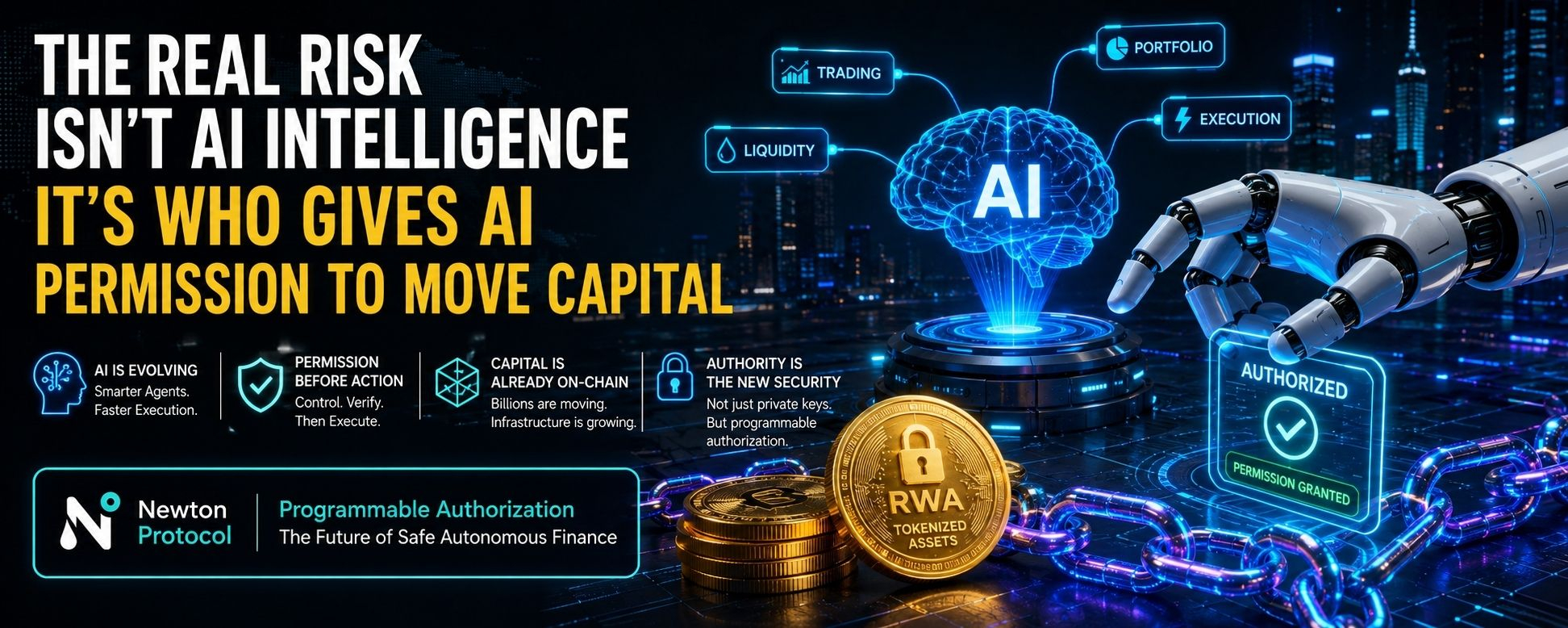
Everyone in crypto keeps talking about how powerful AI is becoming. Every week there’s a new discussion about smarter trading models, autonomous agents, AI-driven portfolios, and automated financial systems that can supposedly outperform humans. But the more I watch this space evolve, the more I feel like the industry is asking the wrong question entirely. The real issue is no longer whether AI can manage money. The scary part is whether AI should be trusted with unlimited authority once billions of dollars are already moving on-chain.
That’s what made Binance’s recent discussion around tokenized assets and on-chain capital feel so important to me. The numbers coming from RWA.xyz show that this market is no longer some experimental niche inside crypto. Hundreds of thousands of holders are already involved with tokenized assets, while billions in monthly volume continue flowing through blockchain-based systems. At this point, capital has already migrated on-chain faster than most people expected. The infrastructure is growing rapidly, but the rules around authority, accountability, and execution still feel unfinished. And honestly, that gap could become one of the biggest financial risks of the next decade.
A few years ago AI mostly existed as an assistant. It answered questions, summarized data, and helped traders analyze markets. But now the role of AI is changing completely. AI is slowly becoming an active participant inside financial systems. It can optimize portfolios, rebalance positions, monitor liquidity, execute trades, and react to market conditions faster than humans ever could. Eventually AI won’t just recommend actions. It will directly move capital by itself. And that completely changes the conversation because blockchain networks don’t actually judge decisions. They simply execute instructions exactly as they are given. If the authorization exists, the transaction goes through. The blockchain doesn’t ask whether the action was intelligent, dangerous, manipulated, or reckless. It only follows instructions.
That’s why I think many people misunderstand what “trust” really means in crypto. Blockchain never solved the problem of judgment. It solved the problem of execution. Even tokenized assets today still depend on trust layers outside pure technology. Investors still care about governance, transparency, asset backing, compliance, and accountability. Once AI agents begin interacting directly with financial infrastructure, the challenge becomes even bigger because machine-speed execution combined with unlimited permissions can create risks that scale globally within seconds.
This is exactly why Newton Protocol feels different from most AI projects entering crypto right now. While many projects are racing to build smarter AI systems, Newton seems focused on something much deeper — programmable authorization before execution. Instead of giving autonomous agents unlimited freedom, the system can verify whether specific actions are allowed before capital actually moves. That may sound simple at first, but it completely changes the security model behind autonomous finance. Execution becomes conditional instead of automatic. AI doesn’t operate through blind trust. It operates inside verifiable boundaries.
And honestly, I think that idea could become far more important than people realize today. The future of finance probably won’t be defined by whichever AI is the smartest or fastest. It will be defined by whichever systems create the safest balance between automation and control. As more real-world assets move on-chain and autonomous financial systems continue growing, permissions may eventually become just as important as private keys themselves. Because in the end, the real challenge was never about teaching AI how to act. The real challenge is deciding who gives AI the authority to act in the first place. And that’s the future Newton Protocol appears to be trying to build.
