
I was reading Newton docs yesterday when I stopped on Session Keys. At first, they didn't seem like a big deal. Wallet permissions have existed for years, so another permission feature didn't sound very interesting.
A few pages later, I realized Session Keys weren't really about permissions. They were about trust. Most wallets ask for approval once, then keep relying on that same approval until someone decides to remove it. The assumption is simple: if you trusted something yesterday, you probably trust it today as well.
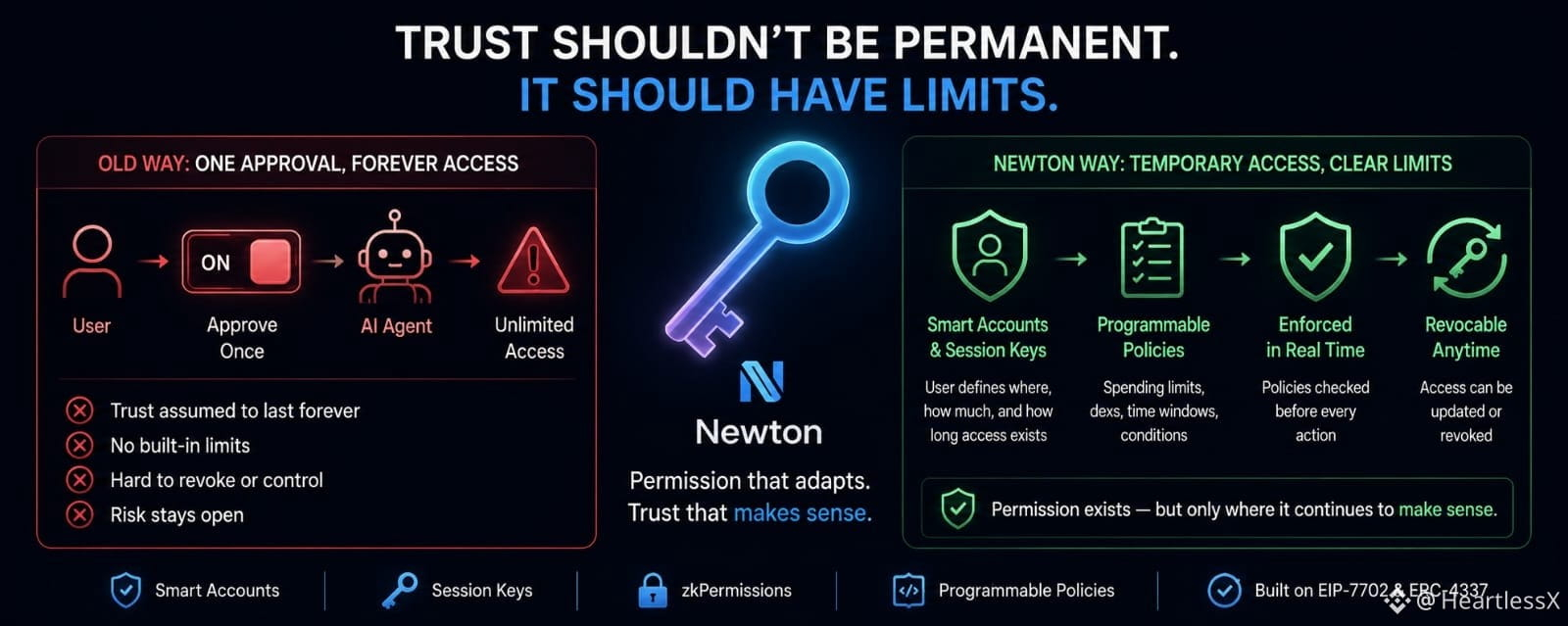
Newton doesn't start with that assumption. Smart Accounts and Session Keys let users decide where an AI agent can act, how much it can spend, which protocols it can use, and how long those permissions should exist. Those limits become programmable policies instead of personal promises, and users can revoke them whenever the situation changes.
That felt much closer to real life.
Nobody lends a car forever. Nobody gives a contractor permanent access to their house. We trust people for a reason, for a period of time, and for a specific purpose. Once any of those things change, the permission changes too. We don't call that distrust. We call it common sense.
The same idea shows up inside Newton.
Instead of assuming one approval should cover every future action, Session Keys keep every AI agent inside the boundaries that were defined at the beginning. The permission still exists, but it only exists where it continues to make sense.
That was the biggest takeaway for me.
Maybe the future of AI agents won't depend on asking people to trust machines more. It may depend on building systems where trust has clear limits from the very beginning.
Not financial advice. DYOR. @NewtonProtocol #Newt $NEWT $TLM