
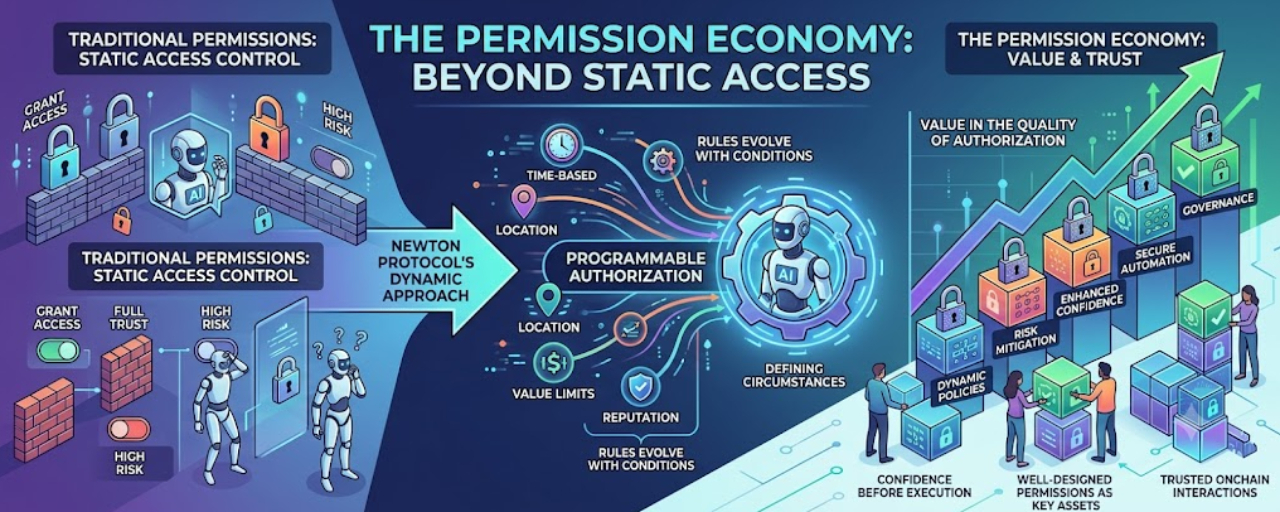
I keep coming back to one idea whenever I study Newton Protocol: we often treat permissions as a technical setting, yet they may become an economic resource of their own. Every AI agent, application, or automated workflow needs boundaries that define what it is allowed to do. Without those boundaries, automation scales risk as quickly as it scales efficiency.
What makes Newton Protocol interesting to me is its focus on programmable authorization instead of assuming every approved action deserves unlimited trust afterward. In my view, that changes the role of permissions from static access controls into dynamic rules that can evolve alongside changing conditions. The value is not simply granting access but defining how, when, and under which circumstances access should exist.
I think this creates the foundation for what I would call a permission economy. Instead of measuring capability by how many actions an AI agent can perform, ecosystems may begin evaluating the quality of the authorization policies governing those actions. Well-designed permissions could become just as important as smart contract logic because they influence confidence before execution ever begins.
Whether this vision becomes reality depends on adoption rather than architecture alone. Developers must find these authorization models practical, and users must believe they improve control without introducing unnecessary complexity. To me, Newton Protocol's long-term opportunity is not making automation more powerful, but making programmable permissions valuable enough that they become an essential layer of every trusted onchain interaction.
