@NewtonProtocol The conversation around artificial intelligence has changed dramatically over the past few years. Not long ago, the biggest competition was about building smarter models, generating better responses, or achieving higher benchmark scores. Today, another transition is quietly taking place. AI is no longer limited to answering questions or creating content. It is beginning to execute decisions that involve real economic value—placing trades, managing portfolios, coordinating financial strategies, and interacting with decentralized applications without constant human supervision.
That evolution changes everything.
The question is no longer whether AI can perform complex tasks. The more important question is whether people can trust AI to perform those tasks when mistakes carry financial consequences.
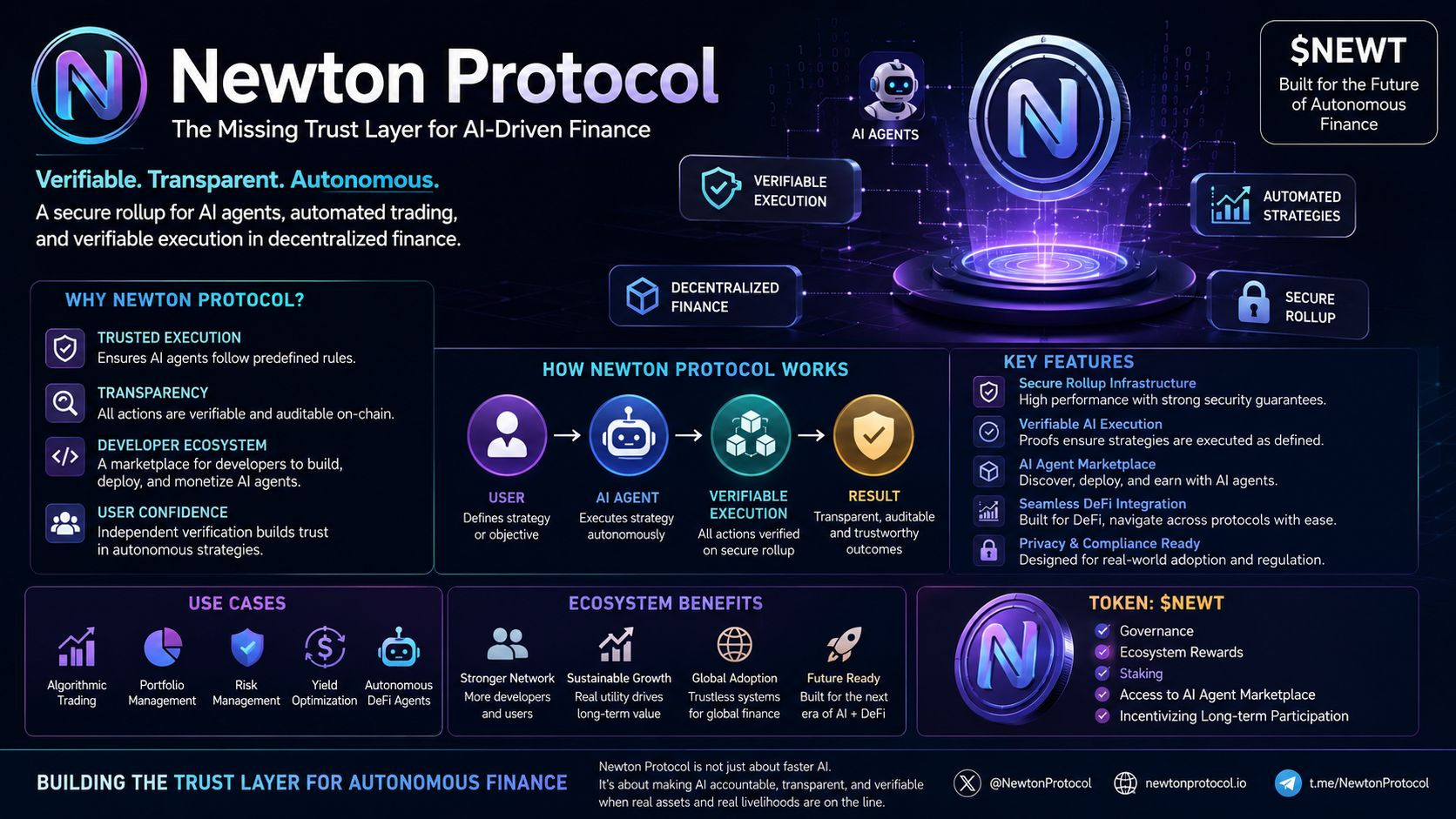
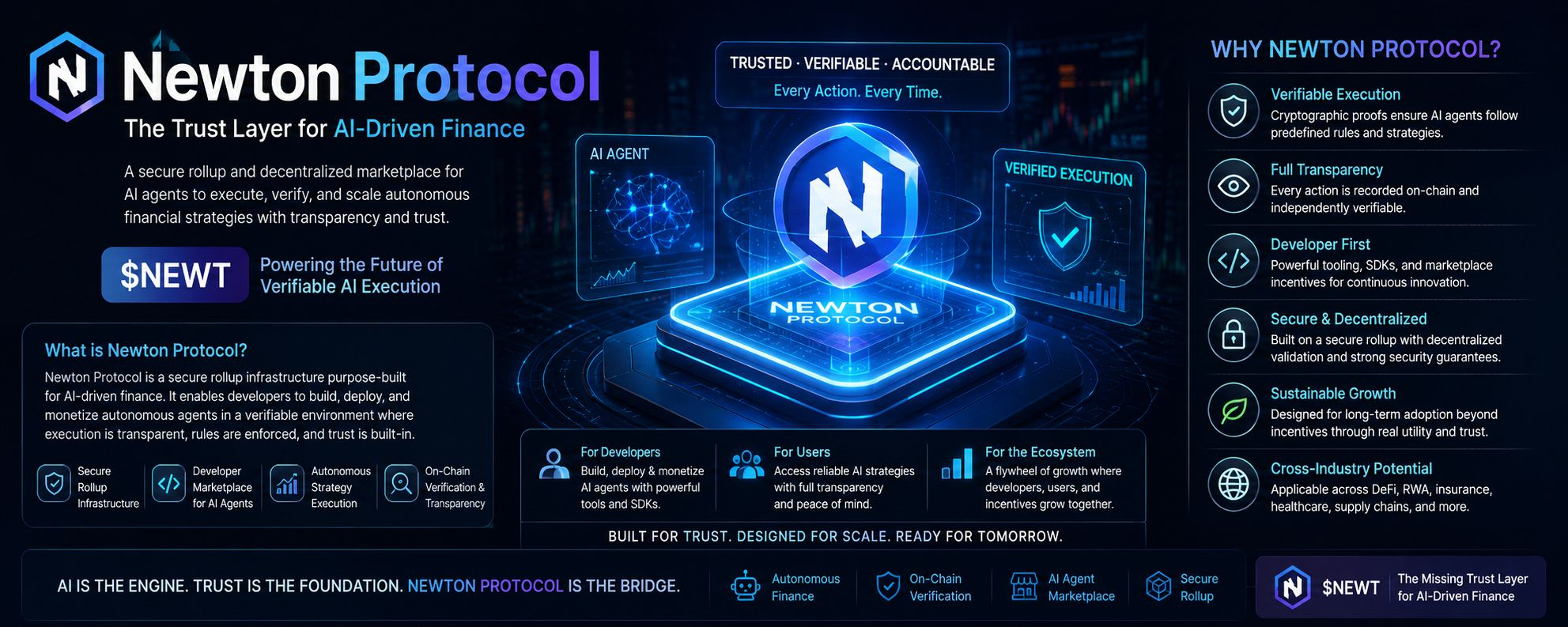
This is where Newton Protocol ($NEWT) introduces an interesting perspective. Instead of approaching AI purely as a performance problem, it focuses on building a secure rollup designed for AI-driven strategies, automated trading, and a marketplace where developers can deploy autonomous agents within a verifiable execution environment. That distinction may sound subtle, but it reflects one of the biggest structural shifts happening across both AI and Web3.
Technology often advances faster than trust.
History repeatedly demonstrates this pattern. The internet became technically capable of handling financial transactions long before consumers felt comfortable entering their credit card information online. Cloud computing existed years before large enterprises entrusted mission-critical workloads to remote infrastructure. Autonomous vehicles continue to improve technologically, yet public confidence still lags behind engineering progress.
Artificial intelligence is now entering that same stage.
Most discussions within crypto still revolve around model capabilities, computational efficiency, inference speed, transaction throughput, or execution costs. Those metrics certainly matter because better performance creates better user experiences. However, performance alone does not answer the questions that become increasingly important once autonomous systems begin controlling actual assets.
Who verifies that an AI agent followed predefined rules?
Who confirms that execution wasn't altered during processing?
Can developers prove that strategies behaved exactly as advertised?
Can users independently verify execution without relying entirely on trust?
These questions rarely dominate headlines because they are less exciting than announcing another breakthrough model or faster infrastructure. Yet they may ultimately determine which ecosystems attract long-term institutional confidence.
Imagine hiring a professional driver.
Most passengers never inspect the engine, analyze the fuel injection system, or study the mechanical design of the vehicle. They simply expect one outcome—they reach their destination safely while knowing the driver followed traffic rules along the way.
If halfway through the journey the driver suddenly decides to ignore every traffic signal, take unexplained detours, or refuse to explain their decisions, confidence disappears immediately regardless of how fast the car moves.
AI agents managing financial capital face an almost identical challenge.
Users don't necessarily need to understand every computational step behind an AI strategy. What they require is confidence that predefined boundaries remain intact, execution follows transparent logic, and important decisions can be independently verified if something goes wrong.
In many ways, verification becomes the financial equivalent of a seatbelt. Most people rarely think about it while everything operates normally, but its value becomes obvious the moment unexpected events occur.
This philosophical shift may become increasingly relevant as decentralized finance evolves.
Traditional finance operates within systems built upon regulation, auditing, compliance frameworks, reporting standards, and legal accountability. None of these mechanisms exist because financial institutions distrust technology itself. They exist because humans naturally demand accountability whenever significant amounts of capital are involved.
Decentralized finance removes many intermediaries but cannot eliminate human psychology.
People still seek assurance.
They still want transparency.
They still want confidence that systems behave predictably under stress.
Newton Protocol appears to recognize that reality by emphasizing infrastructure capable of supporting trustworthy autonomous execution rather than assuming intelligence alone automatically creates adoption.
Another aspect worth examining is the relationship between developers and users inside such an ecosystem.
Many blockchain projects describe themselves as marketplaces, but marketplaces only become valuable when both sides continuously reinforce each other.
Developers represent the supply side.
Users represent demand.
Neither group creates sustainable value independently.
Developers will only continue building sophisticated AI agents if users actively utilize them, generate meaningful feedback, and create economic opportunities. Users, meanwhile, only remain engaged if developers consistently produce reliable tools capable of solving practical problems rather than simply showcasing technical demonstrations.
This creates a feedback loop.
Higher-quality developers attract more users.
More users generate stronger economic incentives.
Growing demand encourages additional innovation.
Better innovation improves user outcomes.
The cycle strengthens itself over time.
However, that cycle can also reverse.
If users lose confidence because verification fails, developers lose motivation to build.
If developers stop producing valuable applications, users leave.
Network effects work in both directions.
That is why infrastructure alone rarely guarantees adoption. Community participation, developer retention, application quality, and user confidence must expand together rather than independently.
Perhaps the most difficult question every crypto protocol eventually faces concerns incentives.
Early-stage ecosystems frequently rely on token rewards to bootstrap activity.
Liquidity mining encourages participation.
Airdrops attract attention.
Trading incentives increase volume.
Campaigns generate social engagement.
These mechanisms are effective for accelerating initial growth, but they cannot permanently substitute genuine utility.
Eventually every ecosystem reaches the same crossroads.
What happens after rewards decline?
Do users continue participating?
Do developers continue building?
Does transaction activity remain healthy?
Or does participation disappear alongside financial incentives?
Behavioral economics provides valuable insight here.
People often confuse temporary behavior with permanent demand.
Offering incentives changes short-term decisions.
Creating lasting utility changes long-term habits.
The distinction matters enormously.
Users who remain because they genuinely trust autonomous execution behave differently from users who remain only because incentives temporarily offset perceived risk.
One group contributes to sustainable ecosystems.
The other contributes to temporary statistics.
For Newton Protocol, long-term success likely depends on whether AI verification becomes valuable enough that participants willingly continue using the infrastructure without requiring constant financial stimulation.
That challenge extends beyond blockchain itself.
Artificial intelligence is becoming increasingly integrated into industries where accountability carries significant consequences.
Healthcare.
Insurance.
Supply chains.
Digital identity.
Asset management.
Corporate operations.
Government services.
In each of these environments, organizations care about more than intelligent outputs.
They care about explainability.
Auditability.
Compliance.
Verification.
Reproducibility.
Those requirements become increasingly important as AI transitions from advisory systems toward autonomous decision-making.
If Newton Protocol successfully positions itself around trusted execution rather than pure computational performance, it may align with broader industry trends extending well beyond crypto speculation.
Nevertheless, optimism should never ignore practical limitations.
Verification introduces cost.
Additional security layers often introduce complexity.
Rollup infrastructure requires technical sophistication.
Developers may face steeper learning curves.
Execution environments may become more restrictive.
Users may encounter additional confirmation steps.
None of these trade-offs automatically represent weaknesses, but they do create friction.
Technology history consistently demonstrates that superior architecture does not guarantee widespread adoption.
Consumers usually prioritize convenience.
Businesses prioritize efficiency.
Developers prioritize flexibility.
Institutional participants prioritize security.
The protocols capable of satisfying all four groups simultaneously remain relatively rare.
This balancing act could become Newton Protocol's greatest challenge.
If verification mechanisms become too complicated, developers may migrate toward simpler alternatives.
If user experiences become cumbersome, adoption slows.
If decentralization sacrifices usability, centralized competitors may retain advantages despite offering weaker transparency.
Finding equilibrium between security and simplicity is one of the hardest engineering problems in decentralized systems.
Competition also continues accelerating.
The intersection between artificial intelligence and blockchain is becoming increasingly crowded.
Some projects focus on decentralized computation.
Others emphasize AI marketplaces.
Several prioritize privacy-preserving machine learning.
Others explore trusted execution environments or decentralized inference networks.
Newton Protocol therefore competes within an ecosystem where innovation moves exceptionally quickly.
Its long-term differentiation cannot depend solely upon technological novelty because technological advantages rarely remain exclusive for extended periods.
Instead, sustainable differentiation must emerge through ecosystem maturity, developer loyalty, trusted infrastructure, consistent execution, practical integrations, and real-world usage that persists regardless of changing market sentiment.
That ultimately returns us to the central philosophical question surrounding autonomous finance.
Human civilization has always progressed by delegating responsibility.
We delegated memory to books.
Calculation to computers.
Communication to the internet.
Navigation to GPS.
Now we are beginning to delegate decision-making itself to artificial intelligence.
Every previous transition required trust infrastructure before mass adoption occurred.
Banks required auditing.
The internet required encryption.
Cloud computing required security certifications.
Artificial intelligence may require verifiable execution.
Perhaps that is Newton Protocol's most interesting contribution to the broader conversation.
Not because verification is more exciting than intelligence.
Not because security generates more headlines than performance.
But because markets built upon autonomous systems eventually depend less on what machines can do and more on whether humans can confidently rely on those machines when real assets, real businesses, and real livelihoods depend upon every decision they make.
Years from now, investors may not remember which protocol claimed the fastest AI execution or the lowest transaction latency. Those advantages will likely continue evolving across the industry. What may prove far more valuable is identifying the infrastructure that consistently enabled trustworthy autonomous execution under real-world conditions.
If decentralized AI becomes an enduring component of the global digital economy, the protocols that survive may not be those promising the most intelligence. They may be the ones that quietly make intelligence accountable, transparent, and verifiable enough that trust becomes an invisible feature rather than an ongoing concern.
That possibility is ultimately what makes Newton Protocol worth studying—not as a short-term market narrative, but as an experiment in solving one of the deepest structural problems facing the next generation of autonomous financial systems.