
I first started noticing @NewtonProtocol during that quiet stretch of the day when the market is still awake, but not really rushing anywhere. That part of the session always tells you something. The loud voices have faded, the biggest moves have already happened, and what is left is usually a better read on what people actually think.
$NEWT has been sitting in that kind of space for a while now. Not chaotic, not dramatic, just there. It does not feel like a token trying to force its way into attention. It feels more like the market is still trying to decide how seriously to take the idea behind it.
What pulled me in was not the price action itself. It was the structure.
A lot of projects talk about compliance, infrastructure, and on-chain execution as if those words automatically create depth. Most of the time, they do not. They sound important, but the product underneath is often thinner than the narrative. Newton feels different in one specific way: it seems to treat rules as part of the system, not as a layer added after the fact.
That is where Rego and OPA become interesting.
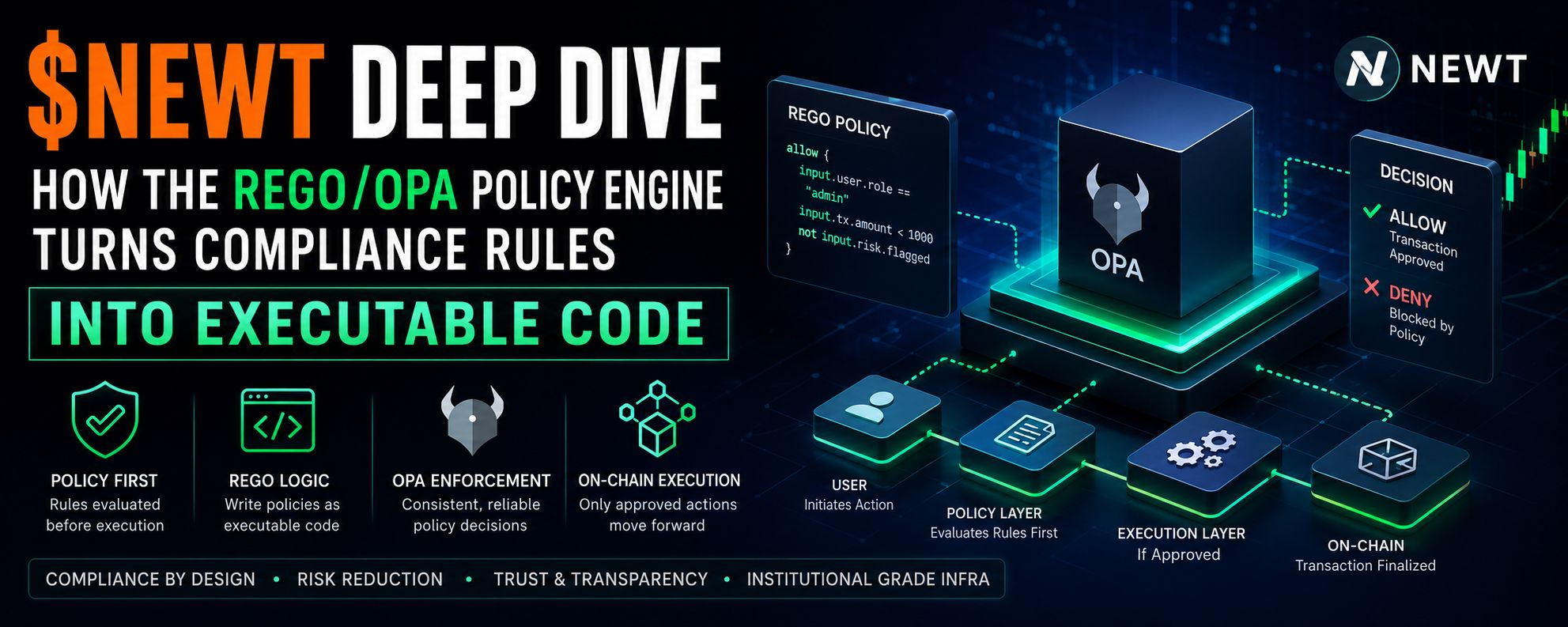
Rego is not just a neat way to describe policy. It is a way to write rules in a form a system can actually use. OPA then takes those rules and makes them enforceable in a consistent way. That matters because the question changes. It is no longer just, “Does this action look compliant?” It becomes, “Should this action be allowed to move at all?”
That is a bigger shift than it first appears.
Most DeFi systems are built around execution first, checks second. The flow is usually simple: a user sends a transaction, the contract runs, and the logic decides what happens. But a policy-driven model changes the order. The rules sit earlier in the process and act before the action moves forward. In practice, that means the system is not only executing transactions. It is deciding which transactions deserve to exist in the first place.
I do not think that automatically makes it better. I think it makes it more serious.
Because once a project starts deciding what can pass through the system, the real issue is no longer just code. It becomes governance. Who writes the policies? Who updates them? Who gets to define the boundaries? Those questions matter more than most people admit, because the policy layer is where trust either becomes real or becomes fragile.
That is why I am not reading NEWT as a simple bullish or bearish setup. The chart may look quiet, but quiet does not always mean empty. Sometimes it just means the market has not agreed on what the story is yet. And in early-stage projects, that gap between technology and consensus is often the most important part.
The technical idea here is genuinely interesting, but the governance side is where I would stay careful. A policy engine is only as open and reliable as the people controlling it. If the rule set becomes too narrow, too centralized, or too hard to inspect, then the whole promise starts to weaken. It could end up solving one trust problem while creating another, less visible one.
That is the part I keep coming back to with $NEWT. The concept of turning policy into executable logic is strong. It feels practical, not just theoretical. But the real test is whether that structure can stay transparent and credible once it is actually in use.
So my view is simple. $NEWT is worth watching because it tries to turn rules into something that can be enforced, not just discussed. That is a more meaningful idea than a lot of the usual infrastructure talk.
Whether it becomes a real advantage or just another clean narrative depends on execution, governance, and how much control sits in the right places. For now, it feels like one of those projects that deserves a slower read, not a quick reaction.I can also make this more sharp, more alpha-driven, or more thread-friendly.
