
@Bitcoin #btcoin $BTC #bitcoin
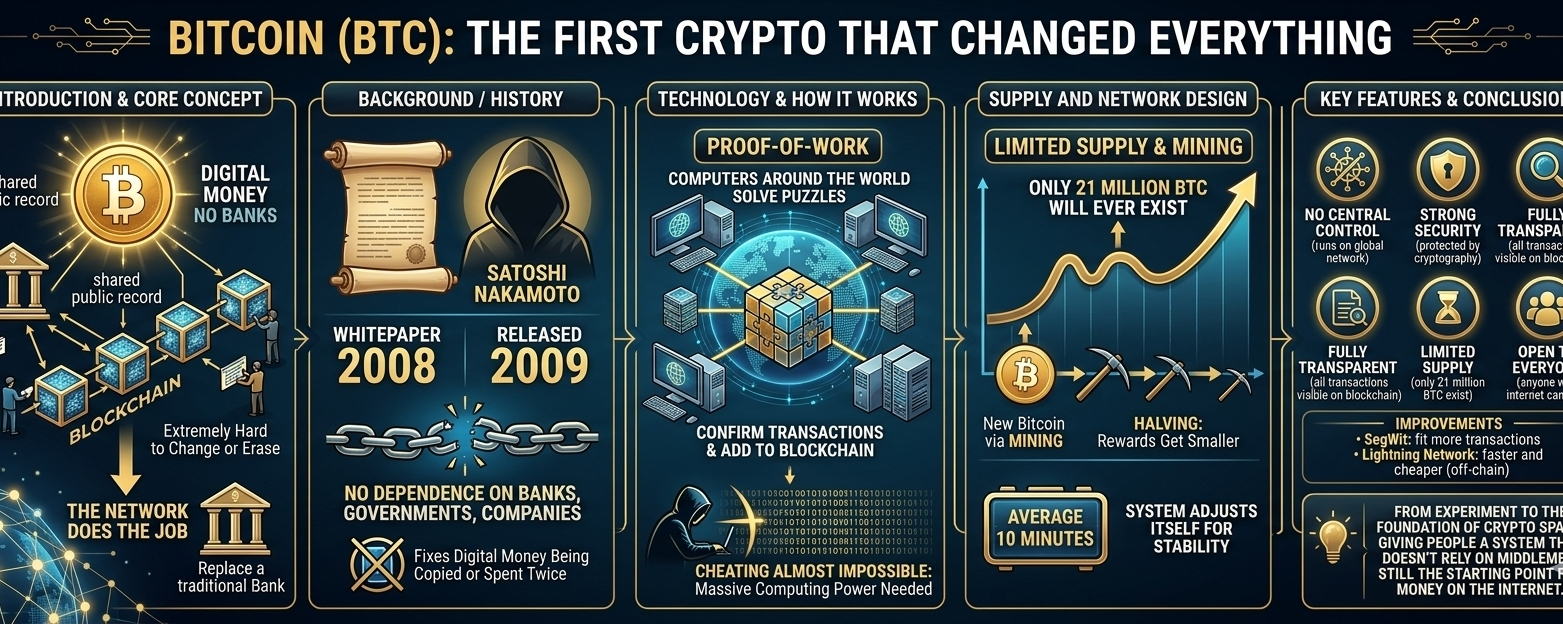
Bitcoin (BTC) is basically digital money that works without banks. You can send it to anyone in the world directly, and no one in the middle can control or stop it.
Core Concept
Think of Bitcoin like a shared public record where every transaction is written down. This record is called the blockchain.
Once something is added to it, it’s extremely hard to change or erase which is why people trust the system even without a central authority.
Instead of a bank checking transactions, the network itself does the job.
Background / History
Bitcoin came out in 2009, after a whitepaper was shared in 2008 by someone using the name Satoshi Nakamoto. No one really knows who they are to this day.
The idea was simple but powerful: create money that doesn’t depend on banks, governments, or any single company and fix the issue of digital money being copied or spent twice.
Technology & How It Works
Bitcoin runs on something called Proof-of-Work. It sounds technical, but the idea is pretty straightforward.
Computers around the world compete to solve puzzles. When one succeeds, it gets to confirm transactions and add them to the blockchain.
This process keeps everything secure and makes cheating almost impossible, because you would need massive computing power to manipulate the system.
Supply and Network Design
One of Bitcoin’s biggest features is its limited supply there will only ever be 21 million BTC.
New Bitcoin enters circulation through mining, but over time, the rewards keep getting smaller. This happens through something called “halving.
On average, a new block is added every 10 minutes, and the system adjusts itself to keep things stable.
Key Features
No central control it runs on a global network
Strong security protected by cryptography
Fully transparent all transactions are visible on the blockchain
Limited supply — only 21 million BTC will ever exist
Open to everyone — anyone with internet can use it
Scalability and Improvements
Bitcoin wasn’t built to be perfect from day one, so upgrades were added over time.
SegWit: helped fit more transactions into each block
Lightning Network: makes transactions faster and cheaper by handling them off the main chain
These upgrades help Bitcoin stay useful even as more people join the network.
Conclusion
Bitcoin started as an experiment, but today it’s become the foundation of the entire crypto space.
It’s not just about digital money — it’s about giving people a system that doesn’t rely on middlemen. Even after more than a decade, Bitcoin still feels like the starting point for how we think about money on the internet.