
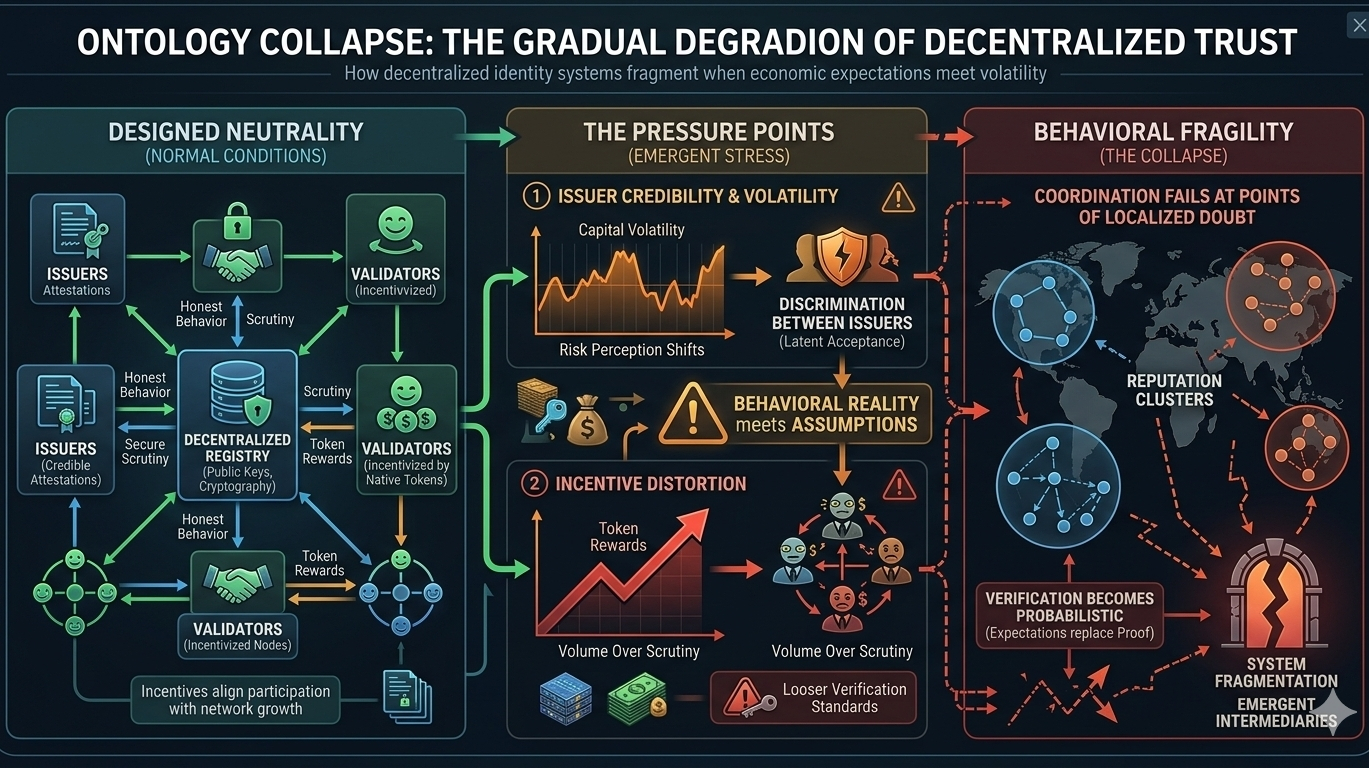
I have spent enough time watching liquidity move to know that coordination systems do not fail at the point of design. They fail at the point of stress, when assumptions about behavior meet the reality of incentives. A global infrastructure for credential verification and token distribution presents itself as neutral plumbing, something closer to a base layer than an application. But I don’t see neutrality when I look at these systems. I see a delicate arrangement of economic expectations, where credentials become instruments of access, and access becomes a proxy for capital. The question is not whether the system works when everything is aligned. The question is what breaks first when alignment disappears.
What draws my attention first is how these systems outsource trust into cryptographic attestations while quietly reintroducing it through issuer legitimacy. In theory, decentralized identity frameworks remove centralized authorities by allowing credentials to be verified through public keys and distributed registries . In practice, verification still depends on whether the market accepts the issuer as credible. I have watched similar dynamics in liquidity markets, where an asset is technically fungible but behaviorally fragmented. Credentials follow the same path. When stress enters the system, the uniformity of verification dissolves into tiers of trust, and coordination begins to fragment along those lines.
The first pressure point emerges here: not at the level of cryptography, but at the level of issuer credibility under volatility. A credential is only as strong as the belief that others will accept it. When capital tightens or risk perception shifts, participants begin to discriminate between issuers, even if the protocol treats them equally. This creates a silent hierarchy inside a system that claims neutrality. I have seen this before in collateral markets, where assets that are technically equivalent diverge in value under stress. The same thing happens here, except the divergence is not priced explicitly. It shows up as latency in acceptance, hesitation in verification, and ultimately refusal.
This leads to a behavioral consequence that is easy to miss when looking only at architecture. The system assumes that verification is binary, but in practice it becomes probabilistic. Participants start asking not “is this valid?” but “who else will accept this?” That shift matters. It transforms a coordination layer into a coordination game, where decisions are based on expectations of others rather than on the underlying proof itself. At that point, the infrastructure is no longer removing intermediaries. It is recreating them in the form of reputation clusters.
The second pressure point sits deeper, in the distribution of incentives around verification itself. In many of these systems, nodes or participants are rewarded for validating credentials, often through token-based mechanisms tied to usage and participation. For example, verification roles can be economically incentivized through native tokens that also function as governance and reward infrastructure . This seems efficient on the surface. It aligns participation with network growth. But I have learned to be cautious when verification becomes a revenue stream.
Under normal conditions, incentives reinforce honest behavior. Under stress, they distort it. If verification yields economic return, then the system quietly encourages volume over scrutiny. The more credentials processed, the more rewards distributed. This introduces a tension between throughput and integrity that is not resolved at the protocol level. It is resolved by participants, each acting under their own constraints. And when those constraints tighten, behavior changes.
What I have observed in markets is that participants rarely defect all at once. They degrade gradually. In this context, that degradation appears as looser verification standards, selective attention, or reliance on heuristics rather than full validation. The system continues to function, but its guarantees weaken in ways that are difficult to detect in real time. From the outside, nothing looks broken. Internally, the quality of coordination is eroding.
There is a structural trade-off here that does not get enough attention. The system can optimize for openness, allowing a wide range of issuers and validators to participate, or it can optimize for consistency, restricting participation to maintain uniform standards. It cannot fully achieve both. Openness increases coverage and scalability, but it also introduces variability in trust. Consistency reduces variability, but it reintroduces gatekeeping. This is not a technical limitation. It is an economic one.
What makes this more complex is how the token sits inside the system. It is not just a medium of exchange. It is coordination infrastructure. It routes incentives, signals participation, and encodes governance. But tokens behave like capital, and capital is reflexive. When confidence drops, participation tied to token rewards becomes unstable. Validators reassess whether the effort is worth the return. Issuers reconsider whether it is worth anchoring their credentials to the system. The infrastructure does not disappear, but its activity profile shifts in ways that directly impact coordination.
I find myself thinking about how quickly belief can unwind once participants start questioning not the validity of credentials, but the behavior of other participants. This is where systems that rely on distributed trust face a unique kind of fragility. They do not collapse through a single point of failure. They fragment through localized doubt. Each participant adjusts slightly, but the aggregate effect is a loss of coherence.
The uncomfortable question is whether a system designed to remove intermediaries can avoid recreating them as emergent phenomena under stress. If trust consolidates around certain issuers or validators, then the system begins to look structurally similar to the one it replaced, just with different interfaces. The difference is that this consolidation is not explicit. It is behavioral, and therefore harder to govern.
I don’t see a clean failure mode here. I see a gradual shift, where coordination becomes less about protocol guarantees and more about social consensus layered on top of them. The infrastructure remains intact, credentials continue to flow, tokens continue to circulate. But the underlying assumption—that verification is enough to coordinate behavior—starts to feel less stable the moment participants begin to doubt each other more than they trust the system.
