
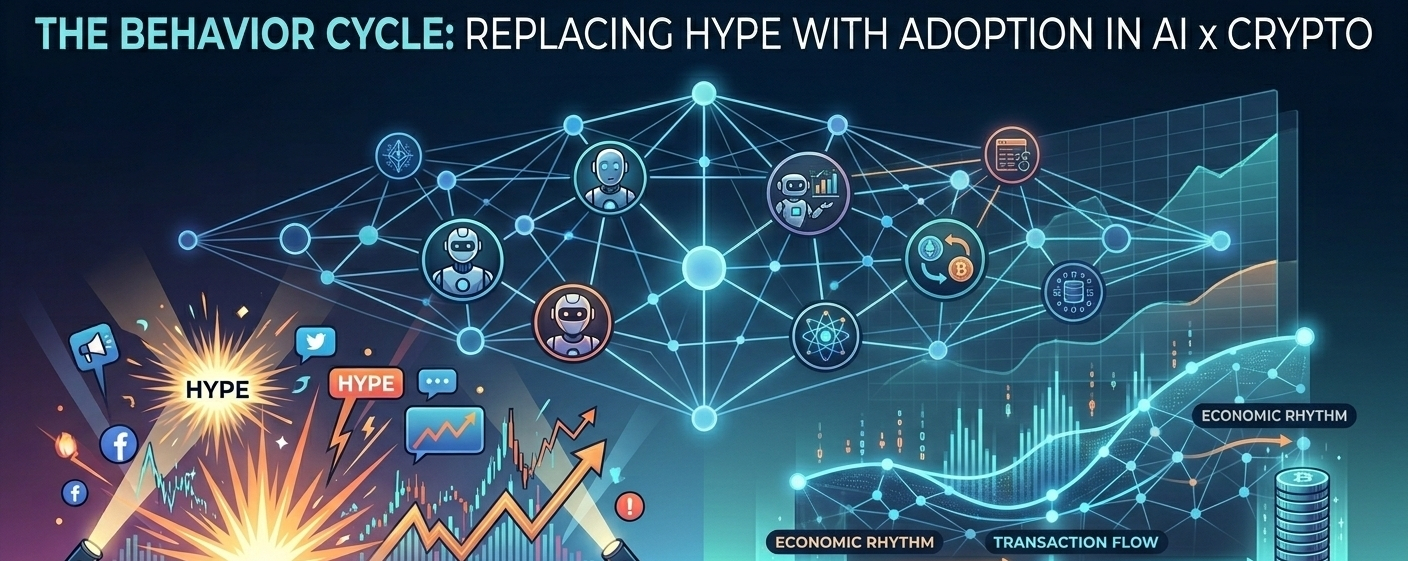
There’s a question I keep returning to whenever I look at projects like OpenLedger, and strangely, it’s not the question most people ask.
It’s not whether the project has potential. Not whether AI and crypto will eventually merge. Not even whether the technology sounds revolutionary.
The real question is much simpler and much harder to answer.
When the excitement fades, where does the consistent paying behavior actually come from?
That’s the uncomfortable part of the conversation. Because hype can create movement, but it cannot create lasting demand on its own.
OpenLedger presents an idea that sounds almost perfectly designed for this era of the market. Data, AI models, agents, and economic incentives all connected through a blockchain layer where intelligence itself becomes monetized. On paper, it feels like one of those concepts that immediately makes sense once you hear it.
Almost like the market was always heading here.
But markets rarely struggle with ideas. They struggle with repetition of demand.
That distinction matters more than most narratives admit.
I’ve watched enough AI-related crypto cycles to recognize the pattern. In the early stages, everything sounds brilliant. Conversations become filled with architecture diagrams, modular systems, decentralized intelligence, ownership layers, and autonomous agents. Liquidity enters carefully at first, almost politely, as though traders are testing whether the story deserves belief.
Then eventually the market enters the phase that matters most.
The quiet phase.
Not when everyone is talking. When nobody is.
That’s when you discover whether a system is genuinely alive or simply reacting to incentives.
What feels different now compared to previous cycles is how traders behave around these narratives. There’s noticeably less blind rotation than before. People hesitate more. They want evidence of actual usage before they commit serious attention. A roadmap that sounds intellectually correct no longer guarantees conviction.
And honestly, that shift might be healthy.
Because projects like OpenLedger don’t survive through speculation alone. Their entire value structure depends on continuous interaction. If AI agents are supposed to function as active economic participants, then the ecosystem has to maintain activity even outside promotional periods.
That’s an incredibly high standard.
Most early ecosystems look active while incentives are flowing. But once rewards slow down, the silence arrives quickly. I’ve opened dashboards during quieter market hours before, expecting to see at least some stable baseline activity holding the system together.
Instead, what usually stands out is how fast engagement disappears once attention leaves the room.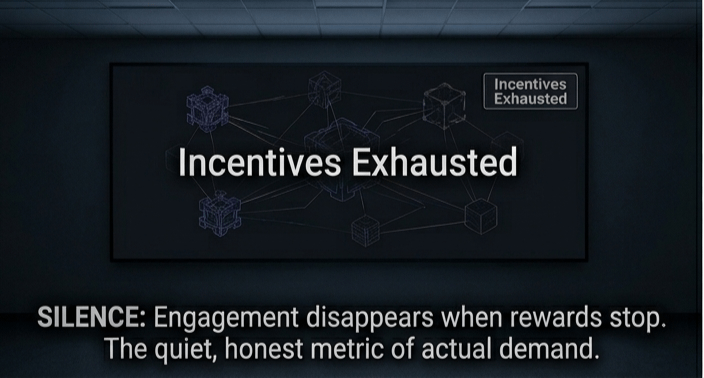
And that silence says more than announcements ever do.
Not loudly. But honestly.
Still, dismissing OpenLedger entirely would be unfair. Beneath the speculation, there is a serious attempt to connect value discovery with real utility rather than endless narrative rotation. If that mechanism ever begins functioning consistently, it could genuinely reshape how people think about AI-linked crypto assets.
Holding a token would no longer rely purely on future expectations. It would reflect ongoing economic behavior happening inside the network itself.
That’s the vision.
But visions remain fragile in early stage systems.
Even a small mismatch between the supply of data and actual market demand can distort pricing very quickly. Once that imbalance appears, valuation starts behaving more like fiction than economics. Sentiment doesn’t collapse dramatically in those moments it leaks away slowly, almost invisibly.
You can feel attention leaving before charts fully reflect it.
And crypto has conditioned people to misunderstand something important:
Attention and adoption are not the same thing.
Attention is loud, emotional, and temporary. Adoption is quiet, persistent, and difficult to fake.
Real adoption continues functioning even when nobody is discussing it publicly.
That’s ultimately what I’m watching with OpenLedger.
Not short-term price action. Not trending narratives. Not temporary excitement.
Persistence.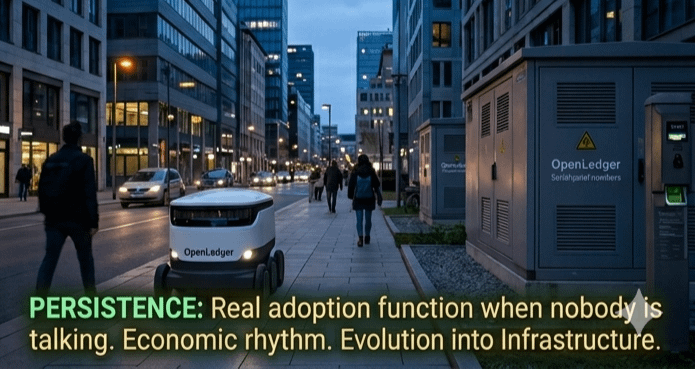
Do participants remain active when incentives weaken? Do agents create any measurable economic rhythm on their own? Does network behavior survive beyond marketing cycles?
Because that’s the stage where projects either evolve into infrastructure or slowly dissolve into the long list of ideas that sounded correct before the market was ready for them.
Right now, OpenLedger feels suspended somewhere between those two futures.
Not failing. Not proven.
Just waiting for real behavior to catch up with the ambition of the design.
