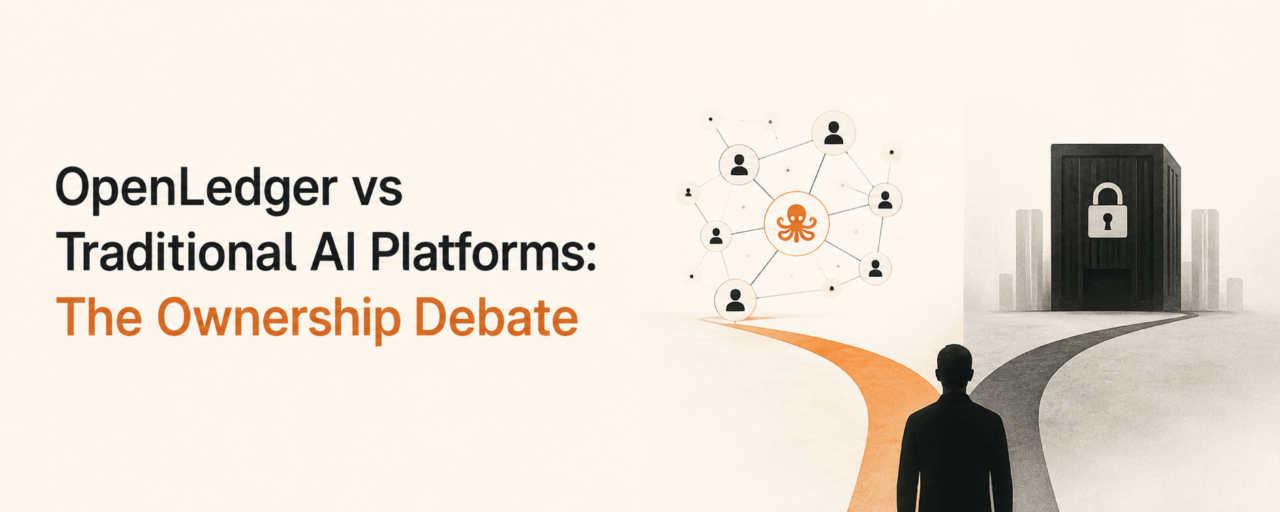
Over the past few weeks, while exploring openledger.xyz�, I kept noticing something unexpected. The biggest source of friction wasn't model quality, inference speed, or onboarding. It emerged somewhere much deeper—the moment ownership had to withstand real operational pressure.
Traditional AI platforms rarely expose this tension because ownership is effectively decided before users ever interact with the system. You contribute data, prompts, feedback, corrections, failed outputs, and edge cases. The platform absorbs all of it into a closed optimization loop that continuously improves the product. Your contributions help make the system better, but what happens behind the scenes remains largely invisible.
The experience feels seamless.
Perhaps a little too seamless.
OpenLedger takes a different approach. Instead of hiding the boundary between contribution and optimization, it exposes it. Sometimes clearly. Sometimes uncomfortably.
I first understood this during a routing inconsistency discussion inside a community evaluation workflow. A contributor submitted a structured financial classification dataset. Validators reviewed it, scoring was completed, and then a separate model pass produced a noticeably different confidence profile on the exact same batch.
The discrepancy wasn't dramatic. The outputs weren't completely contradictory. But the variation was large enough to trigger debate over attribution quality.
In a traditional AI platform, this issue would likely disappear into internal retraining pipelines, human review processes, or backend optimization logic. Users would never see the disagreement because ownership isn't part of the workflow.
Inside OpenLedger, however, the disagreement became immediately consequential because attribution determines who may receive economic credit later.
That changes behavior very quickly.
Suddenly, retry logic becomes important.
One validator reran the batch multiple times because confidence scores hovered near an acceptance threshold. Another refused to rerun it, arguing that repeated evaluations could themselves influence contribution measurements if model behavior shifted between passes.
It was one of the first times I had seen retry behavior become a genuine point of contention within an AI system.
Not governance theater.
Actual workflow politics.
And that's where the ownership debate becomes interesting.
Most discussions focus on whether contributors "own their data." By now, almost every AI project claims some version of that principle. The harder question is whether ownership can survive operational ambiguity once probabilistic systems begin disagreeing under real-world conditions.
AI models are inherently uncertain. Attribution systems become much harder when uncertainty carries economic consequences.
One example highlighted this clearly. A contributor with a relatively small but highly specialized medical-tagging dataset argued that broader, more generalized datasets were absorbing disproportionate influence in downstream scoring.
The complaint wasn't difficult to understand.
Consensus mechanisms naturally favored repeated agreement signals. Larger datasets received more validation activity simply because more participants interacted with them. Increased interaction generated stronger confidence metrics. Stronger confidence metrics encouraged safer routing decisions. Safer routing decisions increased future exposure.
A feedback loop emerged.
Anyone familiar with large closed AI ecosystems has seen this pattern before.
Centralization often reappears through reliability rather than authority.
The difference is that in an open system, you can actually watch it happen.
A simple experiment illustrates the point. Submit two datasets with similar practical value but vastly different scale—one broad and one highly specialized. Then observe which dataset naturally attracts more evaluator attention over time.
The result often reveals more about open AI ownership than entire whitepapers dedicated to the subject.
To be fair, traditional AI platforms solve this problem elegantly from a user-experience perspective. They absorb uncertainty on behalf of users. Contributors don't need to think about validation pathways, attribution disputes, evaluator behavior, consensus dynamics, or scoring persistence.
The platform carries the complexity.
Most users prefer that arrangement.
Sometimes I do too.
But that's also where the tradeoff becomes difficult to ignore.
Open systems make ownership more visible, yet they also distribute the cognitive burden required to maintain it. Contributors are forced to think about questions that closed systems intentionally abstract away.
Is the system rewarding quality?
Or simply rewarding agreement frequency?
At one point, I realized I was spending more time thinking about evaluation survivability than about the dataset itself.
That felt significant.
And slightly concerning.
Yet traditional AI platforms have their own unresolved tension. Eventually, contributors begin asking where the accumulated value of their participation actually ends up. They recognize that their work improves systems they cannot inspect, audit, or economically participate in.
The workflow feels effortless until people start tracing value creation.
That's where OpenLedger's token layer starts to feel less like marketing and more like infrastructure.
Not because of speculation.
Because attribution systems eventually require accounting systems.
Without some form of stake-linked mechanism, contribution weighting risks becoming symbolic. With one, new distortions emerge immediately. Participants with greater resources can remain active through periods of uncertainty far longer than smaller contributors.
Endurance itself becomes an advantage.
Once again, reliability gravity appears.
I'm not convinced OpenLedger has fully solved this challenge. At times, the platform seems to push considerable operational complexity onto contributors who simply want fair participation.
But I'm equally unconvinced that traditional AI platforms have solved ownership. In many cases, they've simply buried the conflict beneath convenience.
The most useful test I've found is surprisingly simple:
Watch what happens during disagreement, not agreement.
Every AI system appears collaborative when outputs align. Ownership only becomes visible when attribution confidence drops, consensus weakens, and someone must absorb the cost of uncertainty.
That's the moment where architecture stops being philosophy and starts becoming reality.
And I suspect most users haven't experienced that layer yet.
For now, the tooling still protects them from it.
But as AI ecosystems mature and attribution becomes economically meaningful, the ownership debate may shift from theory to infrastructure—and systems like OpenLedger could find themselves at the center of that conversation.
#OpenLedger #OPEN #AI #Blockchain #DataOwnership #DecentralizedAI #CryptoAI $OPN