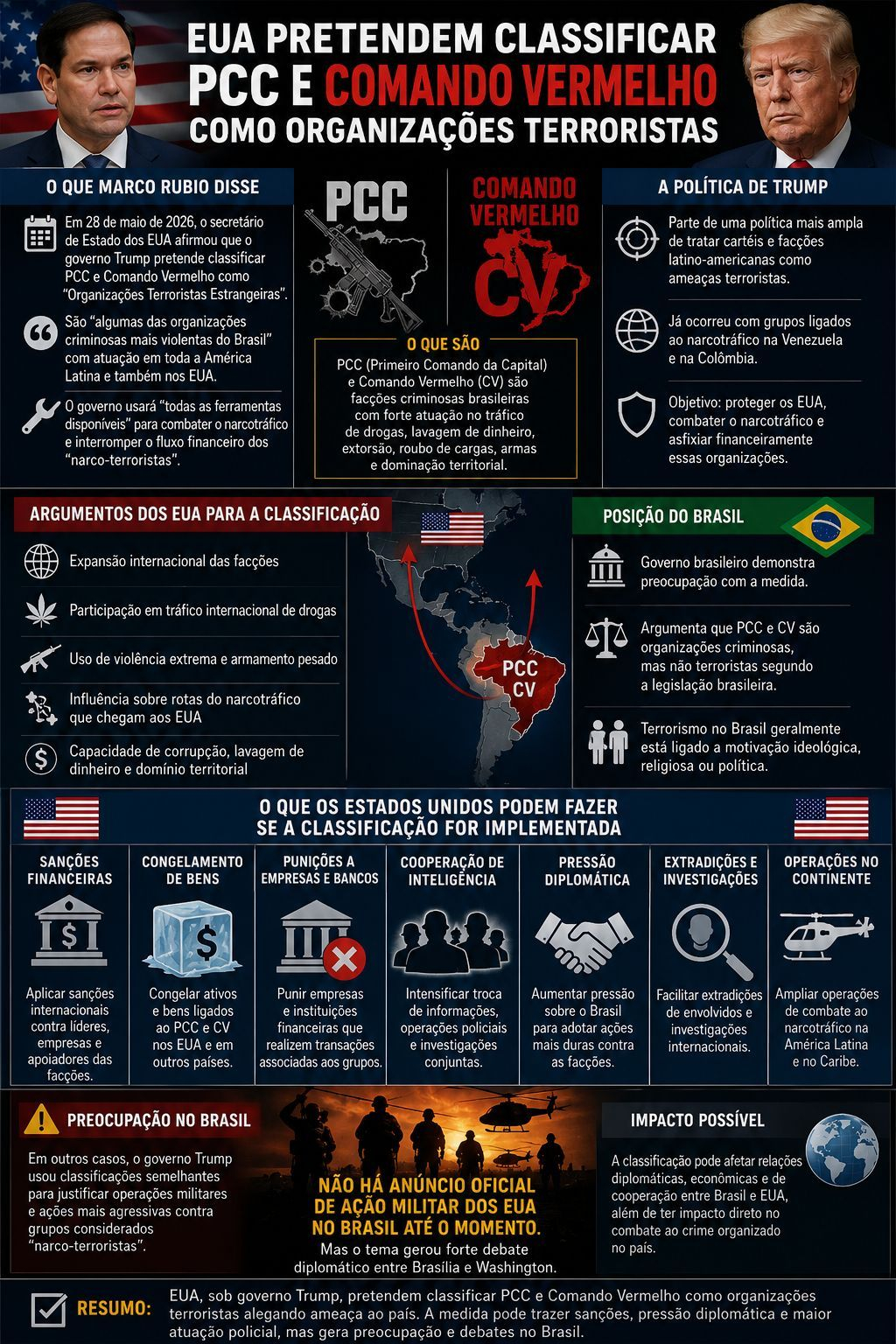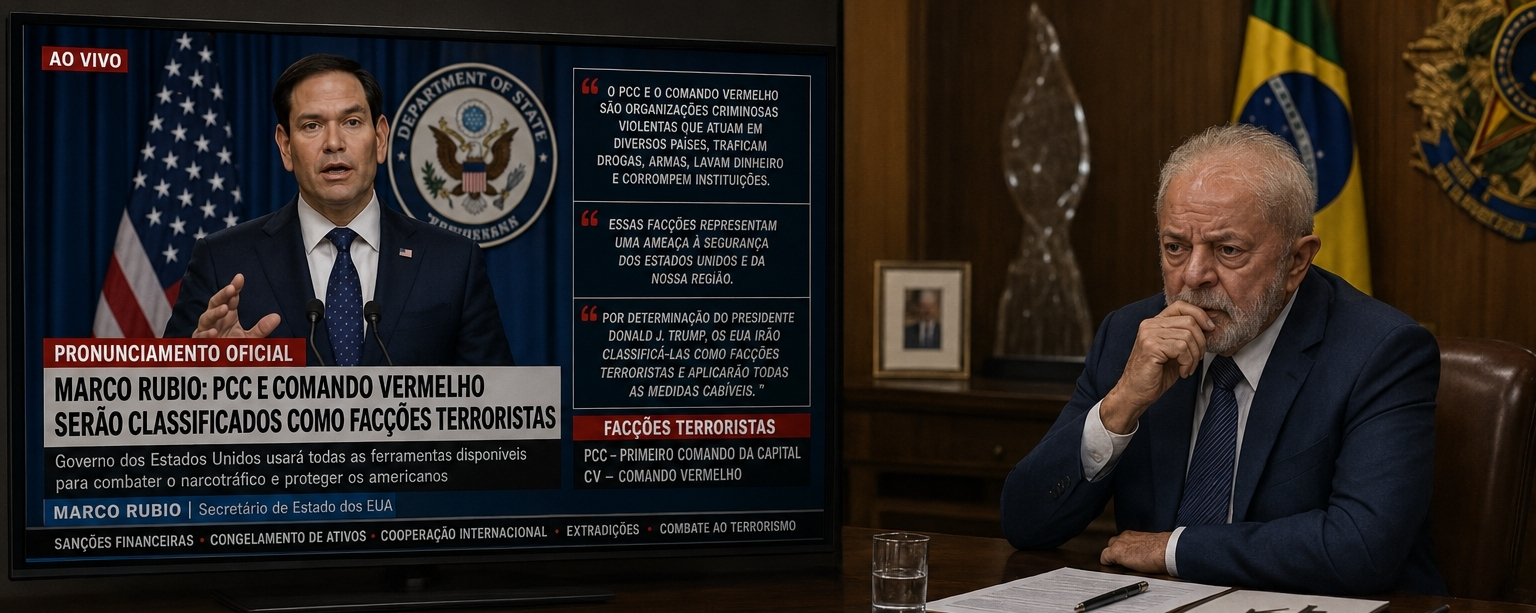
The United States government is preparing to officially classify Brazil’s two largest criminal factions — PCC (Primeiro Comando da Capital) and Comando Vermelho (CV) — as Foreign Terrorist Organizations (FTOs), according to U.S. Secretary of State Marco Rubio. �
Reuters +1
Rubio stated on May 28, 2026, that both groups are among the most violent criminal organizations in Brazil, with operations extending across Latin America and reaching the United States through international drug trafficking and financial networks. �
Reuters +1
The move is part of the Trump administration’s broader strategy to treat major cartels and transnational criminal factions as national security threats. U.S. officials argue that PCC and CV have evolved far beyond local gangs due to their:
Expanding international influence
Role in global drug trafficking
Use of extreme violence and military-grade weapons
Control over trafficking routes connected to the U.S.
Involvement in corruption, money laundering, and territorial domination �
Financial Times +1
Rubio also said the administration will use “all available tools” to disrupt the financial systems supporting what he called “narco-terrorists.” �
UOL Notícias +1
If formally implemented, the designation could allow the United States to:
Freeze assets connected to the groups
Impose international financial sanctions
Target companies or banks accused of facilitating transactions
Expand intelligence sharing and cross-border investigations
Increase extradition efforts and anti-trafficking operations
Apply greater diplomatic pressure on Brazil �
UOL Notícias +1
The decision has already sparked political and diplomatic tension between Washington and Brasília. The Brazilian government argues that PCC and CV are criminal organizations, not terrorist groups under Brazilian law, which generally defines terrorism as violence driven by political, ideological, or religious motives. �
AP News +1
Brazilian officials are also concerned that similar terrorist classifications have previously been used by the Trump administration to justify more aggressive actions against criminal organizations in Latin America. While no U.S. military action involving Brazil has been announced, the debate has intensified fears about sovereignty, foreign intervention, and the future of U.S.-Brazil relations. �
Financial Times +1