OpenLedger ($OPEN)
A few months ago, I still believed the AI race was mostly about capability.
Bigger models. Faster inference. Smarter reasoning. Cleaner outputs.
That seemed like the obvious trajectory. Every major release looked like another step toward increasingly powerful systems, and most people — myself included — measured progress through that lens.
But lately, it feels like the real issue is shifting beneath the surface.
Because capability is no longer the only thing markets react to.
Trust is quietly becoming part of the infrastructure layer itself.
And ironically, trust becomes most visible precisely when incentives start getting distorted.
You can already see this dynamic spreading across the AI industry.
Companies chase benchmark dominance because benchmarks generate headlines.
Startups chase performance narratives because narratives attract capital.
Platforms chase adoption metrics because growth creates momentum.
That behavior is rational. Markets naturally shape incentives.
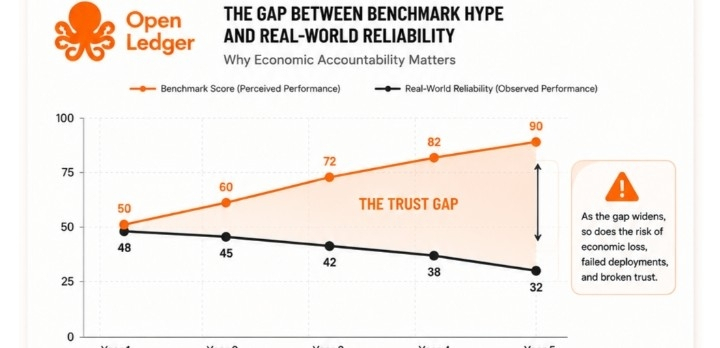
The problem begins when optimization slowly drifts away from reliability.
A model can appear exceptional in controlled evaluations while still behaving unpredictably in real-world environments. Most users never notice the gap until something breaks.
At first, the disconnect feels minor.
Economically, though, it compounds over time.
That is why conversations around “AI trust” still miss the deeper issue.
Most people frame trust emotionally — whether users feel comfortable using AI systems.
But infrastructure trust has never been emotional. It has always been structural.
Banks rely on audits.
Exchanges rely on settlement systems.
Insurance markets rely on risk modeling.
These systems function because accountability mechanisms exist beneath the surface, even when users never directly see them.
AI is gradually entering the same phase.
Especially once these systems become deeply integrated into industries tied to finance, healthcare, legal review, enterprise operations, logistics, and public infrastructure.
At that point, performance claims stop being marketing language.
They become economic assumptions.
And economic assumptions eventually require verification.
That is why projects like OpenLedger keep catching my attention from a completely different angle than most discussions focus on.
Most conversations revolve around the obvious narratives first:
decentralized AI
attribution systems
data contribution economies
agent infrastructure
model monetization
Those narratives matter.
But the more important layer may emerge when attribution evolves into accountability infrastructure instead of simple bookkeeping.
Because provenance sounds boring — until incentives become expensive.
Who trained the model?
Which datasets influenced the outputs?
What evaluation conditions were used?
Which claims influenced adoption decisions?
Who benefited economically when those claims spread?
Right now, those questions still feel administrative because AI remains trapped inside a hype-heavy cycle.
But once institutions begin relying on these systems at scale, ambiguity becomes extremely costly.
And honestly, crypto explored parts of this logic years ago.
Not perfectly. Definitely not cleanly.
But crypto understood something fundamental about incentives:
Systems behave differently when accountability becomes economically embedded instead of socially implied.
Validators get slashed.
Collateral gets liquidated.
Markets punish dishonesty automatically instead of relying purely on reputation damage.
That framework becomes very interesting when applied to AI.
Because benchmark gaming only exists when there is little economic downside to exaggeration.
If AI infrastructure eventually evolves toward transparent attribution, auditable evaluation layers, and financially enforceable accountability, the industry dynamic could change entirely.
The incentive would no longer be:
“Who can make the biggest performance claim?”
Instead, the incentive becomes:
“Who is willing to economically stand behind their claims?”
That shift sounds subtle, but structurally it changes everything.
In that environment, trust stops being a branding exercise.
It becomes part of the market architecture itself.
And that may ultimately become more valuable than raw model capability alone.$OPEN