

I’ve been watching the AI sector long enough to notice a pattern that keeps repeating itself. Every few months, a new platform appears claiming it will revolutionize artificial intelligence, decentralize computation, or redefine ownership in the digital economy. Most of those narratives fade almost as quickly as they arrive. The language changes. The branding evolves. But underneath, many projects still feel disconnected from the actual problems emerging inside AI infrastructure.
That’s partly why OpenLedger caught my attention.
Not because it calls itself an AI Blockchain. A lot of projects do that now. What stood out to me was the direction behind the idea. OpenLedger seems less interested in selling futuristic fantasies and more focused on a question the industry has been quietly avoiding for years: if AI systems are trained on massive amounts of human-generated data, who should actually benefit from the value those systems create later?
I keep coming back to that question because it’s becoming harder to ignore.
Right now, the AI economy is incredibly uneven. Large models absorb enormous quantities of information from developers, researchers, writers, online communities, public datasets, and specialized contributors. Then those models generate billions in value while the original contributors often disappear completely from the economic equation. Most users never think about it. They interact with the final product, not the invisible layers beneath it.
But the imbalance is there.
And I think OpenLedger is trying to build around that imbalance before it becomes impossible to fix.
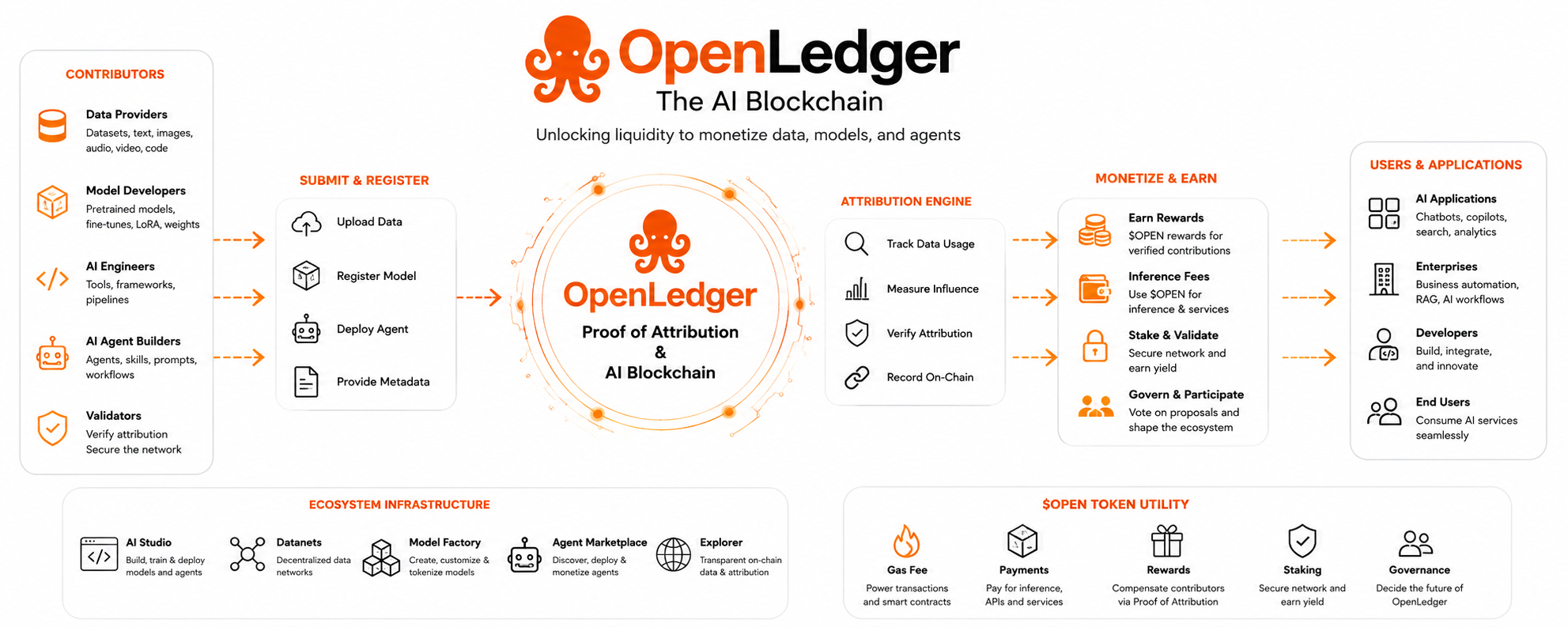
The more I studied the project, the more I realized OpenLedger isn’t simply trying to attach blockchain technology to AI for marketing purposes. The infrastructure itself revolves around attribution, ownership, and monetization. The network introduces systems designed to track how data contributes to AI models and then create mechanisms where contributors can actually receive rewards tied to that influence.
That idea sounds simple when summarized in one sentence, but technically and economically, it’s extremely ambitious.
AI models are not clean systems. Influence inside machine learning networks spreads across billions of parameters, patterns, and statistical relationships. Trying to identify meaningful contribution pathways inside that environment is incredibly difficult. Most companies avoid the problem entirely because it’s easier to centralize the economics and move forward without transparency.
OpenLedger seems to be taking the opposite approach.
Instead of treating attribution as an afterthought, the project places it near the center of the entire ecosystem. I noticed this repeatedly while going through its documentation and ecosystem structure. The language constantly returns to ideas like Proof of Attribution, Datanets, AI agents, model ownership, and contributor rewards. There’s a clear attempt to create an economy around intelligence production itself.
And honestly, I think that’s where the project becomes much more interesting than a standard crypto narrative.
Because this isn’t only about blockchain anymore.
It’s about the future structure of AI economies.
I’ve seen a lot of people describe AI as the new oil, but I think that comparison misses something important. Oil is extracted. Data is generated continuously by human behavior, creativity, interaction, and knowledge sharing. AI systems depend on that ongoing stream of contribution. Yet financially, the relationship between contributors and AI platforms remains mostly one-directional.
OpenLedger appears to believe that eventually changes.
And I can understand why.
The AI industry is moving toward massive concentration very quickly. A small number of companies now dominate compute infrastructure, model distribution, inference APIs, and proprietary training systems. At the same time, concerns around transparency and training rights are becoming louder. Artists are questioning dataset usage. Developers are questioning ownership. Regulators are starting to ask harder questions about accountability.
That creates space for projects like OpenLedger to emerge.
I don’t think the project is positioning itself as an anti-AI movement. If anything, it feels deeply aligned with the idea that AI adoption will continue accelerating. The difference is that OpenLedger seems to assume the economic architecture surrounding AI still hasn’t been solved yet.
And I think that assumption is probably correct.
When I looked deeper into OpenLedger’s ecosystem, I noticed the project has already moved beyond pure conceptual branding. There’s an active network structure, staking systems, developer tooling, AI Studio integrations, validator architecture, and agent-related infrastructure being built around the token economy. The project also secured backing from notable crypto investors, including Polychain Capital and Borderless Capital, which signals that institutional capital sees long-term relevance in attribution-based AI infrastructure.
That doesn’t guarantee success, obviously.
Crypto markets are filled with well-funded projects that never achieve meaningful adoption. I’ve seen enough cycles to know funding announcements alone mean very little over time. What matters is whether a project is solving a real coordination problem people eventually cannot ignore.
That’s the part I keep thinking about with OpenLedger.
Because attribution may become one of the defining issues of the AI era.
Not in a philosophical sense. In a financial sense.
Once AI systems become deeply integrated into global productivity, governments, corporations, creators, and developers will all start asking the same underlying question: where does the value flow, and who deserves a share of it?
Most existing AI infrastructure doesn’t really answer that question clearly.
OpenLedger is at least attempting to build a framework where the answer can be measured, tracked, and monetized on-chain.
Whether the system ultimately scales is another matter entirely. I think that’s where realism becomes important. Building attribution infrastructure for AI is enormously difficult. The technical challenges alone are significant. The incentive design is complicated. The ecosystem participation requirements are high. And like every blockchain project, OpenLedger still has to prove long-term utility beyond narrative momentum.
But I also think dismissing the idea too early would be a mistake.
Some infrastructure projects only make sense once the surrounding market matures enough to expose the problem they were built to solve. I’ve noticed that pattern repeatedly throughout technology history. Open-source software looked inefficient before it became foundational. Cloud infrastructure looked unnecessary before internet-scale applications emerged. Decentralized networks often appear excessive until centralization pressures become impossible to ignore.
OpenLedger feels like it’s positioning itself ahead of a similar curve.
Maybe it succeeds. Maybe it doesn’t.
But I can see the logic behind the direction.
The AI economy currently rewards aggregation more than contribution. OpenLedger is trying to reverse some of that dynamic by turning data, models, and agents into economically traceable assets rather than invisible inputs feeding centralized systems.
And the more I think about it, the more I believe that conversation is only going to grow louder over the next few years.
Because AI is no longer experimental technology sitting quietly in research labs. It’s becoming infrastructure for business, media, software, finance, automation, and digital interaction itself. Once that happens, ownership and attribution stop being niche debates. They become economic battles.
That’s why I keep watching OpenLedger.
Not because I think it has already solved everything.
But because I think it understands where one of the biggest unresolved tensions in AI is heading before most of the industry fully does