
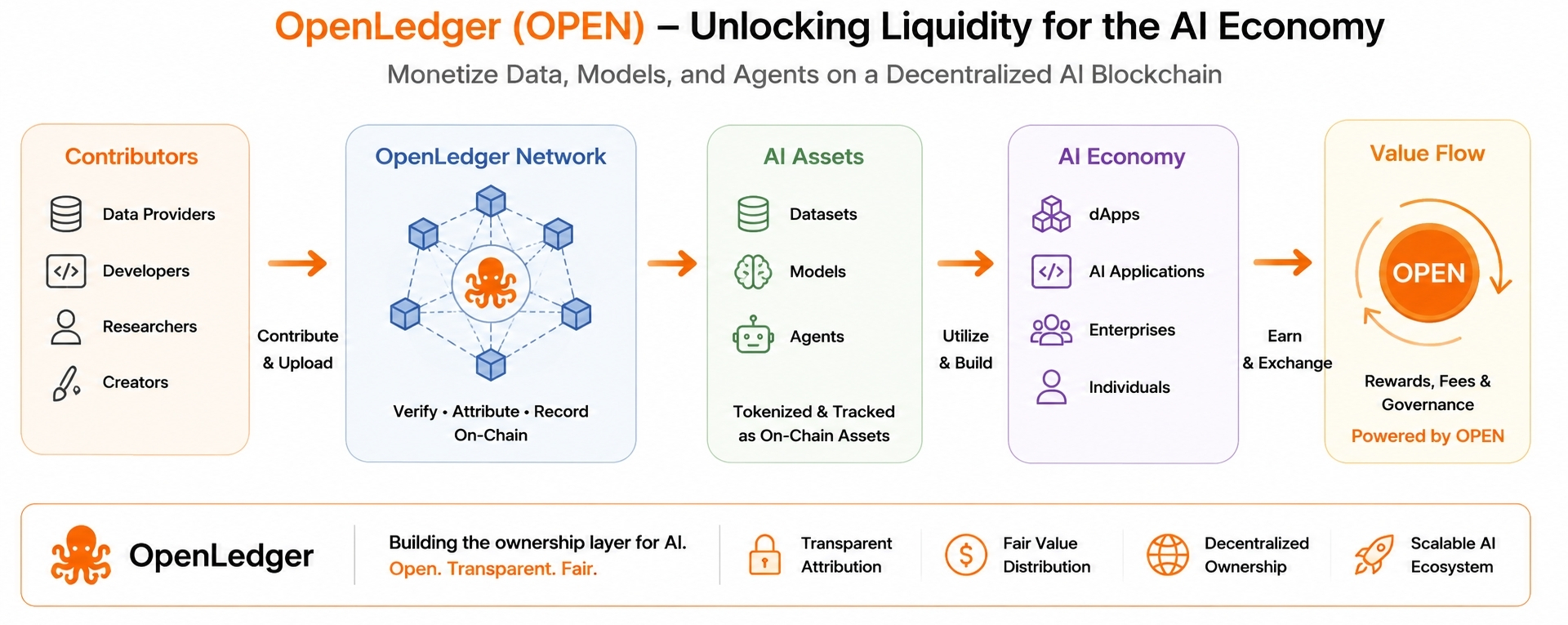
I’ve been thinking about OpenLedger more than I expected to. At first, I thought it was just another crypto project trying to ride the AI wave because that’s become the easiest narrative in the market lately. Every few months there’s a new trend, and suddenly every project starts reshaping itself around whatever people are paying attention to. AI became that story very quickly.
But the more I looked at OpenLedger, the more it felt like the team was actually trying to address something real underneath all the noise.
What caught my attention wasn’t the blockchain side or even the AI branding itself. It was the idea that AI is slowly becoming an economy of invisible contributions. People are constantly feeding value into these systems without even realizing it. Data, conversations, corrections, preferences, behaviors — all of it becomes fuel for models that eventually generate massive value somewhere else.
And honestly, I think most people still underestimate how big that shift is.
I used to assume the AI industry would naturally become more open over time. The internet usually moves in that direction eventually. But now I’m not so sure. The deeper I went into projects like OpenLedger, the more obvious it became that AI is actually concentrating power very fast. A small number of companies control the infrastructure, the models, the compute, and increasingly the distribution too.
That creates a strange imbalance where millions of people contribute indirectly to AI systems, but very few people own any part of the value being created.
OpenLedger seems built around that exact tension.
What stood out to me was that the project doesn’t really position itself as “another AI model.” It feels more like an attempt to build economic infrastructure around AI itself. That’s a very different ambition. Instead of asking how to create the smartest model, the project seems more focused on how value moves between data, models, developers, and users.
The interesting part isn’t the technology alone. It’s what the technology implies.
If AI eventually becomes part of everything online — content, research, automation, applications, digital agents — then ownership and incentives become incredibly important. Who gets rewarded? Who controls access? Who benefits when intelligence becomes scalable infrastructure instead of a standalone product?
The more I thought about it, the more OpenLedger started feeling less like a crypto experiment and more like a response to where the internet may already be heading.
I think that’s why the project stayed in my mind longer than most AI-related tokens. A lot of projects focus entirely on hype because hype is easier to sell than structure. OpenLedger at least seems to understand that AI is not only a technical race. It’s also an economic one.
And economics usually determines what survives.
There’s also something psychologically important happening here. People are starting to feel disconnected from the systems shaping the future. Artists worry about training data. Writers question ownership. Developers increasingly build on platforms they don’t control. Everyone participates, but participation rarely translates into ownership anymore.
OpenLedger appears to be trying to close that gap.
Whether it fully succeeds is another question. I still think projects like this face enormous challenges because centralized systems are simply more convenient right now. Most users don’t think about decentralization unless they personally feel locked out or exploited by existing systems. Convenience almost always wins in the short term.
But long term is where things become interesting.
I get the feeling OpenLedger is building for a future environment where people start demanding more transparency around AI economies. Not just better models, but fairer systems around those models. Systems where contribution can actually be tracked, valued, and rewarded instead of disappearing into black-box platforms.
That’s a much harder problem than building another application.
I also kept thinking about the OPEN token itself while researching the project. In crypto, tokens often become detached from reality. They trade on speculation long before they gain actual utility. But for OpenLedger to matter long term, the token eventually needs to become naturally connected to activity inside the network — not artificially forced into it.
That’s where many projects fail.
Still, I think OpenLedger understands something important about where AI may be heading. The future probably won’t belong only to whoever creates the most advanced intelligence. It may also belong to whoever builds the strongest systems around participation, ownership, and value distribution.
And honestly, that’s the part that kept pulling me back to the project.
Not because it feels guaranteed to succeed. It definitely doesn’t. But because it’s asking questions that feel increasingly relevant the deeper AI becomes part of everyday life. Questions about contribution, control, incentives, and who actually benefits from the next phase of the internet.
Most projects only focus on what AI can do.
OpenLedger seems more focused on who AI should work for.