


Crypto has a habit of chasing whatever story is hottest and then pretending infrastructure magically appears afterward.
DeFi did it. Metaverse did it. AI is doing it now.
Attach "AI infrastructure" to a token and capital shows up fast. GPU marketplaces. Distributed compute networks. Decentralized inference layers. Model serving protocols. Every few months a fresh acronym lands, venture money rotates, and timelines fill with claims about rebuilding artificial intelligence from first principles.
Most of it circles the same territory: compute.
Who owns GPUs. Who rents them. Who allocates resources more efficiently. Who can undercut centralized providers.
Reasonable place to build.
Not necessarily the place where the real bottleneck sits.
Look closer at how modern AI systems actually create value.
Training pipelines absorb enormous datasets. Models improve through endless iteration. Researchers refine outputs. Domain specialists validate edge cases. Developers tune performance. Users generate feedback loops that make systems smarter over time.
Then money gets made.
And most of that money flows toward whoever controls the model.
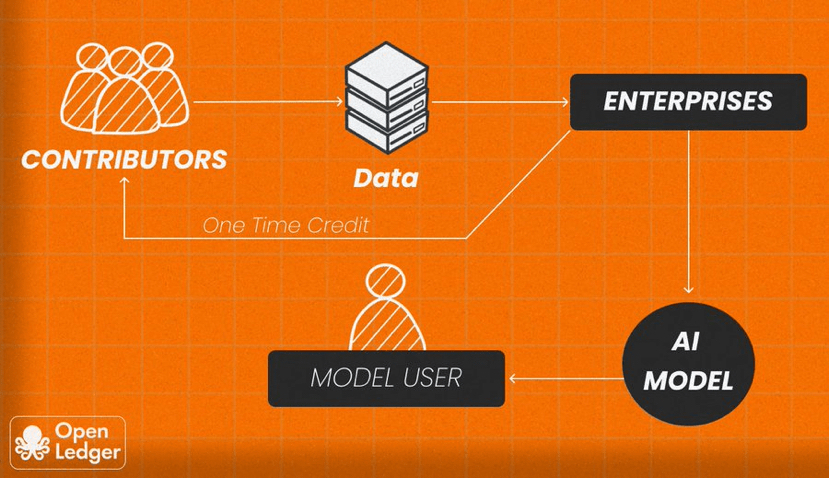
The contributors upstream the people supplying signal, validation, expertise, specialized datasets rarely capture meaningful economic upside after handing over what they built.
That imbalance matters more than people realize because AI increasingly behaves like an input quality business.
Better data wins.
Not always bigger models. Not always more compute.
Better signal.
That’s the corner #OpenLedger $OPEN is trying to attack.
Not another GPU token. Not another "decentralized AI marketplace" pitch wrapped in infrastructure branding.
The bet is narrower. And arguably more interesting.
Can you build systems that actually track who contributed value to AI outputs and compensate them accordingly?
Simple idea.
Nightmare implementation.
Attribution Sounds Easy Until You Try Building It
Blockchains are good at proving things happened.
Balances moved.
Transactions settled.
State changed.
AI systems are messier.
A dataset influences a model. That model evolves. Another contributor fine-tunes behavior. Additional training compounds improvements. Multiple variables overlap. Performance shifts emerge from interaction effects nobody can perfectly isolate.
Now try assigning economic value to individual contributions inside that environment.
That’s basically what OpenLedger is attempting.
Its framework revolves around something called Proof of Attribution an attempt to measure contribution quality instead of merely recording participation.
Not "did you submit data."
Did your contribution actually improve outcomes?
Different problem.
Much harder problem.

The idea feels intuitive because AI economics currently operate with strange blind spots. Someone contributes specialized medical datasets that materially improve healthcare model performance. Another contributor uploads noisy information with little practical utility.
Traditional systems often treat participation itself as the event worth rewarding.
OpenLedger wants impact measurement.
Higher contribution value. Higher economic allocation.
At least in theory.
Here’s the catch.
Machine learning environments are not accounting ledgers.
Causality becomes blurry fast.
Datasets overlap. Improvements compound nonlinearly. Attribution mechanisms become computationally expensive. Economic systems attract gaming behavior the moment incentives become meaningful.
People farm rewards.
People exploit loopholes.
People optimize against metrics instead of outcomes.
Crypto history is basically a museum dedicated to incentive failures.
So OpenLedger isn’t tackling an easy infrastructure problem.
It’s walking directly into one of AI’s hardest ones.
Bigger Models Aren’t Always Better Businesses
AI headlines still orbit giant foundation models because giant foundation models attract giant valuations.
Makes sense.
Massive training runs. Frontier capabilities. Capital expenditure charts large enough to scare CFOs.
But deployment patterns increasingly point somewhere else.
Specialization.
Healthcare systems don’t just need intelligence. They need intelligence constrained by medical context.
Financial systems operate inside compliance frameworks and structured environments where precision matters more than creativity.
Cybersecurity tooling optimizes around entirely different constraints.
Legal AI breaks if nuance disappears.
General purpose intelligence captures attention.
Domain specific systems often capture revenue.
That distinction matters.
Because specialized AI doesn't merely require compute.
It requires proprietary data.
Context rich datasets.
Vertical expertise.
Clear lineage around where information originated and how systems evolved.
OpenLedger appears to be positioning around that shift.
If AI fragments into narrower, industry specific systems rather than consolidating entirely around giant frontier models, attribution infrastructure becomes substantially more valuable.
Not guaranteed.
Directionally logical.
Different thing.
The Data Problem Isn't Volume Anymore
People still talk about AI like we're starving for information.
We aren't.
Data exists everywhere.
Useful data doesn't.
OpenLedger introduces something called Datanets — structured environments designed around contribution tracking and attribution persistence.
Contributors provide datasets.
Systems evaluate contribution credibility.
Attribution remains attached downstream.
Economic rewards attempt to align with measurable impact.
Crypto builders will recognize the pattern immediately.
Create incentives.
Suppress spam.
Increase reward density around higher-value behavior.
Clean framework.
Messy reality.
Open contribution systems almost always attract adversarial behavior faster than expected.
Low-quality submissions.
Reputation farming.
Sybil attacks.
Attribution manipulation.
Reward extraction strategies.
The second money enters a network, optimization behavior changes.
Fast.
Which means OpenLedger’s challenge isn't simply building attribution rails.
It’s defending them.
Without creating verification layers so heavy that developers stop caring.
Infrastructure dies surprisingly often from friction.
Compute Economics Still Matter
No AI stack discussion stays abstract forever.
Eventually everything runs into hardware constraints.
GPU availability.
Inference costs.
Memory efficiency.
Deployment economics.
OpenLedger’s OpenLoRA framework leans into that side of the equation.
The focus sits around scaling specialized models more efficiently dynamically loading narrower systems while reducing memory overhead and improving hardware utilization.
Not flashy.
Potentially important.
Infrastructure markets reward marginal efficiency improvements aggressively.
Sometimes boring optimizations matter more than breakthrough innovation.
If specialized AI deployment accelerates over the next few years which increasingly looks plausible systems that reduce deployment costs gain leverage.
The thesis isn't unreasonable.
The operational burden remains enormous.
Both can be true simultaneously.
Builders Decide Whether Infrastructure Exists
Crypto infrastructure founders love architecture diagrams.
Developers care about workflows.
Different priorities.
OpenLedger seems aware of that.
Its ModelFactory tooling aims to reduce friction around model development dataset permissions, optimization pipelines, deployment tooling, evaluation frameworks, retrieval systems.
Necessary work.
Often overlooked work.
Developer ecosystems rarely fail because engineers hate the technology.
They fail because builders choose easier environments.
Liquidity matters.
Users matter.
Distribution matters.
Technical superiority alone doesn't produce network effects.
Crypto relearns this lesson every cycle.
The graveyard is crowded with technically impressive systems nobody adopted.
Token Design Matters More Than Crypto Likes Admitting
Infrastructure projects love telling grand narratives.
Token mechanics usually get discussed later.
Sometimes too late.
OPEN functions as the coordination layer across the ecosystem governance participation, contribution rewards, deployment operations, inference payments.
The allocation structure leans relatively community heavy compared to typical infrastructure launches.
Community ownership accounts for just over half.
Investors hold under one fifth.
The remainder spreads across ecosystem growth, liquidity, and team allocation.
Useful signal.
Not decisive.
Token sustainability depends on behavior.
Retention.
Developer growth.
Actual usage density.
Emissions.
Nobody builds durable infrastructure because allocation charts look nice.
The Real Bet
Crypto routinely overvalues narratives.
Infrastructure constraints usually arrive later.
AI tokens are especially vulnerable to this.
Every project claims developers will migrate away from centralized providers.
Few explain why.
OpenLedger, at minimum, appears focused on a problem that actually exists.
Data ownership remains unresolved.
Attribution remains unresolved.
Economic alignment across AI systems remains unresolved.
Those bottlenecks become increasingly important if AI evolves toward specialized vertical intelligence where proprietary datasets carry meaningful strategic value.
But none of that guarantees anything.
Execution risk here is massive.
Measuring attribution accurately inside production AI systems is extraordinarily difficult.
Incentive design failures destroy otherwise good architecture.
Developer ecosystems fail constantly.
Technical quality helps.
Distribution usually decides.
The metrics worth watching aren't complicated.
Developer activity.
Model deployment growth.
Dataset contribution velocity.
Inference utilization.
Retention.
Real infrastructure demand eventually reveals itself.
Whitepapers don't create it.
Builders do.
OpenLedger is trying to build around a genuine fault line inside the AI stack.
Whether it becomes foundational infrastructure or another thesis that looked smarter on paper than reality depends entirely on execution.