

I used to think innovation was mostly about creation. If a project could build something technically impressive, I assumed the hard part was already done. More data, bigger models, smarter agents, faster infrastructure — I believed scale itself would naturally attract relevance. And honestly, that’s how a lot of people still evaluate AI and blockchain projects today. They look at what has been built, not what continues to happen after the building is finished.
But over time, I realized I was looking at the surface of the machine instead of the movement inside it.
That completely changed how I look at projects like OpenLedger.
At first, I saw the familiar narrative. AI blockchain. Data monetization. Decentralized intelligence. Community-owned models. Oh yeah, the wording sounded powerful, but I’ve learned that modern systems are very good at sounding important long before they become useful. A beautiful factory means nothing if nothing meaningful keeps moving through it.
That became the real question for me.
What happens after something is created?
Not when the model launches. Not when the infrastructure goes live. Not when the token trends for a week. I mean afterward. Does the thing continue moving inside an economy? Does it interact with other systems? Does somebody actually return to use it again tomorrow without being pushed by incentives?
Because most systems don’t collapse at the design stage. They collapse at the integration stage.
That’s the part people underestimate.
A lot of AI today reminds me of abandoned industrial zones. Expensive machinery everywhere, but very little circulation. Models are built, datasets are collected, agents are deployed, yet most of them never become part of a living economic process. They exist, but they don’t flow.
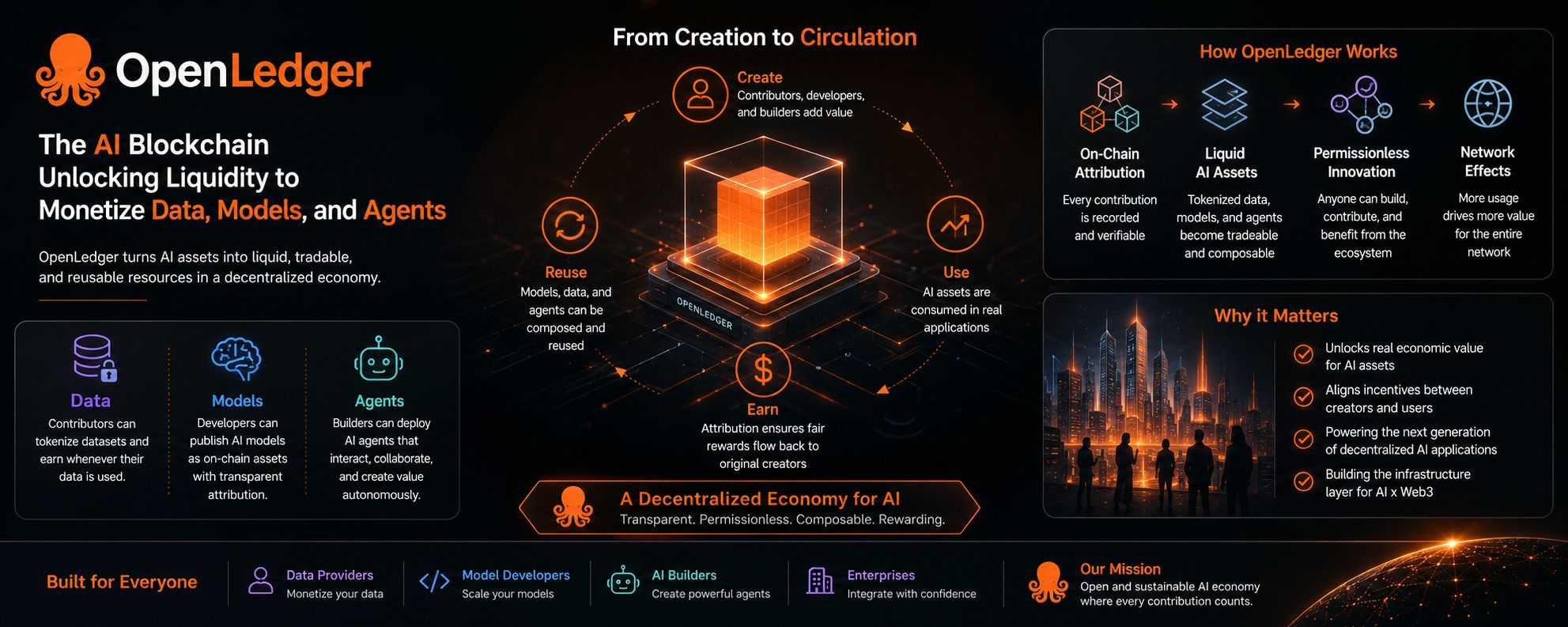
OpenLedger became interesting to me when I stopped looking at it as another AI narrative and started looking at it as an attempt to solve circulation.
The platform is trying to turn data, models, and AI agents into active economic assets instead of static outputs. That distinction matters more than people realize. A static system can create something once. A living system allows that thing to continue generating value through repeated interaction.
Okay, think about it like this.
A road matters more than a parked car.
Not because the car is useless, but because the road allows continuous movement between participants. Commerce happens through circulation. Economies survive because things keep passing through them repeatedly.
That’s how I now think about AI infrastructure.
OpenLedger’s structure tries to connect contributors, developers, applications, and AI agents into an environment where outputs can continue interacting long after they are created. Data contributors can be attributed. Models can be reused. Agents can build on previous outputs instead of operating in isolation. The system is attempting to make intelligence behave less like a product and more like infrastructure.
And honestly, that’s a much harder problem than people think.
Creating intelligence is already difficult. Creating economic continuity around intelligence is even harder.
What caught my attention is that OpenLedger seems to understand something most projects ignore: value is not created at the moment of production alone. Real value appears when usage becomes repetitive.
A hospital doesn’t care that an AI model exists somewhere on the internet. It cares whether that model can continuously support real workflows inside diagnostics, administration, or patient systems. A financial institution doesn’t need abstract decentralization narratives. It needs reliable systems that can integrate into actual operational environments without friction.
That’s where infrastructure becomes different from a tool.
A tool is something you occasionally use.
Infrastructure is something your daily activity quietly depends on.
And I think OpenLedger is positioning itself closer to the second category, even if it’s still early.
The interesting structural layer is how participation feeds future participation. When contributors provide data, developers create specialized models, and applications repeatedly consume those outputs, the network starts forming memory. Each interaction increases the usefulness of the system for the next participant. That’s where network effects begin — not from marketing, but from dependency.
Oh, and that’s the part I pay the most attention to now.
Can the system create dependency without forcing it?
Because artificial activity is easy to manufacture temporarily. Incentives can attract users for a while. Campaigns can generate noise. Speculation can create traffic. But sustainable infrastructure behaves differently. People continue using it because leaving becomes inconvenient.
That’s the real test.
Right now, OpenLedger still sits in an interesting middle stage between positioning and maturity. The narrative is strong because AI and blockchain are both attracting enormous attention, but attention alone is not proof of embedded adoption. I still think a lot of the visible activity around these systems is ecosystem-driven rather than economically unavoidable.
There’s an important difference there.
A project can have high engagement during incentives and still fail to create long-term operational relevance. Temporary motion is not the same as sustained economic gravity.
So when I look at OpenLedger, I separate potential from proof very carefully.
The potential is clear. If AI models, datasets, and agents can become reusable, attributable, and economically connected assets, then the infrastructure layer itself becomes extremely valuable. Especially as industries move toward specialized AI rather than generalized systems. Businesses don’t just need intelligence. They need intelligence tailored to specific operational environments.
But proof comes later.
Proof appears when developers continue building even when incentives slow down. When institutions integrate systems quietly into workflows. When models are reused repeatedly across independent applications. When participation expands outward beyond early communities and starts becoming geographically and commercially diverse.
That’s when infrastructure stops being an idea and starts becoming part of the economy itself.
And honestly, that’s also where the biggest risk exists.
The danger is not technological failure. The danger is temporary participation disguised as adoption.
If usage depends mainly on rewards, narratives, or speculative cycles, then the system remains fragile. Real strength only appears when activity becomes self-sustaining. When people return because the system genuinely improves operational efficiency, lowers costs, creates revenue opportunities, or becomes embedded inside daily processes.
That’s the signal I’m watching for.
Not hype.
Not announcements.
Not promises.
Repeated usage.
Because the systems that end up mattering usually become boring in a very specific way. Nobody talks emotionally about cloud servers anymore, yet modern business depends on them every second. Nobody wakes up excited about payment rails, but global commerce quietly runs through them continuously.
That’s the future real infrastructure reaches.
Invisible dependence.
So when I evaluate OpenLedger now, I’m no longer asking whether it can create AI assets. That question feels incomplete to me. I’m asking whether those assets continue moving after creation. Whether they circulate through developers, businesses, applications, institutions, and agents in a way that compounds over time without constant stimulation.
Because in the end, the systems that survive are rarely the loudest ones.
They’re the ones where things keep moving long after people stop paying attention.