


Something has been bugging me about how we value gaming tokens in crypto....
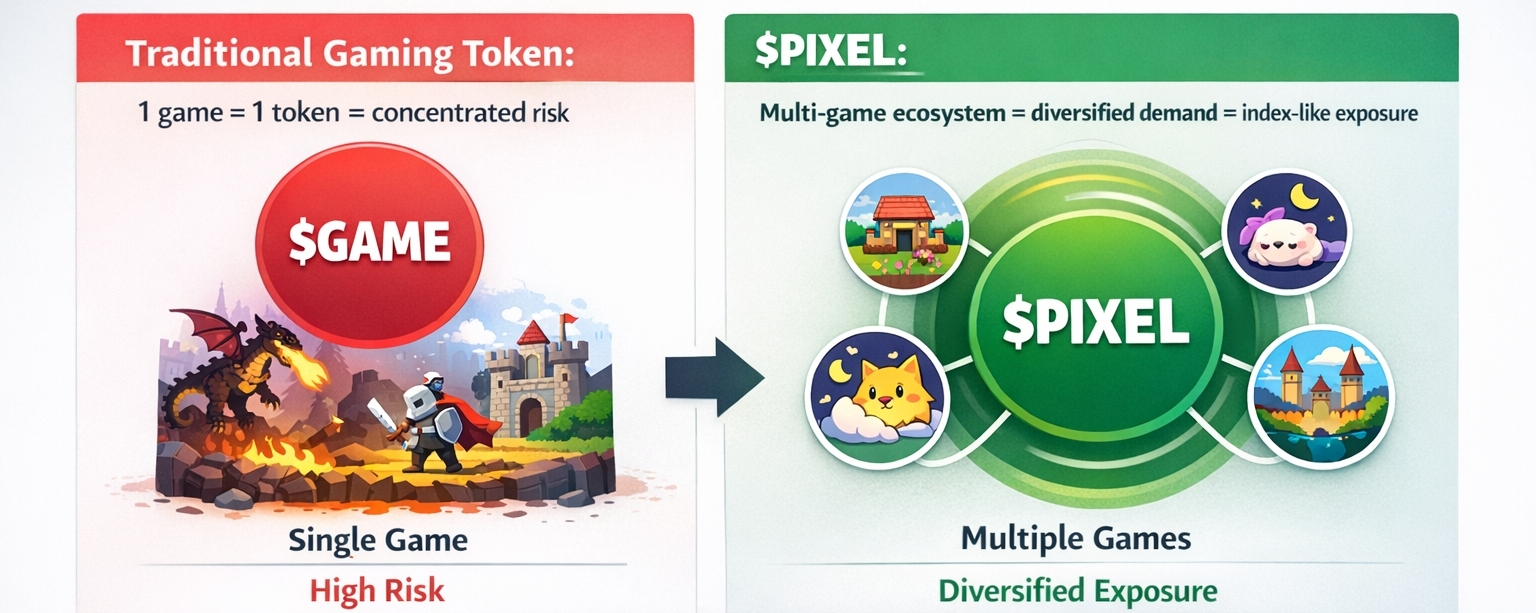
Every gaming token I've seen follows the same pattern. One game. One token. Token goes up when game is hot. Token goes to zero when game cools off. Axie Infinity. StepN. Illuvium. The list goes on. The fundamental problem is concentration risk. You're not investing in a gaming company or a gaming ecosystem. You're betting on one single game maintaining its player base forever. That almost never happens in gaming. Games are cyclical by nature.
@Pixels is building something structurally different and I don't think the market is pricing it in....
Instead of one game with one token, Pixels is creating a multi-game ecosystem where $PIXEL serves as the shared currency and staking layer across everything. Here's what's currently live or in development:
The flagship Pixels game. A social casual farming and exploration MMORPG on Ronin. 5M+ lifetime players. $25M in revenue. The game that started it all. Chapter 3 Bountyfall launched October 2025 with Chapter 4 expected in 2026.
Pixel Dungeons. A roguelike dungeon crawler. Battle through procedurally generated levels. High risk, high reward gameplay. Already integrated with Stacked for pixel rewards.
Chubkins. This is the interesting one. A mobile-native pets game specifically designed to attract Web2 audiences. The team's thesis is that to grow crypto gaming you have to stop building exclusively for crypto gamers. Chubkins is the experiment to prove that. Web2-first design with blockchain elements invisible to the end user.
Sleepagotchi. A wellness game that turns your sleep schedule into a reward mechanism. Earn for consistent healthy sleep habits. Yes really.
Forgotten Runiverse crossover. A live cross-game event where Runiverse players can earn and spend $PIXEL, with a 5M pixel prize pool. This is the first real cross-game economy on Ronin.
Five to six more games in development that we haven't seen yet.
Now here's what makes the pixel tokenomics interesting in this context....
The multi-game staking system lets you stake pixel across different games and earn boosted rewards from all of them. Barwikowski calls it an "index-like model." Instead of staking into one game and hoping it stays hot, your staked $PIXEL generates returns from the entire ecosystem. If the flagship game has a slow month but Pixel Dungeons is thriving, your staking rewards keep flowing.
This is a fundamentally different investment thesis than any other gaming token. You're not betting on one game. You're betting on a portfolio of games sharing the same economic infrastructure. Diversification in gaming tokens. That's new.
And Stacked takes this even further. Because Stacked is open to external studios, any game developer who integrates the platform could potentially use pixel as a reward currency. Imagine a world where 50 games are integrated with Stacked and all of them drive organic demand for $PIXEL through player rewards. That's not one game's user base creating token demand. That's an entire network of games.
The revenue model supports this. Pixels already proved the economics work. $25M in revenue. 131% return on reward spend. More tokens deposited than withdrawn. The foundation is solid. Now the question is whether the ecosystem expansion can scale those economics across multiple games and eventually multiple studios.
Pixel at $0.00827 with a $5.2M market cap. FDV around $34M. The token is down 99.3% from ATH. Gaming sector is in the dumps. Vesting unlocks continue to pressure the price with the next one April 19 releasing 91M tokens.
But if the multi-game thesis plays out, and if Stacked gains adoption among external studios, the demand profile for $PIXEL transforms from "currency for one farming game" to "reward infrastructure token for an entire gaming network."
That's the bet. That's why I'm watching this closely even though the chart looks brutal.
Track new game launches. Track Stacked studio integrations. Track cross-game staking volumes. Track whether token deposits continue to exceed withdrawals. Those are the leading indicators that tell you if the index thesis is working before the price reflects it.
DYOR fam.... and game on.