

For a brief moment, the tension eased.
Not completely. Not convincingly. Just enough for markets to react.
When Iran signaled that the Strait of Hormuz was open again for commercial shipping—under conditions, under watch—the global market didn’t wait for details. It responded to the shift in tone.
Oil softened. Equities climbed. And quietly, almost instinctively,Bitcoin began to rise.
What looked like a simple headline turned into a much deeper market signal.
A Strait That Carries More Than Oil
The Strait of Hormuz isn’t just a line on a map. It’s a pressure point.
A significant share of the world’s oil passes through that narrow corridor. When it’s threatened, the impact ripples across energy prices, inflation expectations, and global confidence. When it appears to reopen, even partially, those pressures begin to loosen.
That’s exactly what markets reacted to—not a solved crisis, but a reduced threat.
Bitcoin Didn’t Wait for Certainty
Bitcoin’s move wasn’t dramatic at first. It didn’t spike out of nowhere. It climbed.
But that climb mattered.
Because it happened at the same time as broader risk assets were recovering. Stocks moved up. Oil moved down. The mood shifted from defensive to cautiously optimistic.
And Bitcoin, as it often does now, leaned into that shift.
There’s a common idea that Bitcoin thrives purely on chaos. That when the world looks uncertain, it rises as a safe alternative.
But reality has become more nuanced.
In moments like this, Bitcoin behaves less like a shield and more like a signal—one that reflects how comfortable markets feel taking risk.
The Market Heard “Less Risk,” Not “No Risk”
Here’s the detail that changes everything: the strait didn’t fully return to normal.
Shipping was described as open, but controlled. Movement required coordination. Security concerns didn’t disappear. And within a short time, reports suggested that restrictions could return.
So why did markets react so strongly?
Because markets don’t wait for clarity. They move on direction.
Before the announcement, traders had to consider a prolonged disruption—a worst-case scenario that could push oil higher and strain the global economy.
After the announcement, that scenario felt less immediate.
Not gone. Just less likely.
That was enough.
How One Headline Traveled Across Markets
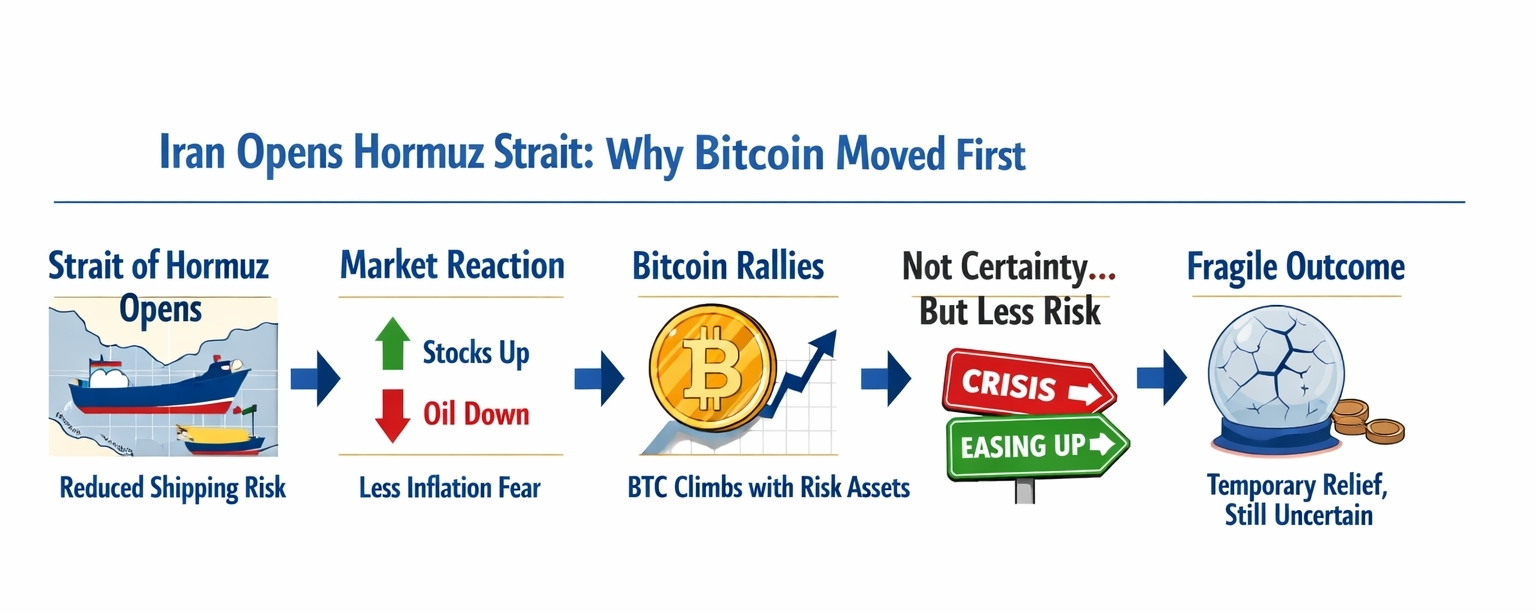
The reaction followed a familiar chain:
Oil pressure eased
Inflation fears softened
Rate expectations relaxed
Risk appetite returned
Bitcoin accelerated
Bitcoin didn’t start this chain. It sat at the end of it—and amplified it.
That’s what makes it different.
It doesn’t just respond. It exaggerates.
A Rally Built on “Maybe”
There’s something fragile about rallies like this.
They aren’t built on certainty. They’re built on possibility.
Possibility that tensions won’t escalate further.
Possibility that supply disruptions will stay limited.
Possibility that the worst outcomes won’t happen.
That kind of optimism can move markets quickly. But it can also reverse just as fast.
If the situation tightens again, the same logic that pushed Bitcoin higher could easily pull it back.
What This Moment Reveals About Bitcoin
Bitcoin has changed.
Not in what it is—but in how it behaves within the broader system.
It used to feel separate, almost detached from traditional market forces. Now it moves with them, reacts to them, and sometimes magnifies them.
When fear dominates completely, liquidity disappears and Bitcoin struggles.
When fear fades—even slightly—liquidity returns, and Bitcoin responds faster than most assets.
That’s what we saw here.
The Real Story Behind the Move
The headline suggests a clear cause and effect: Iran opens the strait, Bitcoin rallies.
But the reality is softer, more human.
Markets didn’t celebrate a solution.
They reacted to a shift in expectations.
Bitcoin didn’t rise because the world suddenly became stable.
It rose because, for a moment, things felt a little less uncertain than before.
And in today’s markets, that’s often all it takes.