
Privacy in crypto has traditionally followed two paths.
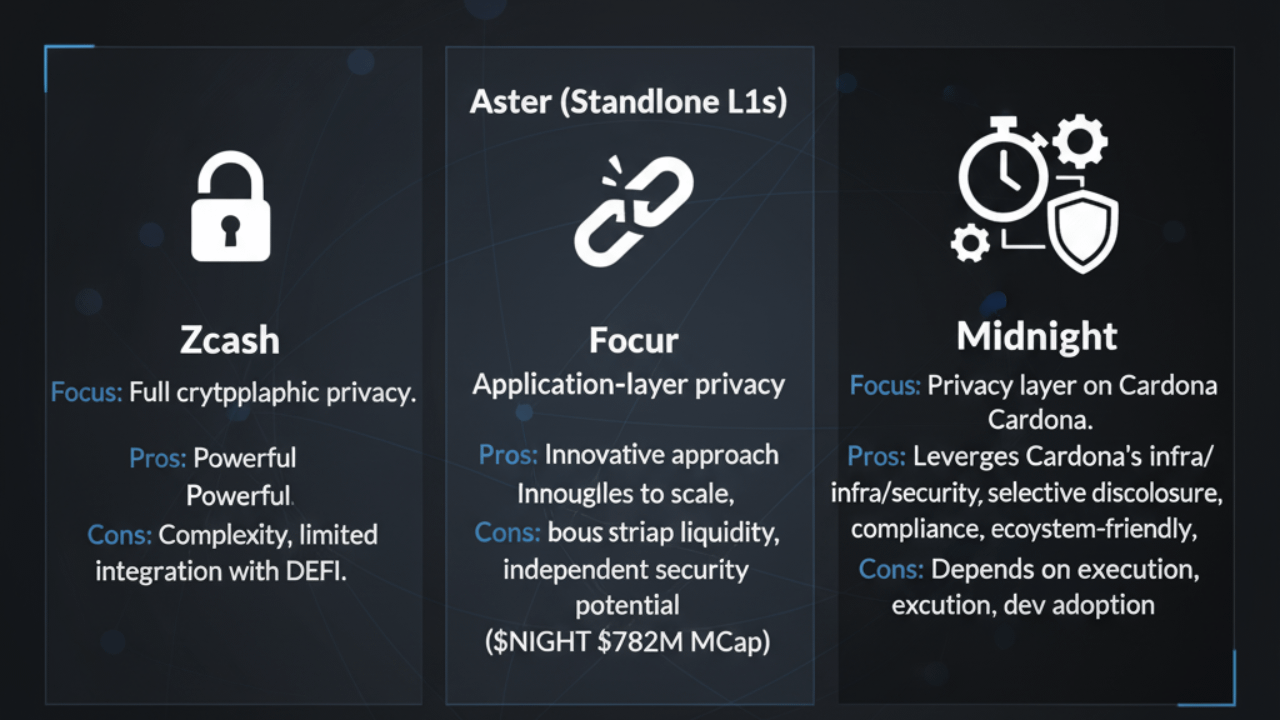
On one side, you have chains like Zcash, which focus heavily on cryptographic privacy but often come with complexity and limited integration. On the other side, newer projects attempt to build privacy directly into application layers, but struggle to scale or attract real liquidity.
Midnight sits somewhere in between and that positioning might be its biggest advantage.
Instead of building an isolated privacy chain, @MidnightNetwork is designed as a privacy layer connected to the Cardano ecosystem. That means it doesn’t need to bootstrap everything from scratch. It can leverage Cardano’s existing infrastructure, security model, and user base, while adding a layer of programmable privacy on top.
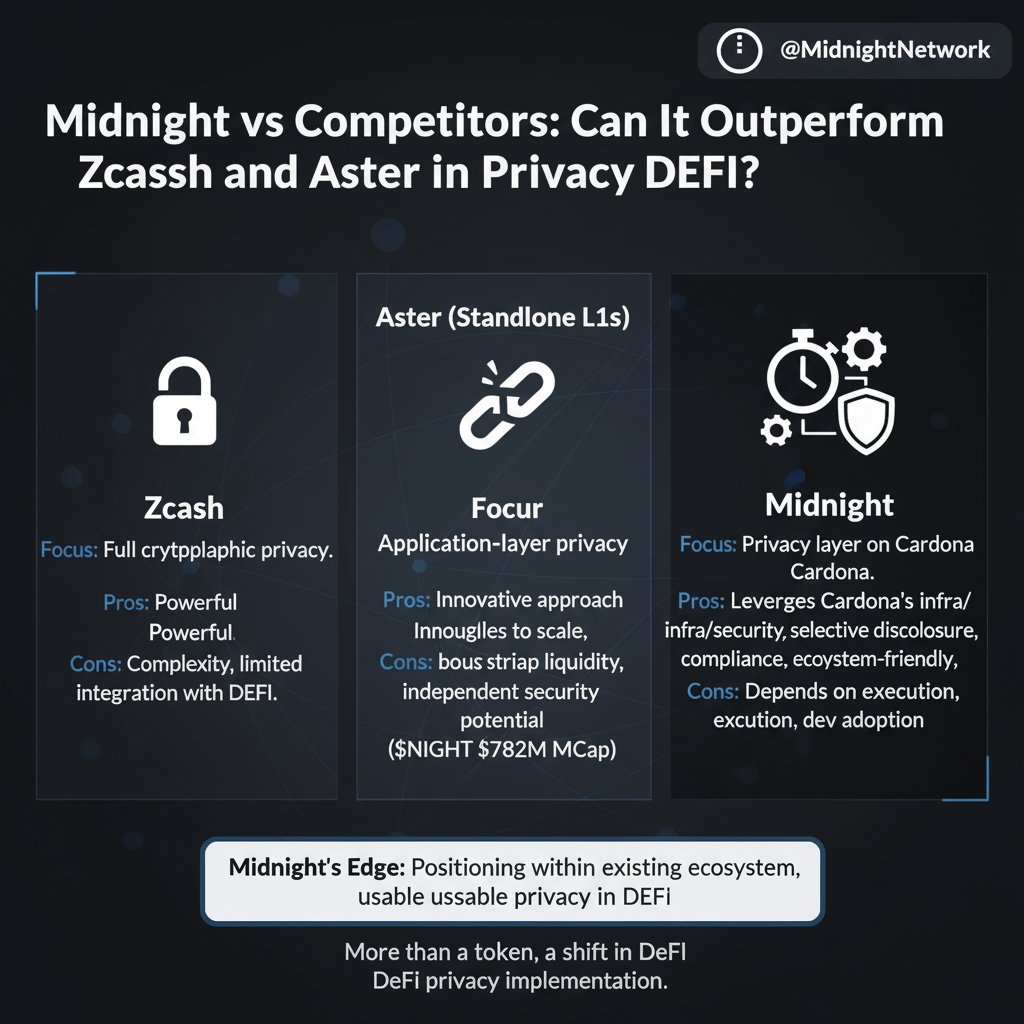
Projects like Aster, which operate as standalone L1s, face the usual challenge of building liquidity, attracting developers, and maintaining network security independently. Midnight, by contrast, inherits part of its security assumptions from Cardano and integrates more naturally into an existing ecosystem.
When compared to Zcash, the difference becomes even clearer.
Zcash focuses on full privacy through complex cryptographic circuits, which can be powerful but also harder to integrate into broader DeFi systems. Midnight takes a more flexible approach with selective disclosure, allowing applications to remain private while still being verifiable and, importantly, more compatible with compliance requirements.
That flexibility matters if the goal is not just privacy, but usable privacy in DeFi.
From a market perspective, early signals suggest that Midnight is already gaining attention. With $NIGHT reaching a market cap around $782M, it is positioning itself among the more visible projects in the privacy narrative, especially as discussions around “privacy-first DeFi” continue to grow.
But the more interesting angle may not be short-term hype.
Midnight’s real edge could come from ecosystem lock-in.
If Cardano’s DeFi ecosystem expands, and if builders begin integrating privacy features through Midnight, the network could benefit from a kind of network effect that standalone privacy chains struggle to achieve. Integrations, developer tools, and shared infrastructure can create a moat that is difficult to replicate.
This is especially relevant in a cycle where narratives tend to cluster around ecosystems rather than isolated projects.
In that context, Midnight is not just competing on technology. It is competing on positioning.
A privacy layer embedded within an existing ecosystem may ultimately be more sustainable than a fully independent privacy chain trying to attract users from scratch.
Of course, this thesis depends on execution.
Midnight still needs developer adoption, real applications, and sustained usage to validate its design. Without that, even strong positioning won’t translate into long-term value.
But if the privacy narrative continues to evolve toward compliance-friendly, application-level privacy, then Midnight’s model could become increasingly relevant.
In that scenario, $NIGHT isn’t just another privacy token.
It becomes a key asset tied to a broader shift in how privacy is implemented across DeFi.
And that’s a very different game than what earlier privacy coins were playing.