
I remember the first time I really grappled with what a blockchain can actually be not just a public log of transactions, but a place where privacy means something real. That was the seed of my fascination with what projects like Midnight are trying to do with a dual‑state ledger. You’ve seen public verifiability and private data protection often pitched as opposing forces one insists on transparency so anyone can audit and trust the system, the other insists on secrecy so users and enterprises don’t expose sensitive info. @MidnightNetwork doesn’t just talk about both, it layers them into a single architecture so they can coexist without collapsing into ambiguity.
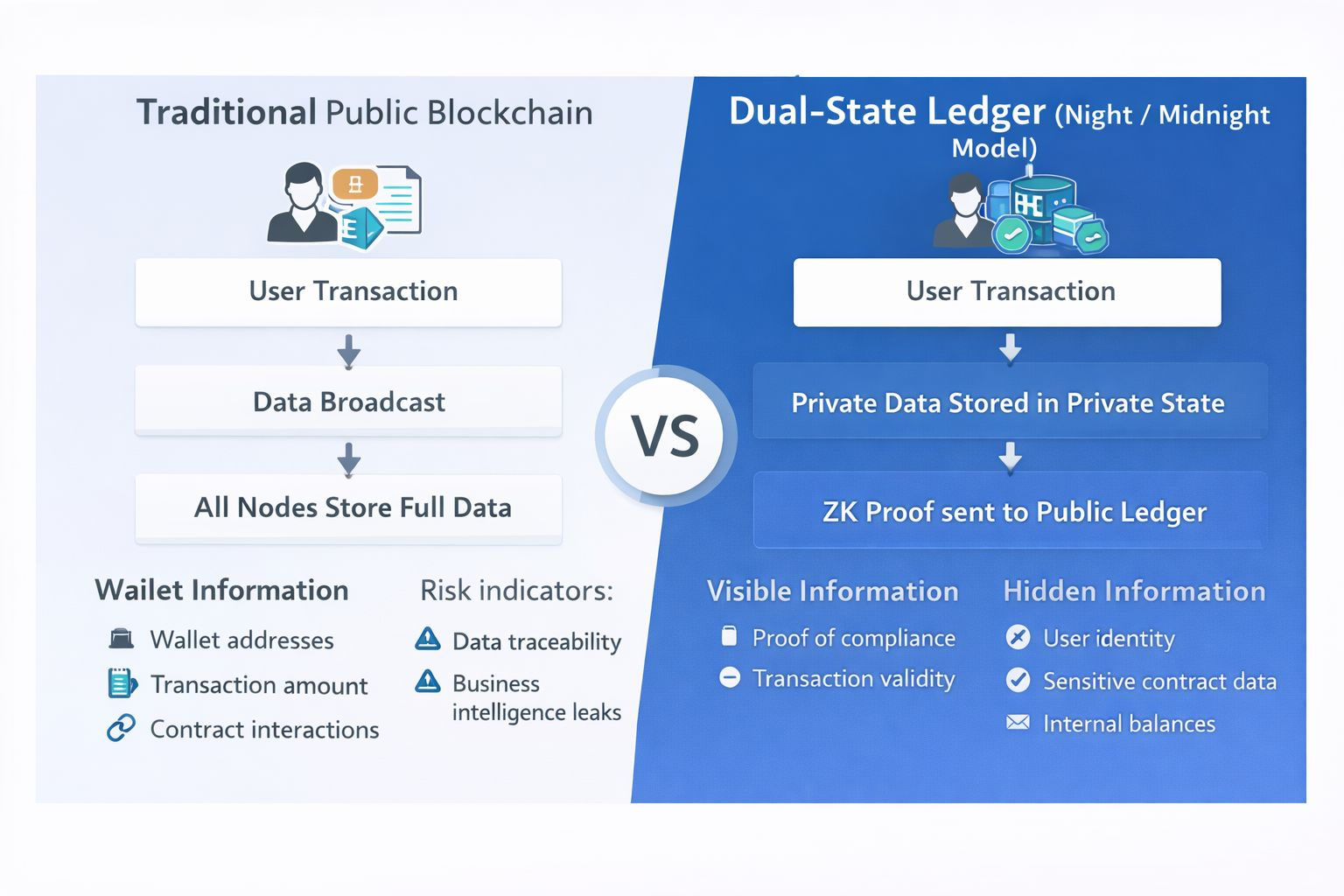
On the surface, a dual‑state ledger sounds like marketing: public stuff here, private stuff there. But when you look a bit deeper, you see it’s a practical resolution of that age‑old tension. Most blockchains are fully public: every transaction, every balance is on display for the world. That’s great for trust, but terrible if you’re a business worrying about proprietary data being broadcast forever. Midnight splits the state: general consensus and verifiable actions go into a public state that anyone can audit, while sensitive user or business data resides in a private state that only gets exposed when and only when it’s appropriate.
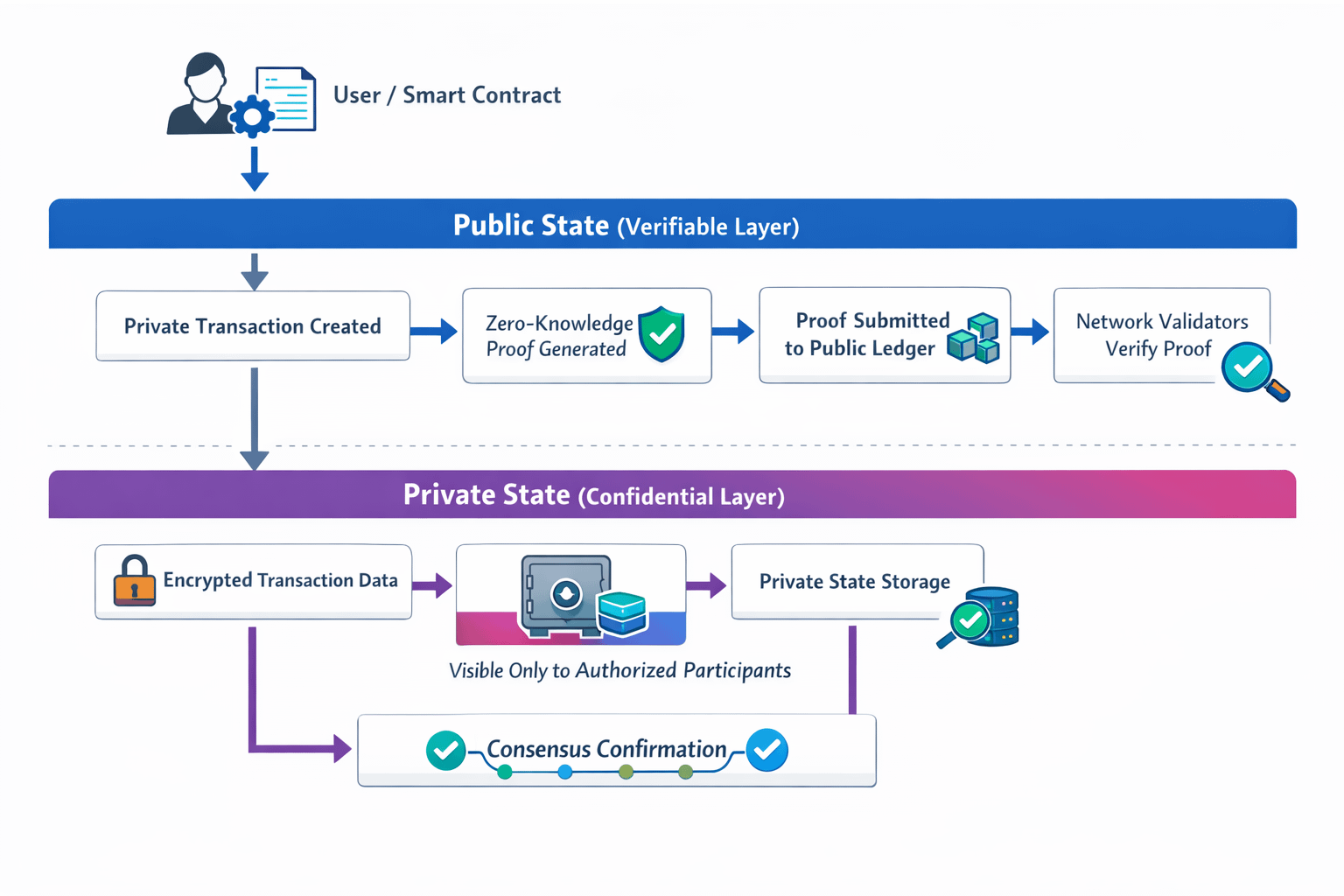
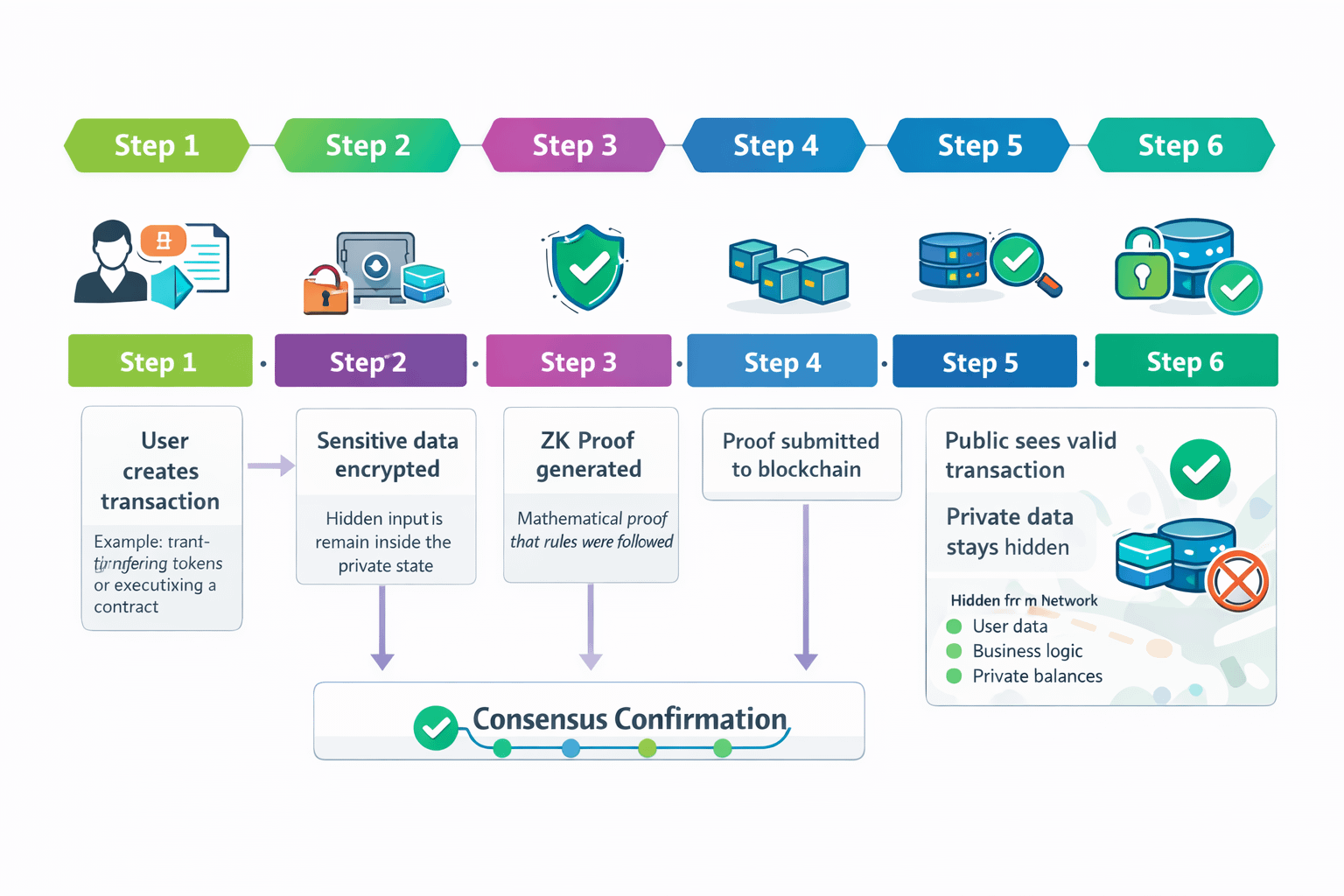
The magic under the hood is zero‑knowledge proofs (ZKPs). At its most basic, a ZKP lets you prove you know a secret without revealing the secret itself. It’s like saying “I’m old enough” without handing over your birth certificate. In Midnight’s case, when a private transaction is submitted, the network doesn’t see all of the details. Instead it sees a mathematical proof that the transaction is valid. That proof is small, verifiable, and publicly checkable, yet there’s no way to reverse‑engineer the hidden data. That’s what gives you both worlds at once: the public ledger still proves legitimacy, but the private data stays private.
That’s not just technical elegance. What struck me most was the real world momentum as this thing hit markets, especially around Binance, which started supporting NIGHT tokens and facilitating trading and distribution. Listing on major venues like Binance usually means liquidity and user engagement suddenly jump. And while some early hype around NIGHT saw eye‑popping numbers near $10 billion in trading volume over short bursts, numbers like that are as much a commentary on market appetite for privacy narratives as they are on the technology itself.
But you can’t pretend this is a solved problem. There’s still risk here. ZK systems are notoriously complex to build and audit. They require new developer toolchains and expertise that most teams still lack. And while dual‑state ledgers solve some regulatory headaches by enabling selective disclosure, they also raise new questions about who controls the disclosure keys and how access requests are governed. The system can prove a transaction was compliant, but deciding what to disclose when regulators ask is a procedural question, not a cryptographic one.
Meanwhile, platforms like Binance Square are shaping how projects communicate these subtleties to broader audiences. Square isn’t a trading venue; it’s a social and content hub tied to the Binance ecosystem that blends insights with actionable data. It’s where creators, analysts, and traders dissect launches and architectural distinctions like public/private state models, or debate whether a wrapped NIGHT token on an external chain truly represents the native Midnight asset.
What stands out is how these patterns reflect a deeper shift: privacy isn’t a niche anymore, it’s a design requirement. Public verifiability alone isn’t enough for many use cases; total secrecy isn’t acceptable either, especially when institutions must show compliance without leaking strategic data. Projects that acknowledge that and bake in mechanisms for controlled visibility are gaining attention not because they’re esoteric, but because they’re practical.
If this holds, we won’t think about blockchain privacy as a binary anymore. Dual‑state architectures are showing that you can build systems where public trust and private confidentiality aren’t trade‑offs, but co‑equal components of a coherent whole. That quiet shift is what matters most.
