
I am thinking about how quickly automation technology is evolving. Every year we see improvements in robotics, artificial intelligence, and machine learning systems. Robots are becoming more capable, more efficient, and able to perform increasingly complex tasks.
The Rapid Growth of Automation:-
Across industries like logistics, manufacturing, and warehousing, machines are already handling operations that once required large human workforces. Automated sorting systems, warehouse robots, and AI-driven production lines are becoming more common.
But while machines themselves are improving rapidly, another challenge is quietly growing alongside them.
The Coordination Challenge:-
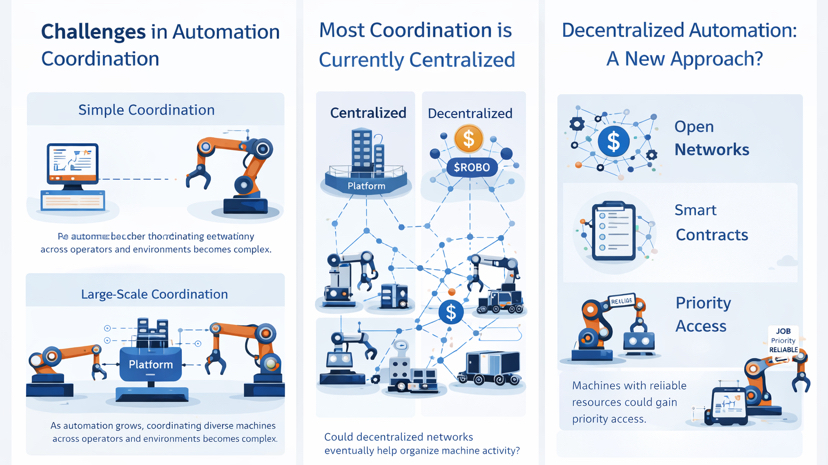
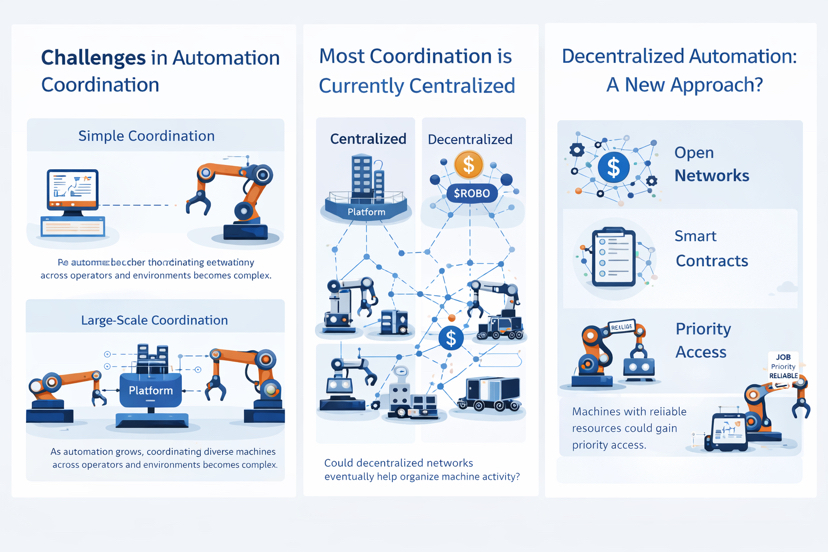
When a small number of machines operate in a controlled environment, coordination is relatively simple. A central system assigns tasks, monitors performance, and ensures everything runs smoothly.
However, as automation expands and machines begin operating across larger networks, coordination becomes far more complicated.
Different machines may belong to different operators, work in different environments, or perform different types of tasks. Managing how these systems interact efficiently becomes a major challenge.
Centralized Systems Today:-
Right now, most automated systems rely on centralized platforms to coordinate this activity. These platforms assign tasks, track results, and manage operational data for machine networks.
While centralized coordination works well within single organizations, it can become less flexible when automation scales across multiple operators and environments.
A Decentralized Possibility:-
When I looked into the idea behind $ROBO, it made me think about whether decentralized coordination systems could eventually help address this challenge.
In a decentralized model, machines or their operators might participate in open networks where tasks are distributed automatically through smart contracts.
Instead of relying on a single coordinating authority, economic incentives and network rules could help organize machine activity.
My interpretation is that tokens in these types of systems might represent participation in automated task networks. Machines backed by stronger resources or operators with reliable performance could gain priority access to work.
Why Coordination May Become Critical:-
Over time, this could create automated ecosystems where machines interact through open economic networks rather than purely centralized systems.
Whether ROBO ultimately becomes part of that infrastructure is still uncertain.
But as machines continue getting smarter and more capable, the systems coordinating their activity may become just as important as the machines themselves.
And that coordination challenge is the idea that stood out to me today while thinking about the concept behind the project.
@Fabric Foundation $ROBO #ROBO
