
At first, I thought $FOGO was just another speed play.
High-performance L1.
Solana Virtual Machine.
Parallel execution. Familiar tooling.
It sounded like an efficiency upgrade. Cleaner blockspace. Maybe less congestion. A technical refinement more than a strategic shift.
But the more I sit with it, the less this feels like a performance story.
It feels like a containment story.
Specifically, whether Fogo can contain incentives long enough for them to harden into something durable.
Because attracting activity is one thing. Keeping it from leaking back out is something else entirely.
By using the Solana Virtual Machine, Fogo lowers technical friction. That matters. Developers don’t have to relearn an execution model. Tooling ports more easily. Mental models transfer.

In theory, this makes experimentation cheaper.
A team can deploy on Fogo without abandoning its SVM foundation. That reduces risk. Or at least it looks that way.
But incentives don’t just respond to compatibility. They respond to opportunity.
And opportunity in crypto is restless.
Developers go where users are.
Users go where liquidity is.
Liquidity goes where returns are highest — until they aren’t.
The challenge for Fogo isn’t attracting incentives. It’s containing them.
Imagine a mid-sized DeFi protocol currently live on Solana. They’re comfortable. They have users, integrations, analytics support, and decent liquidity depth.
Fogo offers them grants and a more controlled execution environment. Maybe fewer unpredictable fee spikes. Maybe a tighter validator set that keeps latency consistent.
They consider launching a parallel deployment.
From a code perspective, that’s manageable.
From an economic perspective, it’s messy.
If they incentivize liquidity on Fogo, they fragment their own market. If they don’t incentivize it heavily, users won’t bridge. If they over-incentivize, they risk mercenary capital — liquidity that disappears when emissions slow.
This is the containment problem in miniature.
Incentives are easy to deploy. They are hard to anchor.
There’s a structural assumption beneath Fogo’s design that feels decisive.
It assumes that execution alignment with Solana creates enough psychological and operational familiarity that developers will treat Fogo as an extension, not a leap.
That assumption might hold.
But familiarity reduces friction. It does not create loyalty.
And loyalty is what contains incentives after subsidies fade.
If Fogo’s early growth depends heavily on grants, liquidity mining, or fee rebates, it needs a mechanism to convert temporary participation into structural commitment.
Otherwise, capital will treat it as rotational exposure.
Yield in, yield out.
We’ve seen that pattern before.
There’s a trade-off here that feels unavoidable.
If Fogo competes aggressively on incentives, it accelerates adoption but risks shallow roots.
If it takes a slower approach, focusing on organic growth, it may struggle to reach critical mass at all.
Speed of growth versus depth of attachment.
That tension sits quietly under the surface.
And because @Fogo Official shares an execution environment with Solana, comparison is constant. Developers and users will benchmark fee stability, latency, liquidity depth, ecosystem activity.
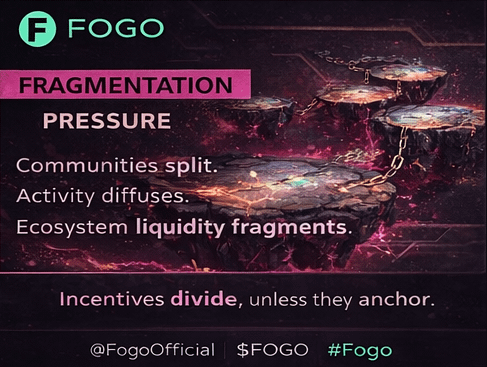
Containment becomes harder when your closest reference point is only one bridge away.
There’s also a behavioral pattern worth noticing.
Under stable market conditions, developers experiment. They deploy to secondary chains. They test new environments.
Under volatility, they consolidate.
When markets get unstable, teams retreat to the deepest liquidity and the most battle-tested infrastructure. Users do the same. Institutions especially.
Institutions don’t chase marginal execution gains. They chase predictability.
If Fogo wants to contain long-term activity, it must survive at least one serious stress event without seeing an exodus back to Solana or elsewhere.
That’s not a technical milestone. It’s a psychological one.
Zooming out, this becomes an ecosystem positioning question.
Fogo isn’t competing against Ethereum-style VM alternatives. It’s operating within the SVM universe. That narrows differentiation to performance characteristics, governance style, and incentive structure.
But shared VM alignment means switching costs remain relatively low.
Low switching costs cut both ways.
They make entry easier. They make exit easier too.
Containment is fragile in environments with low lock-in.
And crypto users are extremely sensitive to opportunity cost.
What would realistically motivate sustained adoption?
For developers, predictable blockspace and meaningful economic upside. If Fogo can offer an environment where certain workloads perform consistently better — not just marginally, but structurally — that creates a reason to stay.
For users, differentiated opportunities. Unique yield strategies. Exclusive applications. Something they can’t access elsewhere.
For market makers, reliable volume and fee structures that justify capital allocation.
But what would prevent movement even if the technology is strong?
Liquidity fragmentation. Bridge risk. Social inertia. Integration overhead. The simple fact that “good enough” performance on a larger chain often beats marginal improvements on a smaller one.
There’s a quiet line that keeps resurfacing in my head:
Attraction is cheap. Containment is expensive.
Fogo can attract through incentives and performance metrics. But containing activity requires deeper alignment — economic, social, and infrastructural.
There’s also a governance dimension hiding here.
If #fogo evolves independently from Solana’s roadmap, it must make its own upgrade decisions. That creates divergence over time. Divergence can be healthy. It can also create compatibility tension.
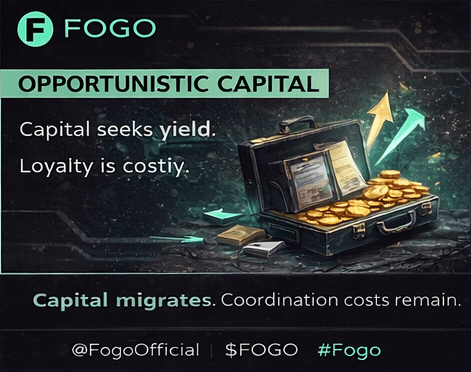
Too much divergence, and the shared VM advantage weakens.
Too little, and differentiation disappears.
That balance feels delicate.
And it depends on long-term strategic clarity, not just early growth momentum.
I’m not dismissing the model.
There’s something elegant about leveraging a proven execution environment while trying to carve out a more optimized space within it. It’s pragmatic. It avoids unnecessary reinvention.
But containment remains the unresolved variable.
If #Fogo becomes a specialized enclave — a place for certain high-performance applications that genuinely need its environment — incentives might stabilize naturally around that niche.
If it aims for broad ecosystem parity with its SVM counterpart, containment becomes much harder.
Because then it’s not just building performance.
It’s building gravity strong enough to resist leakage.
And gravity takes time.
Right now, it’s still early. Incentives can be deployed quickly. Activity can spike.
Whether that activity stays — whether it embeds — is less clear.
I’m not fully convinced either way.
It still feels fragile.
Time will tell if Fogo can do more than attract attention — if it can contain it long enough to matter.
