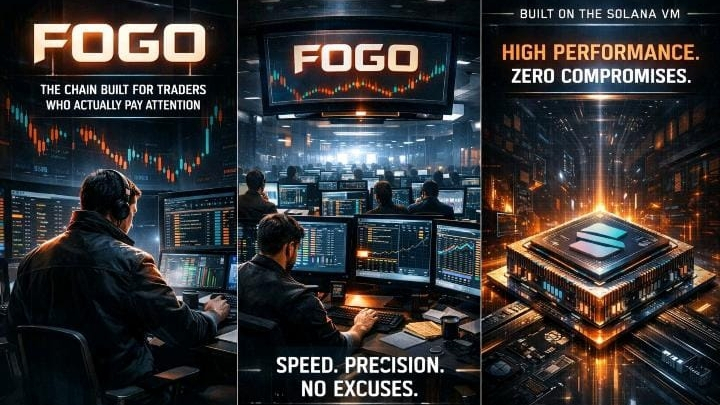

If you’ve ever watched a chart blink from green to red in a heartbeat, you know: the real world doesn’t wait for block confirmations. Traders don’t think in seconds; they think in milliseconds. And yet, for years, “high-performance” blockchains have been content with block times measured in fractions of a second, with finality still taking seconds. On most networks, by the time your transaction looks confirmed, the price has already moved. And that means orders get missed, liquidations slip, arbitrage goes to centralized venues — all because the blockchain can’t keep pace with how markets actually move.
This is the core problem Fogo set out to solve — not “blockchain speed” for its own sake, but trading performance that feels real. Fogo is a Solana Virtual Machine (SVM) Layer 1 built with distance and delay in its crosshairs, tailored so that interacting with on-chain markets doesn’t feel like waiting for dial-up in a fiber-optic world.
The founders didn’t start with “let’s make a blockchain.” They started with “what happens if on-chain trading actually matched the latency expectations of institutional systems?” And that ambition shows up in the technical DNA.
The Machine Beneath the Buzzwords and Why It Matters
To understand what’s different about Fogo, you have to unlearn a few assumptions about decentralized infrastructure:
Compatibility Is a Feature, Not a Constraint.
Fogo runs the same virtual machine as Solana. That means developers don’t need to rewrite programs or change tooling — they can bring SPL tokens, Anchor contracts, existing wallets, even entire apps across with minimal changes. That’s not just convenience. It’s a shortcut for adoption that preserves tooling ecosystems while swapping out the slower parts underneath.Speed Through Specialization, Not Just Tuning.
There are two ways to call something “fast”: optimize every last millisecond, or change the rules so that milliseconds matter less. Fogo does both.It uses a custom Firedancer-based validator client, which eliminates much of the overhead that slows traditional nodes.
Its consensus isn’t a one-size-fits-all global dance — it has zones of validation and dynamic co-location that reduce the physical and logical distance between participants. That’s a radical answer to the usual decentralization versus performance trade-off.
Trading Isn’t a Side-Hustle — It’s the Core Narrative.
Other high-throughput chains boast about throughput, but Fogo explicitly targets real-time markets: on-chain order books, auctions, precise liquidations, and latency-sensitive automated strategies. That’s a different use case from “run as many transactions as possible.” It’s a performance ambition rooted in market behavior, not benchmarks alone.
Why Latency Is the Real Game Changer
When Fogo’s mainnet launched, it wasn’t just another genesis event. The network touted block times as low as 40 milliseconds that’s twenty-five times faster than most comparably high-throughput chains.
At a gut level, 40ms doesn’t sound dramatic unless you’re trading. Traders make decisions in tens of milliseconds. Exchanges still compete on tenths of milliseconds. When a blockchain can confirm transactions faster than some centralized venues can match them, the whole premise of on-chain finance changes. It means settlement risk collapses, front-running strategies shift, and the order execution landscape becomes traceably transparent. That’s the only reason someone building high-frequency strategies would care and that’s precisely the community Fogo is courting.
And it shows in implementation details like:
Curated validator sets, not open-ended validation pools that slow consensus under real-world conditions.
Multi-local consensus zones, which reduce latency without sacrificing security.
UX innovations like session-based gasless interactions so users don’t waste precious time signing for every single action.
These aren’t marketing lines; they’re practical responses to the friction people actually hit when they try to run real markets on existing chains.
More Than Speed — A Shift in Market Narrative
What’s remarkable about Fogo isn’t that it can claim impressive numbers — lots of networks do that. It’s that the design decisions consistently privilege execution quality over generic throughput. Think of it this way:
Trying to run leveraged perpetuals, on-chain auctions or competitive liquidity provision on most L1s is like entering a drag race in a family sedan and telling yourself it’s about the scenery. Fogo’s aim is to put you in something that actually handles the turns.
That’s also why community mechanics matter. Instead of “just another token launch,” Fogo built incentive programs (like Flames Points) and ecosystem coordination with order-book DEXs, native price feeds, and liquidity programs. It’s signaling that it expects volume, not just speculation.
Which leads to the real inflection point: will developers and capital actually gravitate toward performance as a first principle? Practical performance, after all, is not measured by whitepaper claims but by sustained real-world usage the kind that actually moves markets and locks in liquidity.
A Thought That Outlives the Buzz
Here’s the take that really matters: decentralization isn’t useful if it means being too slow to be competitive. Fogo’s journey isn’t just about a new L1; it’s about demanding that networks meet markets where they already are in time, not just in theory. If that turns out to be the metric that differentiates long-term viable chains from “also-rans,” the repercussions will outlast the initial hype.
The question now isn’t whether Fogo exists it’s whether the rest of the ecosystem will finally measure blockchains not just by how many transactions they can process, but by how quickly they allow real economic activity to feel real.