
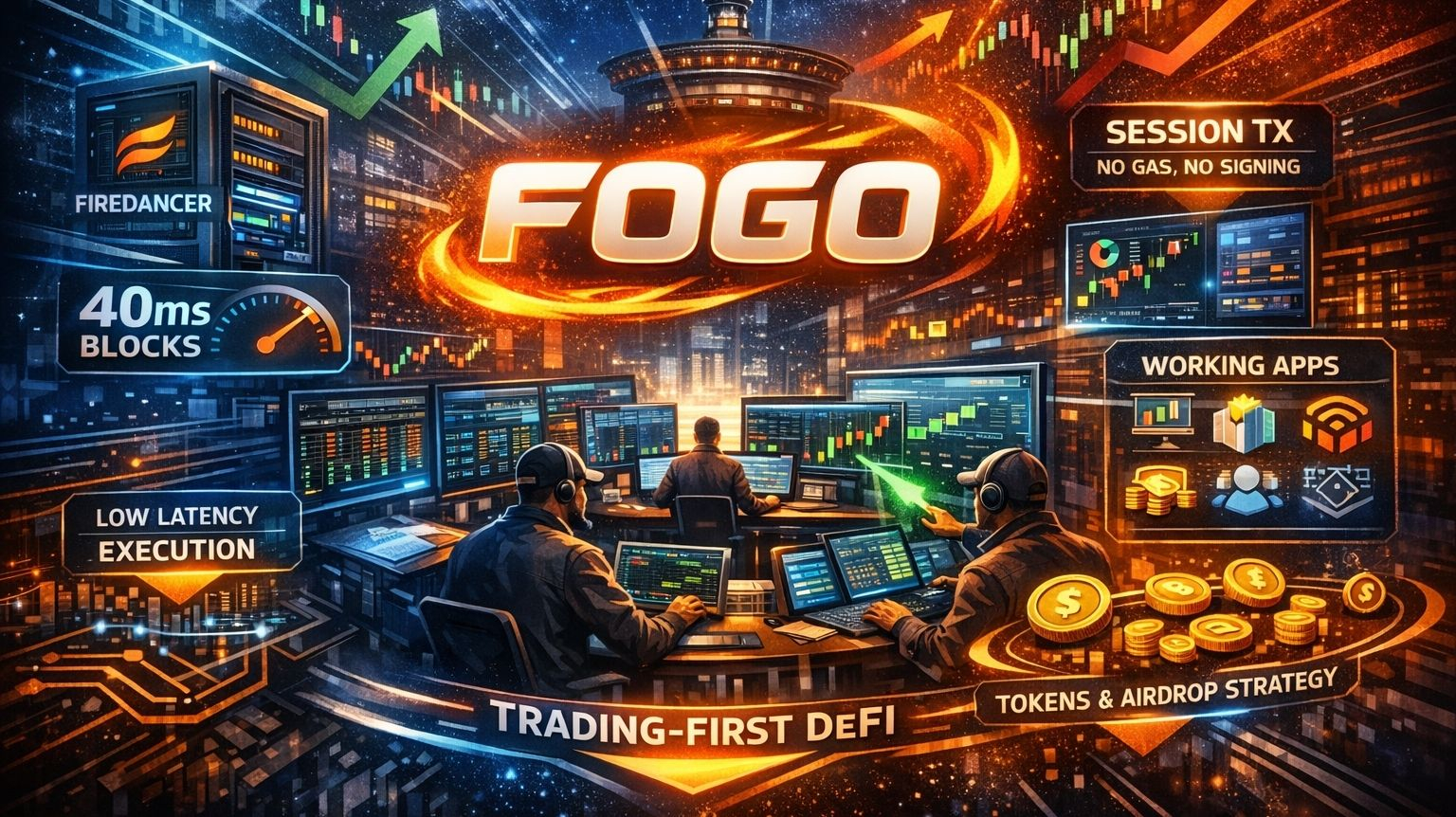
What makes Fogo interesting to me is that it doesn’t feel like a chain trying to win a benchmark contest. It feels like a chain trying to fix a very specific annoyance that traders know in their bones: the moment you need speed most, on-chain UX usually turns into friction, extra signatures, uncertainty, and execution drag.
That’s why I think describing Fogo as “a high-performance SVM L1” is technically correct but emotionally incomplete. Yes, it is SVM-compatible, and yes, it is built for low-latency DeFi-style workloads. But the more useful way to think about it is this: Fogo is trying to make on-chain trading feel less like using a blockchain and more like using a serious execution venue. The docs are pretty explicit about the target use cases too—on-chain order books, real-time auctions, precise liquidations, and reduced MEV extraction—so this isn’t me projecting; it’s baked into the design brief. 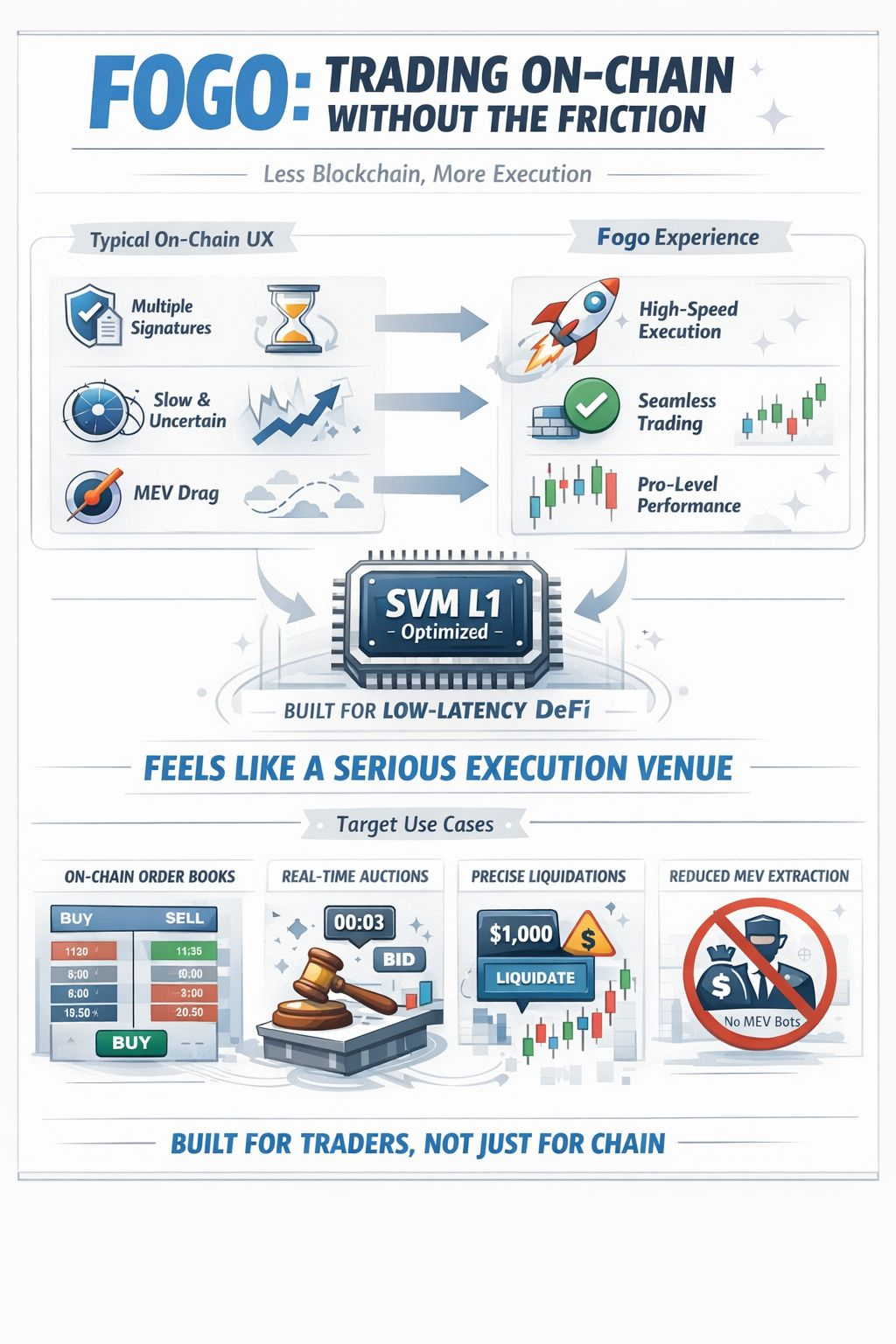
A lot of L1s market speed like a car ad: bigger engine, faster top speed, done. Fogo’s pitch reads more like a pit crew talking about lap consistency. On the homepage, it leans into “40ms blocks, 1.3s confirmation,” a custom Firedancer-based client, and collocated validators in Asia near exchanges with backups on standby. That combination matters because it suggests they care about coordination and latency variance, not just a flashy average number. In trading systems, that difference is everything. Fast-but-jittery can still be expensive.
The part I find most compelling (and honestly more differentiated than the block-time slogan) is Fogo Sessions. If you’ve spent real time in DeFi, you know the actual UX tax isn’t always the network fee—it’s the interruption loop. Sign this. Approve that. Switch wallet. Confirm again. By the time you’re done, the market has already moved. Fogo’s docs describe Sessions as a chain primitive that combines account abstraction and paymasters so users can interact without paying gas or signing every transaction, with guardrails like domain restrictions, token limits for limited sessions, and expiries. They also note that users can sign the intent message using any Solana wallet, even if it doesn’t natively support Fogo. That’s a meaningful design choice if your north star is “time-to-action” rather than just raw throughput.
And this is where Fogo starts to feel less like “another performance chain” and more like a deliberate product thesis. The chain speed matters, yes—but speed without continuity is still a choppy experience. Sessions attack the continuity problem directly. It’s the difference between a fast elevator that keeps stopping on every floor and one that takes you straight to where you need to go.
The latest updates also make the project more real, in the sense that it has moved from architecture narrative into live network and token coordination. On Fogo’s blog index, the most recent public posts listed are the January 15, 2026 airdrop update and the January 12, 2026 tokenomics post, with the site also prominently linking to “Explore Mainnet.” That matters because once a chain is in mainnet mode, it is no longer being judged on design intent alone; it starts getting judged on user behavior, market behavior, and incentive behavior.
The tokenomics post is worth reading closely because it’s one of the few L1 token frameworks that tries to explain why the token should matter beyond the standard gas/staking/governance template. Fogo explicitly describes a “Fogo Flywheel,” where the Foundation supports projects via grants/investments and partners commit to revenue sharing that directs value back to Fogo, and says several agreements are already in place. Whether that works in practice remains to be proven, but it’s a stronger starting point than the usual “the ecosystem grows, therefore the token somehow accrues value.”
The distribution details are also more important than people usually admit. In the same tokenomics post, Fogo groups Echo raises, Binance Prime Sale, and airdrop into a “Community Ownership” category (16.68%), with 6% allocated to the community airdrop, including a 1.5% distribution at public mainnet launch on January 15 and 4.5% reserved for future rewards. The post also says 63.74% of genesis supply is locked at launch, with gradual unlocks, and that the remaining unlocked supply flows to Foundation, grants, airdrops, and liquidity, with 2% burned. That’s not just token accounting—it shapes early float, volatility, and the quality of participation the chain attracts in its first months.
The January 15 airdrop post gives even better texture on what kind of activity Fogo wanted to reward. It says the airdrop covered roughly 22,300 unique users with an average allocation of about 6,700 FOGO per wallet, fully unlocked, with a 90-day claim period closing April 15, 2026. It also details anti-sybil methods (wallet history, connection data, behavior analysis, cluster analysis) and a minimum 200 FOGO threshold to avoid dust allocations. I actually like that they explained the filtering logic in plain language. Whether every user agrees with the results is a different question, but the methodology signals that the team understands airdrops are adversarial environments, not community theater.
There’s also a subtle but important clue in the airdrop category breakdown: Season 1.5 rewards explicitly include bridging via Wormhole Portal, activity in Fogo Fishing, and swaps/liquidity on Valiant. That tells you the team isn’t only measuring abstract “engagement”; they’re trying to seed the exact behaviors a trading-focused chain needs—capital movement, transaction frequency, and early market depth. In other words, they used rewards not just to hand out tokens, but to rehearse the kind of ecosystem traffic they want on mainnet.
Another recent update that doesn’t get enough attention is on the engineering side: Fogo’s docs now show a releases page, and the listed Fogo v20.0.0 release includes changes such as moving gossip/repair traffic to XDP, support for native token wrapping/transferring with Fogo Sessions, reducing consecutive leader slots, and several breaking changes for node operators (including port updates and config requirements). That matters because it shows the project isn’t only shipping consumer-facing narratives; it’s still actively tuning validator/client behavior and operational reliability—the less glamorous work that usually decides whether performance claims survive real usage.
I also think Fogo’s ecosystem framing is smarter than average. The docs “What is” page and releases/docs navigation surface pieces like Pyth Lazer Oracle, Wormhole Bridge, Goldsky, FluxRPC, Birdeye, Codex Data API, and Fogoscan. The homepage, meanwhile, highlights an “Arsenal” of trading/lending/staking apps like Ambient, Valiant, Flux Beam, Pyron, Fogolend, and Brasa Finance. That mix matters because a trading chain is not a single product; it’s a stack. Speed alone doesn’t create an edge if the oracle is slow, the bridge is clunky, the indexer lags, or the app layer is thin. Fogo appears to understand that the chain is only one layer of the experience.
One “latest” data point I’d include, even if only as a snapshot, is from the explorer search snippet: it shows Fogo’s explorer surfacing slot-time stats with a 1-minute and 1-hour average at 40ms at the time of indexing. The explorer page is dynamic (it didn’t render parsed lines cleanly here), so I’d treat that as a directional signal rather than a permanent number. Still, the important thing is that Fogo exposes this kind of operational metric publicly, because that’s the right layer to watch if you want to judge whether the trading-first story holds up.
Personally, I don’t think Fogo’s hardest challenge is technology. It’s habit. Traders already have places they trust, workflows they know, and venues where liquidity is deep enough that execution feels predictable. A new chain can be genuinely better on paper and still lose if users don’t feel the advantage in the first week. That’s why I keep coming back to the combination of low-latency design + Sessions + trading-specific ecosystem seeding. Fogo seems to understand that what it’s really selling is not “blockchain performance,” but the absence of little delays that quietly bleed edge away.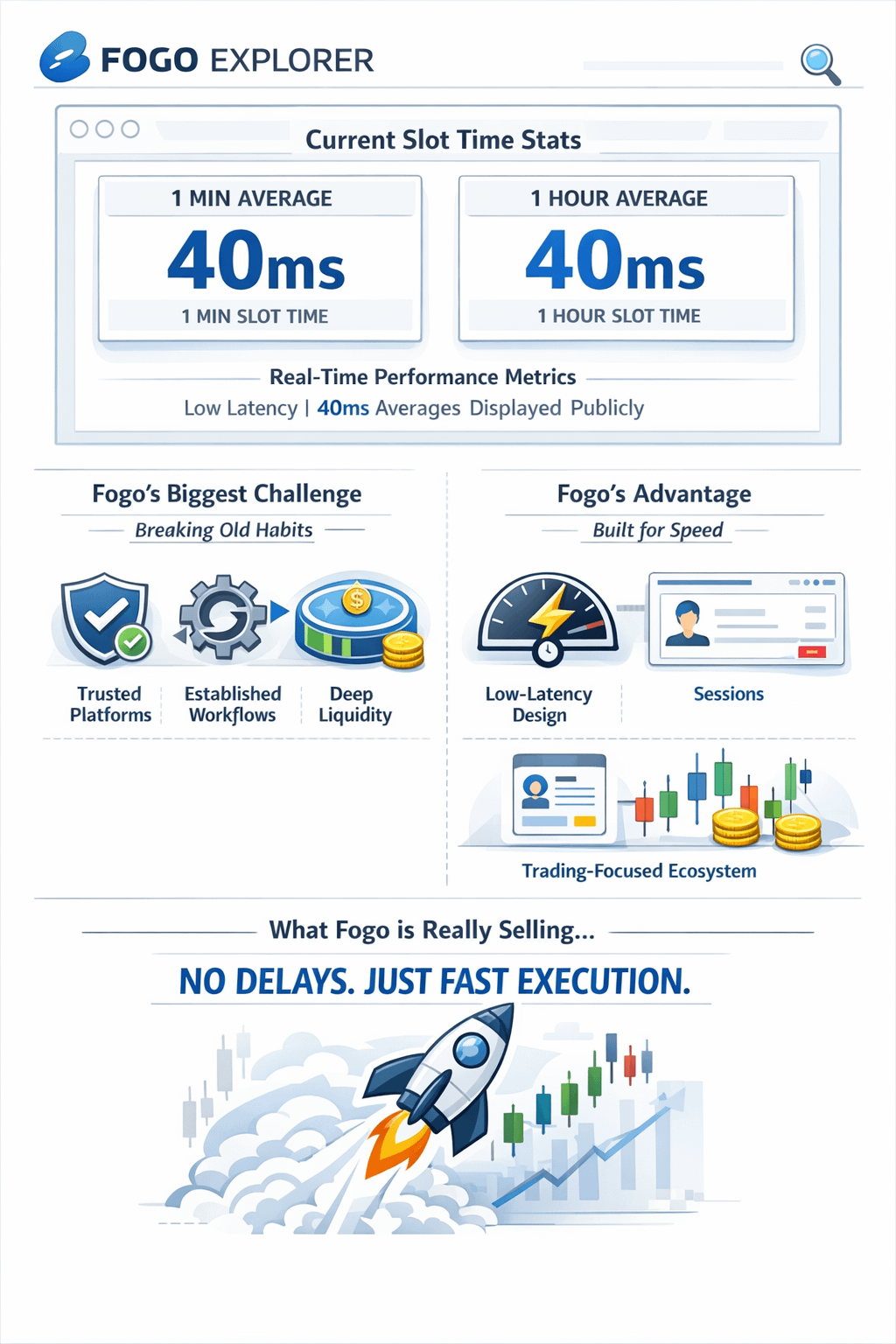
If they get this right, the winning outcome won’t be people praising the chain on social media for being fast. It’ll be something much more boring—and much more valuable. People will just start using apps on Fogo because the trades feel clean, the flow feels uninterrupted, and the chain itself fades into the background.
That’s a very different ambition than most L1 launches. And in a market full of chains trying to be universal, a chain trying to be specifically excellent at execution might be the more realistic bet.