

The crypto industry has always loved spectacle. The loudest metrics dominate the timeline: transactions per second, theoretical throughput, microsecond latency claims. Every new Layer-1 arrives promising to be faster than the last. And yet, when real capital moves under stress, when liquidations cascade and arbitrage engines fire simultaneously, something more important than peak speed determines survival: predictability.
The more I analyze @Fogo Official , the more I see a project that understands this difference. It is not trying to win a marketing contest around TPS. It is trying to solve something quieter and harder operational discipline under pressure. That distinction matters far more for serious trading infrastructure than most narratives admit.
Speed is impressive. Predictability is bankable.
In traditional finance, systems do not earn trust because they are fast on quiet days. They earn trust because they behave consistently during volatility. Exchanges are judged not by their best-case latency but by how they handle stress — when volume spikes, when markets gap, when thousands of participants act at once.
Blockchains, historically, struggle here. Average block times look clean on dashboards, but tail latency — those rare spikes when confirmations stall or propagate unevenly — creates hidden risk. A chain that usually produces 40ms blocks but occasionally jumps to 400ms without warning introduces uncertainty into execution assumptions. For high-frequency trading, that uncertainty is not cosmetic. It alters outcomes.
Fogo’s architecture reads like a direct response to that problem.
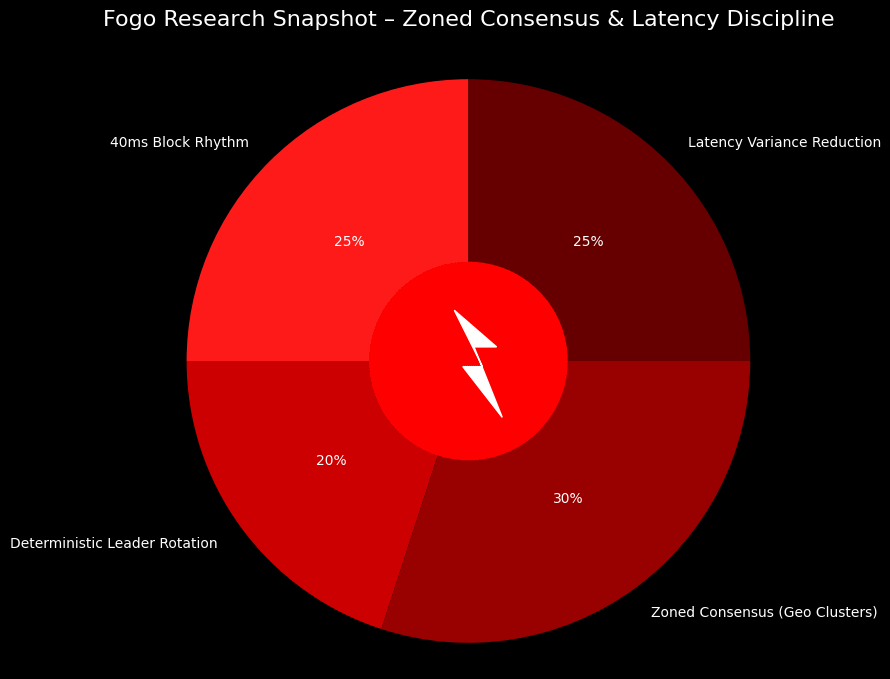
Its 40-millisecond block target is not just a speed metric; it is a rhythm. Leader slots rotate deterministically every 375 blocks — roughly 15 seconds per leader — so validator responsibility shifts in a predictable cadence. That cadence matters. When leadership timing is structured and visible, developers can design around it. Traders can model behavior. Systems can anticipate rotation rather than react to chaos.
This is what operational discipline looks like on-chain.
The zoned consensus model amplifies this philosophy. Instead of pretending geography does not exist, Fogo embraces physics as a design constraint. Validators are grouped into geographically tight clusters — ideally within the same data center or region — and only one zone handles consensus during a given epoch, roughly one hour.
In traditional global validator setups, cross-continental messaging introduces unavoidable propagation delays. A packet bouncing between North America, Europe, and Asia can add 150–200 milliseconds of variance. That may sound small, but in markets, it is the difference between neutral execution and value leakage.
Fogo compresses that uncertainty window by shrinking the active quorum. In testnet measurements, intra-zone latency consistently stayed below 40ms with tight variance. The improvement is not just about lower averages; it is about narrower distribution.
Then comes the rotation.
Every hour, consensus leadership rotates to another zone — APAC, Europe, North America — distributing influence across geography over time rather than freezing it permanently. Critics will debate decentralization trade-offs, and they should. But what Fogo is doing is honest: it prioritizes execution quality within epochs and decentralization across epochs.
That shift reframes the conversation.
Instead of asking, “How many validators exist at once?” the better question becomes, “How does the system behave when money is moving?” Because in real trading environments, predictability under load outweighs snapshot decentralization metrics.
Infrastructure maturity shows up in the layers builders actually use. RPC reliability is often ignored in whitepapers but deeply felt by developers. A chain can have perfect consensus timing and still feel broken if its endpoints lag or drop requests.
Fogo addresses this through dedicated multi-region RPC deployments. During testnet, ecosystem partners operated six high-availability nodes — two in each major region — purely for developer access, not consensus. That separation matters. Consensus nodes secure the network; service nodes secure user experience.
A 2026 industry study estimated that roughly 15–20% of DeFi application failures stemmed from RPC instability rather than smart contract bugs. Fogo appears determined not to repeat that oversight.
Compatibility also plays a strategic role. By adopting the Solana Virtual Machine and aligning with Firedancer-based client infrastructure, Fogo lowers migration friction for developers already building in high-throughput environments. The point is not imitation. It is acceleration. When cognitive barriers shrink, serious builders can experiment faster.
But compatibility alone does not create durability.
Durability emerges from how a system behaves under stress.
Testnet peaks near 46,000 TPS and consistent sub-40ms blocks are impressive, but performance in calm conditions is marketing. Performance under volatility is infrastructure. The real signal will be whether Fogo maintains latency discipline during chaotic market activity — liquidations, arbitrage waves, sudden liquidity surges.
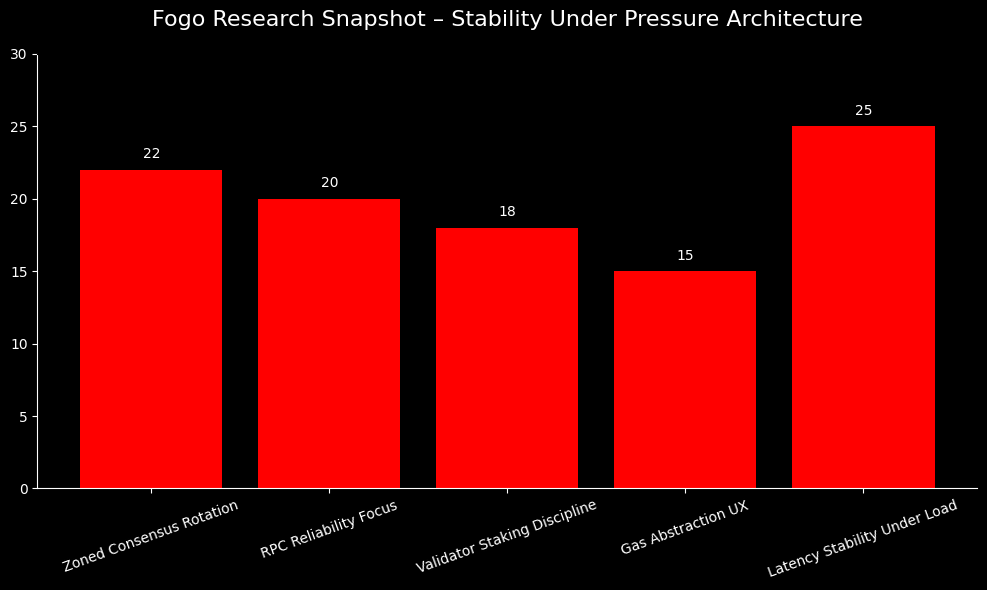
Token mechanics reinforce this discipline. $FOGO functions as gas and staking collateral, with staking participation reaching approximately 65% of circulating supply early post-mainnet — a relatively strong alignment metric compared to many new Layer-1s. Validators in a zoned system cannot afford downtime or performance lapses without facing economic consequences. Discipline is not optional; it is financially enforced.
The gas abstraction model further reflects maturity. Allowing fees to be paid indirectly via SPL tokens, with paymasters handling conversions, reduces friction for end users. Instead of forcing traders to constantly manage native token balances, Fogo pushes operational complexity to infrastructure layers where it can be optimized competitively.
A 2026 Web3 UX analysis suggested that 20–25% of user abandonment in DeFi stems from signature and fee fatigue. Removing that friction does not make headlines, but it improves retention — and retention compounds.
Ultimately, what intrigues me most about Fogo is not what it promises but what it quietly optimizes for.
It does not frame itself as the most decentralized chain in the abstract. It does not rely solely on peak TPS claims. It focuses on timing consistency, validator enforcement, RPC reliability, and infrastructure-level discipline.
These are not glamorous features. They are boring. And in financial systems, boring is strength.
If Fogo sustains predictable block times during volatility, executes zone rotations cleanly without disruption, maintains RPC stability as usage grows, and enforces validator performance standards without governance breakdowns, it may carve out a unique identity: a chain that treats performance as a measurable service level rather than a marketing statistic.
Predictability might be crypto’s most undervalued upgrade.
Markets reward systems that behave the same way on good days and bad days. If Fogo proves it can do that consistently, transparently, and under real load it will not just be another fast chain. It will be remembered as one that understood something deeper: stability under pressure is what turns technology into infrastructure.
What part of @Fogo Official operational approach stands out to you most the zoned consensus rhythm, RPC-first mindset, or disciplined staking enforcement? I’m genuinely curious to hear different perspectives. Let’s discuss below.