

The first time I watched a “fast” chain meet a real market, it wasn’t some dramatic outage that changed my mind. It was the slower, uglier thing: everything kept working, just not when it mattered. A price spike hit, liquidations stacked, bots surged, and what felt instant in calm conditions turned into a moving traffic jam. Orders arrived late. Priority became a tax. People stopped trading the asset and started trading the network.
That’s when you realize on-chain speed isn’t a vibe. It’s physics.
Most networks are effectively global group chats. Everyone is in the same room, all the time, from everywhere, and the chain’s rhythm is forced to respect the slowest communication paths on earth. That openness is a strength, but it also creates an invisible ceiling: consensus can’t safely outrun the worst latency links that still have to hear, verify, vote, and propagate.
Fogo reads like it was built by someone who’s been burned by that ceiling in production and decided to stop pretending it’s just an optimization problem.
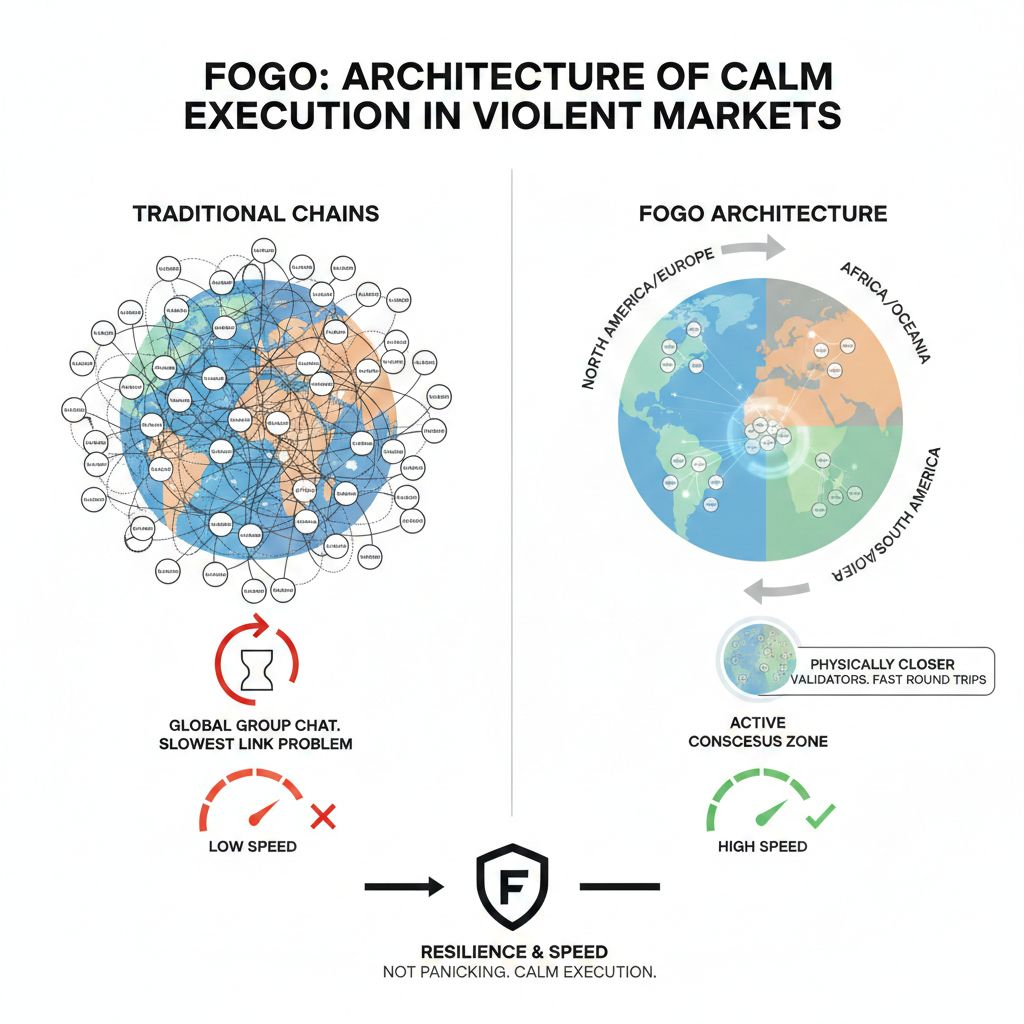
Instead of keeping the entire validator set constantly co-coordinating across the globe, validators are grouped into geographic zones, and only one zone is active for consensus at a time. That active zone rotates across epochs. In plain terms: keep the validators that must coordinate right now physically closer, so round trips are closer to hardware limits than global-internet limits—then rotate the “center” so the chain doesn’t become permanently anchored to one region.
What makes this more than a hand-wavy decentralization story is that the zone system is meant to be explicit and on-chain: zone definitions and validator assignments are stored through program-derived accounts, so it isn’t just social consensus about who belongs where. And the activation logic isn’t a single hard-coded choice either—it supports multiple activation strategies via an on-chain algorithm identifier. One option is epoch-based rotation (zones rotate sequentially by epoch number). Another is a follow-the-sun model, where zones activate based on UTC time windows across the day, letting consensus shift in a time-aware way. There’s also a practical safety rail: zone configurations can enforce a minimum stake threshold, so a low-stake zone can’t become active and quietly weaken the consensus set.
Inside that rotating-locality design, finality still follows recognizable stake-weighted voting mechanics. A block is considered confirmed once more than 66% of stake has voted for it on the majority fork, and it’s considered finalized once it reaches maximum lockout—commonly represented as 31+ confirmed blocks built on top. That detail matters because low-latency block production is only half the battle; the real question is whether confirmation and finality remain coherent when the chain is being hammered.
Then there’s the second constraint most people underestimate until they run into it: implementation variance.
In ecosystems where multiple validator clients and multiple implementations coexist, the network tends to get dragged down to the speed and quirks of the slow tail. You can have the most optimized node in the world, but if the protocol must remain safe and live for slower common setups, you end up with an invisible speed cap. Fogo’s posture is basically: we don’t want that cap. We want one high-performance path, and we’re going to integrate the stack around it.
On the validator side, it implements the Solana Virtual Machine via the open-sourced Firedancer approach, and the mainnet validator is described as a production bridge client nicknamed “Frankendancer”—a hybrid where Firedancer components (notably networking and leader block production) run alongside Agave code, with additional Fogo-specific modifications. The name is almost irrelevant; what matters is the intent: validator performance is treated like protocol surface area, not a nice-to-have.
The internal architecture is built around sandboxed functional units (“tiles”), each pinned to a dedicated CPU core instead of fighting through context switching. Data moves through the pipeline using a zero-copy design: transactions and blocks remain in fixed memory locations, and tiles pass lightweight pointers instead of constantly copying and re-serializing data. That’s the kind of engineering that sounds obsessive until you’ve felt how small overheads become massive under real load.
And when the market is serious, congestion behavior is everything. Fogo’s fee model follows the shape traders already understand: a base fee and an optional prioritization fee (a tip) to increase inclusion probability during congestion. Half of the base fee is burned, half goes to the processing validator, and 100% of the priority fees go to the block producer. Rent exists for state storage as well, with rent distributed and burned via a split model, and rent-exempt accounts avoiding ongoing charges once they maintain the minimum balance. Validator ordering can default to priority-fee value when assembling blocks, which is an unromantic admission of reality: in urgent moments, users will pay for urgency and validators will optimize revenue inside the rules. If you want a chain that survives volatility, you can’t pretend fee markets don’t exist—you have to design them so they behave predictably when everything is stressed.
On token incentives, the materials describe two closely related views of the same long-term intent: converge to a lower steady-state inflation while keeping security incentives aligned. One description presents mainnet as operating with a fixed annual inflation rate of 2%, distributed to validators and delegated stakers. Another outlines a schedule that starts at 6% annual inflation and decreases linearly to 2% after two years via year-on-year decrements. Either way, the shape is clear: bootstrap incentives early, then settle into a lower dilution floor.
The part I keep coming back to, though, is that Fogo doesn’t treat UX as an afterthought bolted onto a fast chain. It tries to remove the specific frictions that kill real usage when people are actually doing things at speed.
Fogo Sessions is described as an open-source standard designed to deliver a Web2-like experience by tackling three pain points at once: wallet compatibility, transaction costs, and signature fatigue. The mechanism is clean: a user creates a time-limited, scoped session with a single signature, granting permissions—authorized programs, spending limits, expiration—to a temporary session key. That key is stored in the browser and marked non-exportable under normal browser operation, so the session can act without constantly pulling the user back into signing popups for every action.
The flow is explicit: session creation via a signed intent message; on-chain registration through a session manager program that validates and stores the authorization parameters; and session usage where transactions are executed with the temporary key and validated against the constraints. There’s also optional fee sponsorship baked into the model—apps or third parties can sponsor transaction fees with configurable constraints to prevent abuse. That opens the door for developers to choose how users “pay” (native token, stablecoins, or another token) without forcing every interaction to feel like a toll booth. Under the hood, the token program is based on SPL Token and modified to accommodate Sessions while preserving backward compatibility, layering session authorization onto familiar delegation mechanisms. And for builders, the integration story is concrete: a React SDK package is part of the intended path, with a provider component to manage sessions, plus an example paymaster URL and sponsor public key used in the current integration flow.
From the developer side, the compatibility story aims to feel familiar: because it’s SVM-aligned, much of the workflow looks like pointing existing Solana-shaped tooling at the right RPC endpoints rather than changing the entire mental model. Mainnet connectivity is specified in practical terms—public RPC URL, entrypoints, genesis hash, shred version—with the same general shape for testnet. And testnet is described with very specific timing targets: 40-millisecond blocks, a leader term of 375 blocks (about 15 seconds), and epochs of 90,000 blocks (about one hour), with consensus moving to a different zone each epoch. On the public explorer, slot timing is shown around ~40ms as currently displayed, which is the kind of number that only matters if it keeps meaning something when the chain isn’t being admired but being used.
The zone rotation also isn’t framed as decoration. The rationale is operational: rotating across zones supports jurisdictional decentralization (less exposure to a single authority), infrastructure resilience (surviving regional outages), and strategic optimization (positioning consensus closer to where price-sensitive information is flowing). That last one is quietly honest. Markets are information games, and latency is part of fairness whether anyone wants to say it out loud.
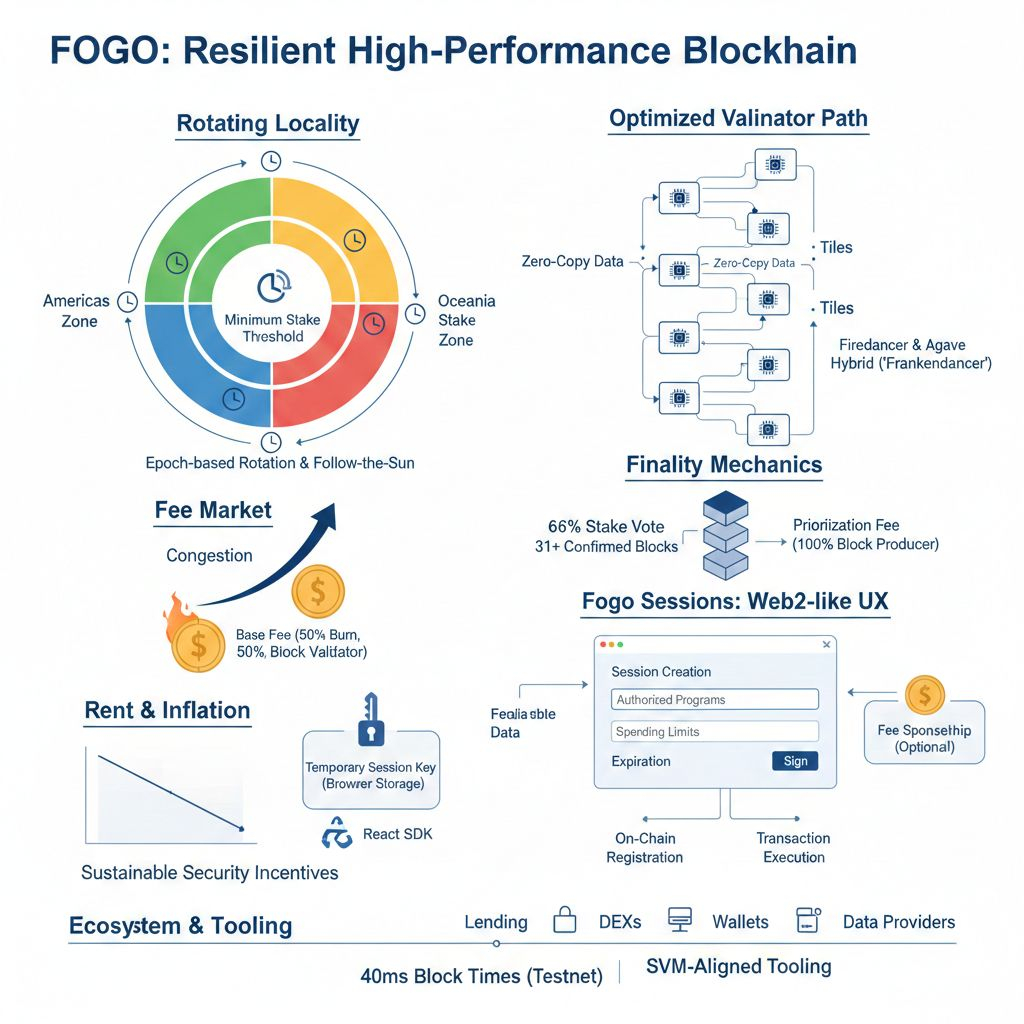
Even the ecosystem signals the intended direction of travel. You see the expected primitives for a chain that thinks people will actually trade and build DeFi on it: lending markets, RPC infrastructure positioned for load, indexing and data providers, wallets, and trading venues that talk openly about spreads and execution quality through hybrid approaches. That’s not the menu you write first if you expect occasional settlement. That’s the menu you write first if you expect people to live inside the order flow.
If I had to boil it down without turning it into slogans, it’s this: Fogo seems less interested in “being fast” and more interested in choosing which latencies it will inherit—and which it will design away. Localize consensus, rotate locality. Reduce the slow tail by committing to a single high-performance validator path. Make congestion behavior explicit and market-real. Remove signature fatigue so speed isn’t wasted on UX friction.
Because when markets are quiet, almost everything looks good enough. It’s when the room gets loud—when volatility spikes, liquidations cascade, and urgency becomes a real cost—that you find out what a chain is actually made of.
And that’s the feeling I’m left with here: this doesn’t read like speed built for screenshots. It reads like speed built for the moment you can’t afford confusion—when you still need the truth to land on time, even while everyone was pushing on the system at once.