
I didn’t notice the pressure when the transaction was created.
I noticed it when nothing else happened.
The state was valid. The record existed. The sequence had completed cleanly enough that, in most systems, attention would drift elsewhere. That’s usually when responsibility thins out, once execution finishes, the system assumes memory is optional.
That assumption doesn’t last long inside Dusk Foundation.
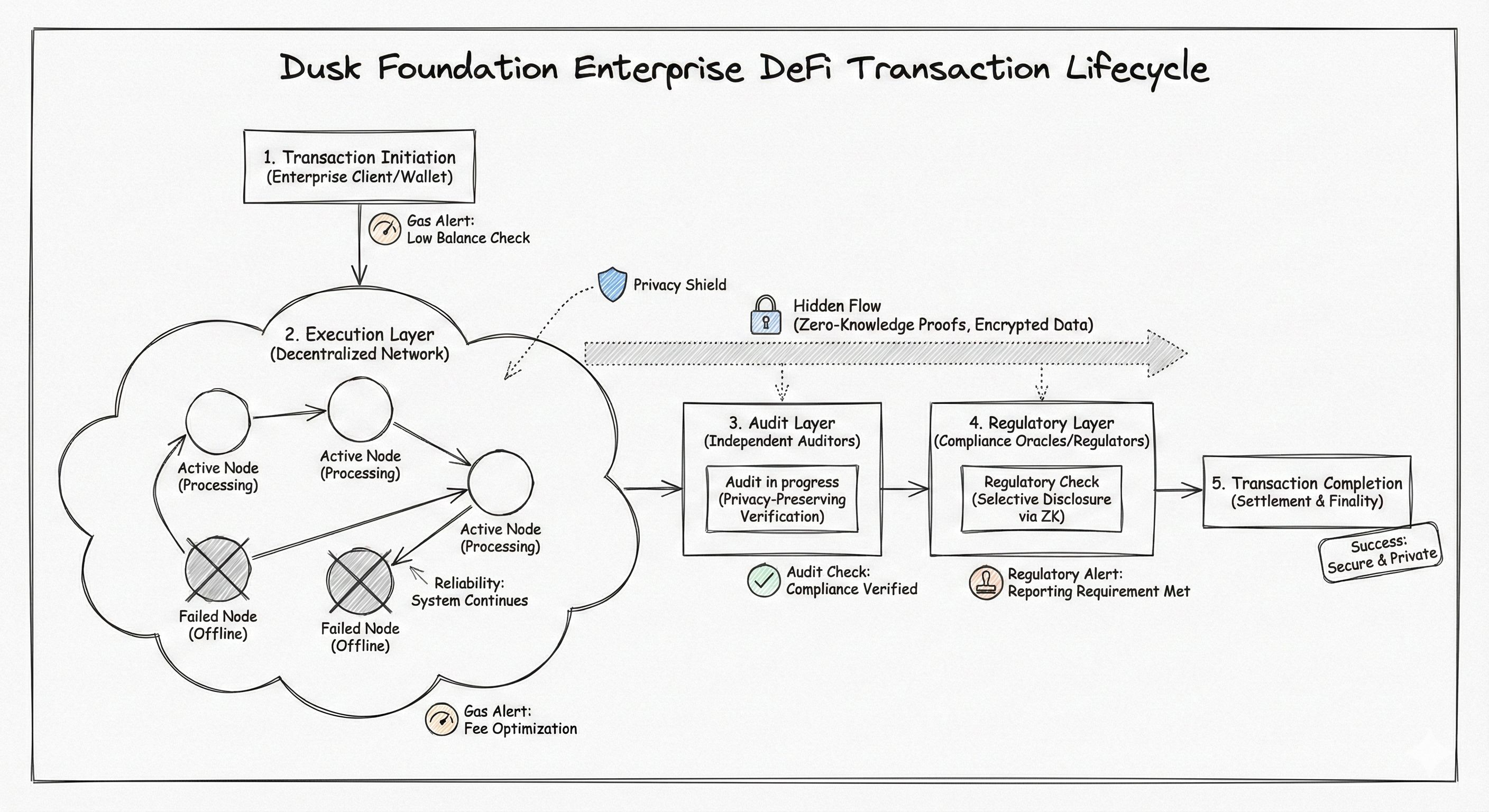
What struck me wasn’t a delay or a rejection. It was how the ledger behaved after finality. The transaction didn’t disappear into history. It stayed present, not visibly, not noisily, just present enough to feel like it could still be asked about later.
Nothing failed.
Nothing retried.
Nothing demanded intervention.
But the system didn’t let go.
I was watching activity move through a privacy-preserving execution path that looked calm on the surface. Identities remained shielded. Sensitive details never surfaced. At the same time, the transaction carried a posture I hadn’t felt elsewhere, as if it knew that disclosure wasn’t a present-tense concern, but an eventual obligation.
On Dusk, settlement doesn’t mean closure. It means readiness.
The ledger doesn’t explain this. It doesn’t label it. It simply behaves as if auditability by design is not something you switch on later. Selective disclosure holds in the moment, but disclosure scope is already defined for the future, even if no one is asking yet.
That changes how you watch the system.
I noticed teams slowing down without being blocked. Not because access was denied, but because responsibility was explicit. Compliance rectification wasn’t hypothetical. Committee attestation wasn’t active but it was assumed. Every step felt aware that if something needed to be reconstructed later, the chain would not improvise on anyone’s behalf.
That awareness creates a different kind of friction.
Not the friction of throughput.
The friction of memory.
Under normal load, this stays subtle. Transactions flow. Privacy remains intact. Validators do their work without surfacing themselves. But the tension shows up in coordination, in the way workflows hesitate before advancing, even when nothing technical stands in the way.
I caught it during a handoff between two regulated participants. The transfer completed. Balances reflected reality. And still, no one rushed. The question wasn’t “did it work?” It was “who owns this explanation if it’s questioned later?”
That’s when Dusk’s posture becomes unmistakable.
Privacy here isn’t about disappearance. It’s about containment. Confidentiality with oversight. Visibility that doesn’t vanish, it waits. When disclosure becomes mandatory, the system doesn’t scramble to remember what happened. It already knows how it must be shown, and to whom.
This isn’t free to maintain.
As activity scales, the cost shows up in time. Not delays you can point to, but pauses you can feel. The ledger doesn’t rush to make things feel easy. It tolerates uneven pressure, tracks obligations quietly, and lets coordination absorb the weight.
There’s no theater around this.
No dashboards celebrating compliance.
No assurances that everything is fine.
Just behavior that refuses to trade future explainability for present comfort.
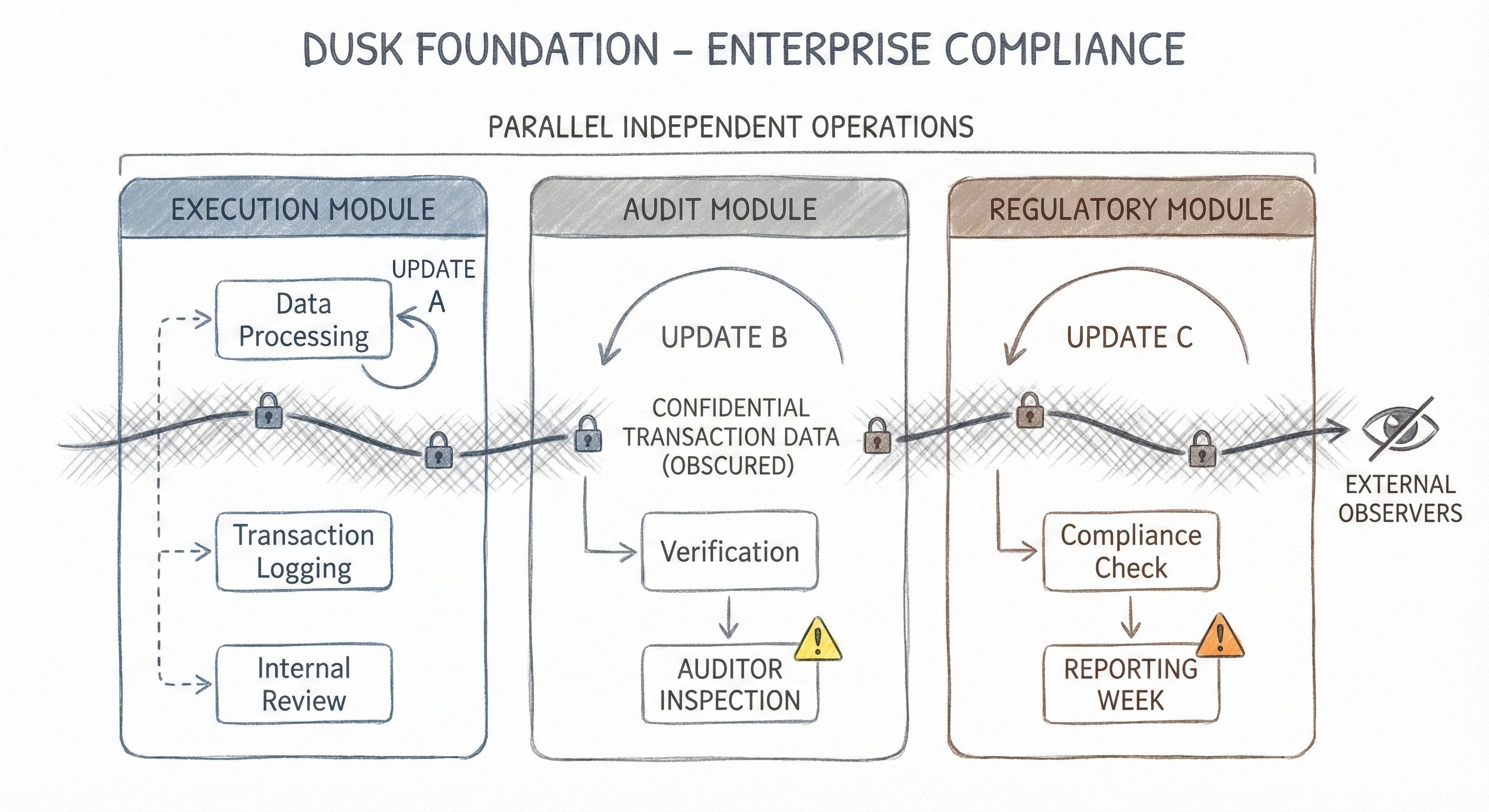
That’s why Dusk doesn’t feel like infrastructure built to impress. It feels like infrastructure built to survive institutional scrutiny. The kind that arrives late, asks precise questions, and doesn’t accept “we’ll figure it out” as an answer.
Most systems optimize for forgetting.
Dusk doesn’t.
It assumes the ledger will be asked to remember and prepares accordingly.
Nothing dramatic happens when a block finalizes. No signal that responsibility has shifted away. Just a quiet insistence that privacy, regulation, and accountability are not phases of a workflow.
They are the conditions it lives under.
And the ledger keeps moving, patiently recording what can remain unseen and what will eventually have to be shown.
