
Privacy in finance didn’t click for me through theory. It clicked through discomfort.
I was in a bank, waiting, watching a conversation that should’ve been private slowly become public. A rejected loan. A raised voice. Account details said just loud enough to travel. No one meant harm, but the damage was already done. That’s when it hit me: financial exposure isn’t dramatic—it’s quiet, embarrassing, and deeply human.
That’s the emotional gap Dusk seems built to close.
Launched in 2018, Dusk never behaved like a typical blockchain project. It didn’t chase attention or promise instant disruption. Instead, it chose a narrower, more difficult path: regulated finance. The part of the system where mistakes are expensive, transparency has limits, and privacy isn’t philosophical—it’s contractual.
Most blockchains are radical by default. Everything visible. Everyone watching. That openness has its place, but it collapses the moment real institutions enter the room. Banks, asset managers, and issuers can’t operate in a world where every move becomes public record. Dusk acknowledges that reality without apology.
Its core idea is simple but powerful: you can prove correctness without revealing content.
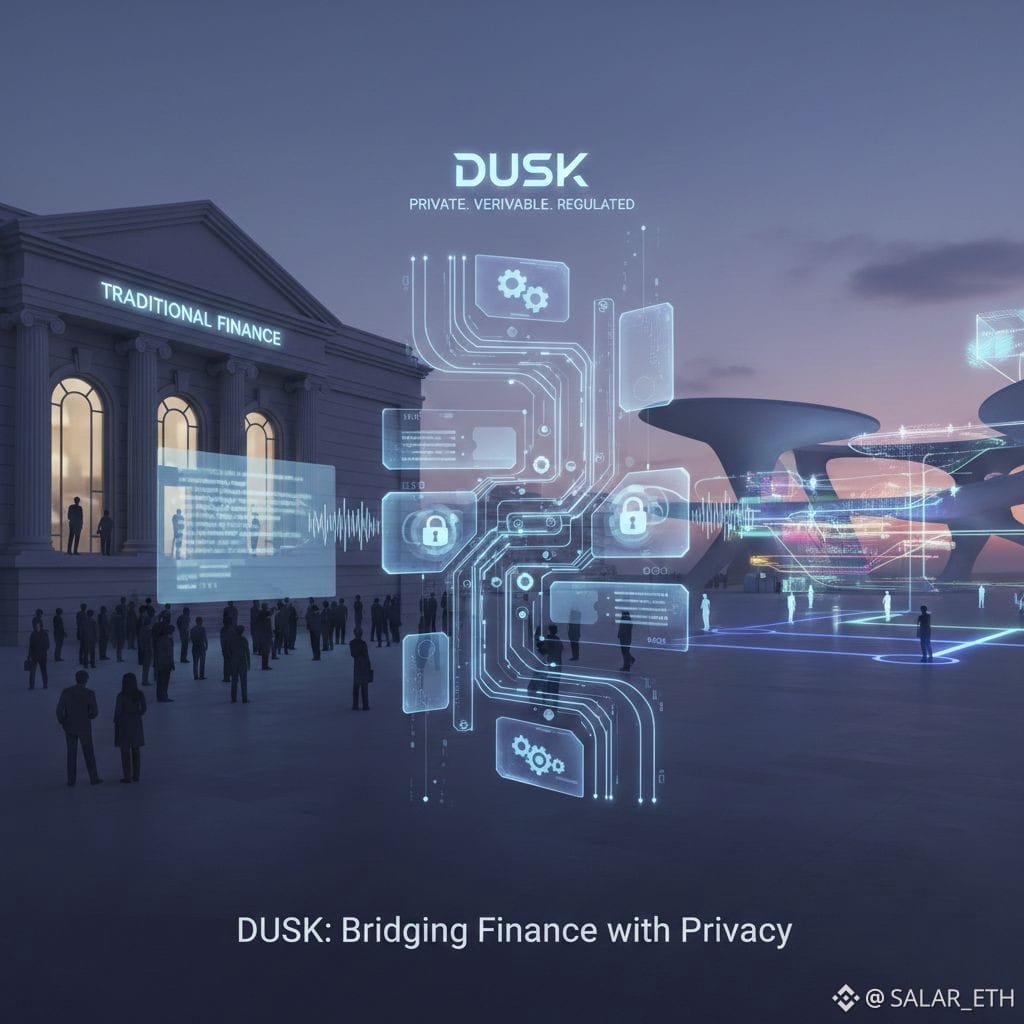
By leveraging zero-knowledge proofs, Dusk allows transactions and smart contracts to remain confidential while still being verifiable. The system can confirm compliance, legitimacy, and authorization—without turning sensitive financial activity into public theater. You don’t hide the truth. You just don’t overshare it.
What sets Dusk apart is how intentionally it embraces regulation. Compliance isn’t treated as a necessary evil or something to be cleverly bypassed. It’s treated as part of the blueprint. Identity, auditability, and permissioned access are integrated from the start, not bolted on when institutions start asking uncomfortable questions.
That matters more than people realize.
Anyone who has tried to tokenize real-world assets knows the friction isn’t technical—it’s procedural. Who can see ownership? Who can trade? Who can audit? One wrong answer and the whole structure collapses under legal scrutiny. Dusk is clearly designed for that reality. It’s a blockchain where tokenized bonds, equities, and real assets can exist without violating confidentiality or trust.
Its modular design reinforces that pragmatism. Instead of enforcing a single rigid framework, Dusk lets applications compose the pieces they need—privacy layers, identity systems, settlement logic—based on real operational requirements. That flexibility mirrors how financial institutions already work, which lowers the psychological and technical barrier to adoption.
There’s a maturity in that approach.
Dusk doesn’t market itself like a rebellion. It positions itself like infrastructure. Something meant to be relied on, not hyped. It’s built for environments where buzzwords don’t survive due diligence and where silence often signals competence.
And yet, the ambition is unmistakable.
Dusk isn’t anti-DeFi or anti-tradition. It’s trying to connect both worlds without forcing either to compromise their core values. A system where privacy and transparency coexist. Where decentralization doesn’t mean disorder. Where institutions can participate without losing control or credibility.
In a space obsessed with volume—louder launches, faster promises, bigger narratives—Dusk chooses restraint.
Some technologies demand attention. Others earn trust over time.
Dusk feels like it’s aiming for the second category.
Not the loudest voice in the room.
Just the one that still makes sense when the noise fades.