
@Plasma Stablecoins have become one of the most impactful innovations in the digital asset space, evolving into the dominant medium for on chain payments, DeFi activity, remittances, and dollar denominated value transfer. Yet their rapid adoption has exposed a critical weakness in existing blockchain infrastructure. Today, stablecoin settlement is scattered across numerous Layer 1 and Layer 2 networks, each offering different trade offs in security, finality, cost, and usability. This fragmentation introduces inefficiencies, volatile fees, and unnecessary complexity for developers and users alike. Plasma emerges in response to this gap, positioning itself as a standalone Layer 1 blockchain designed specifically to optimize stablecoin settlement from first principles.

#Plasma Inefficient settlement is more than a technical inconvenience it directly limits stablecoins’ ability to function as global financial rails. To compete with traditional payment systems, blockchain transactions must be fast, inexpensive, and predictable. On general purpose networks, fee spikes can make transferring small stablecoin amounts economically irrational, undermining everyday payment use cases. In addition, treating stablecoins as generic tokens rather than core settlement assets results in poor UX and awkward integrations for commerce and institutional finance. Plasma is built around the assumption that stablecoins are no longer a peripheral use case, but the primary unit of value on-chain.
At the architectural level, Plasma operates as an independent blockchain that prioritizes stablecoin activity through both protocol design and economic structure. The network combines full Ethereum Virtual Machine compatibility implemented via the Reth execution client with a custom consensus system known as PlasmaBFT. This pairing is intentional. EVM compatibility allows developers to seamlessly deploy existing Ethereum based applications and tooling without reengineering their codebase. PlasmaBFT, a Byzantine Fault Tolerant consensus variant, enables transaction finality in under a second, making the network suitable for real time payments and instant settlement scenarios where latency is unacceptable.
Several protocol level features are explicitly tailored to stablecoin usage. One of the most prominent is gasless stablecoin transfers. Under this model, the network can subsidize transaction fees for approved stablecoins such as USDT, allowing users to send funds without holding a separate gas token. This removes a major friction point in onboarding and mirrors the simplicity users expect from traditional payment systems. In parallel, Plasma supports paying transaction fees directly in stablecoins. Rather than forcing users to manage volatile native assets, fee payments can be denominated in the same stable asset being transferred, creating a more intuitive and predictable economic experience.

#PlasmaXPL also incorporates a Bitcoin anchored security model to enhance neutrality and resistance to censorship. While implementation details may evolve, the core concept involves periodically anchoring Plasma’s state or consensus proofs to the Bitcoin blockchain. By leveraging Bitcoin’s unmatched security and decentralization, Plasma gains an immutable historical record that makes large scale reorganization or censorship attacks significantly more costly. This design choice is particularly relevant for institutional users who require strong guarantees around settlement integrity and auditability.
From an application standpoint, Plasma is designed to serve both retail and institutional demand. In regions where stablecoins are already widely used, sub second finality, negligible fees, and gas abstraction enable practical microtransactions and everyday payments that are currently impractical on congested networks. For financial institutions and payment providers, Plasma offers predictable costs, immediate settlement, and strong security assurances key requirements for treasury operations, payment rails, and automated liquidity systems where timing and certainty are critical. Developers building stablecoin centric DeFi protocols also benefit from an environment where the primary asset is natively optimized, reducing complexity and improving end user experience.
For builders, Plasma’s value lies in its focus and familiarity. Developing on Plasma means operating within an ecosystem where stable value is treated as the core primitive. Full EVM compatibility allows teams to continue using Solidity and established tooling such as Hardhat, lowering migration costs. At the same time, stablecoin denominated fees and gas abstraction enable application designs that shield users from blockchain specific friction, making products feel closer to traditional financial apps.
Security and reliability are addressed through a layered approach. PlasmaBFT delivers immediate, deterministic finality once a transaction is confirmed, it cannot be reversed. This eliminates the uncertainty associated with probabilistic finality models. Bitcoin anchoring acts as a long term security backstop, preserving the canonical transaction history even under extreme adversarial conditions targeting the validator set. Together, these layers are designed to support high value settlement with strong safety guarantees.
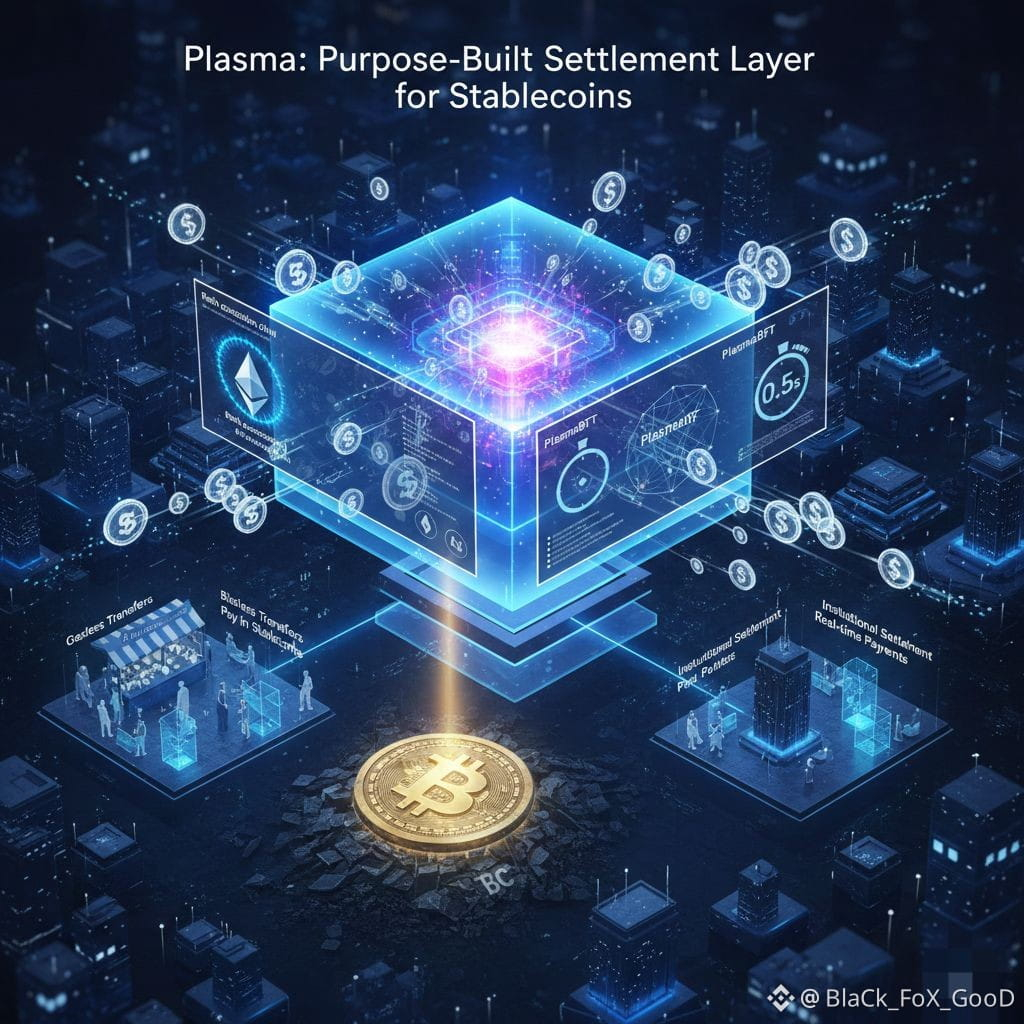
Rather than attempting to scale indiscriminately, Plasma optimizes for a single vertical: stablecoin settlement. This specialization enables high throughput and low latency without the overhead of supporting unrelated workloads. At the same time, EVM compatibility ensures Plasma remains interoperable with the broader Ethereum-aligned ecosystem, allowing stablecoins and liquidity to move freely via bridges and cross-chain messaging protocols.
Performance and cost advantages follow directly from these design decisions. Near instant finality unlocks real-time applications that are infeasible on slower networks. Gasless transfers and stablecoin based fees reduce both monetary and cognitive overhead for users. By tailoring its fee market and block space to stablecoin heavy transaction patterns, Plasma can maintain lower and more predictable costs than general purpose chains during periods of congestion.
Plasma’s long term success depends on establishing itself as the default settlement layer for stablecoins. This requires achieving sufficient validator diversity and decentralization to uphold neutrality, while also cultivating deep liquidity and developer adoption beyond basic transfers. While competing networks may introduce similar features, Plasma’s vertically integrated design offers a cohesive environment purpose built for stable value. Ultimately, its impact will not be measured by speculative metrics, but by its reliability in quietly moving stable value at scale forming an essential, if largely invisible, layer of the emerging digital financial system.


