
Introduction: Price Volatility Versus Structural Progress
In crypto markets, short-term price action often dominates attention. Red candles trigger emotional reactions, while green candles revive confidence just as quickly. Yet the projects that ultimately endure are rarely the ones optimized for short-term price performance. They are the ones built to survive regulatory scrutiny, institutional expectations, and real-world operational demands.
@Dusk currently sits at this exact intersection.
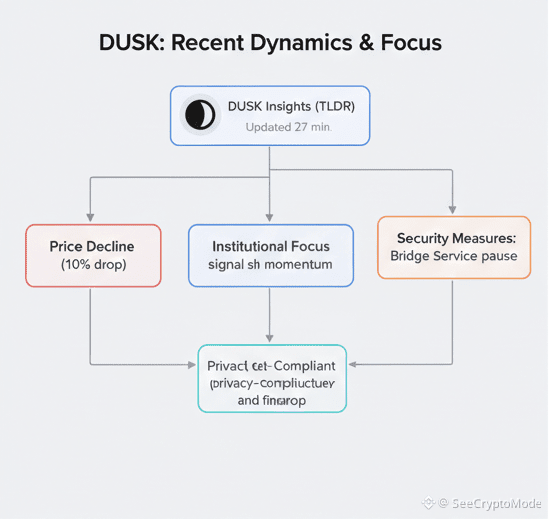
A notable price decline of over ten percent in a short time window has pushed DUSK into the spotlight. Technical indicators signal strong bearish momentum. At the same time, the project continues to focus on building privacy-compliant infrastructure for real-world assets and regulated finance. Adding to this complexity, a recent bridge service pause has highlighted the team’s approach to security and operational hardening.
Taken together, these three elements tell a much deeper story than price alone ever could.
This article explores $DUSK

through three core dimensions. Price decline and bearish technical structure. Institutional focus on privacy-compliant infrastructure. And the role of security measures as a signal of long-term seriousness. More importantly, it examines what #dusk represents in a market that is gradually shifting from speculative experimentation toward regulated, compliant, and institution-ready systems.
Understanding DUSK’s Core Mission
Before diving into the three key factors, it is essential to understand what DUSK is actually trying to build.
DUSK is not positioning itself as a general-purpose chain chasing mass retail adoption. Its focus is much narrower and more demanding. The project is designed as a privacy-preserving and compliant Layer One blockchain tailored for real-world assets and regulated financial activity.
This combination is not accidental.
Institutions require privacy, but they also require compliance. They need confidentiality of transaction data without violating regulatory frameworks. They need selective disclosure rather than full transparency. They need systems that regulators can understand and approve.
DUSK is attempting to operate in this constrained but potentially massive design space.
This context changes how its current market behavior should be interpreted.
Price Decline: What Bearish Technical Signals Actually Reflect
The first and most visible signal from the recent DUSK insights is price decline. Technical indicators show strong bearish momentum following a significant price drop. For many market participants, this alone becomes the entire narrative.
But technical signals are reflections of behavior, not explanations of intent.
Bearish momentum indicates that sellers currently dominate buyers. It suggests risk aversion, uncertainty, or short-term profit-taking. It does not inherently indicate failure of the underlying project.
In fact, for infrastructure focused projects like DUSK, bearish technical phases often coincide with periods of intense development and low narrative visibility.
The market is highly reactive to news, listings, incentives, and hype. Infrastructure development is slower, quieter, and often invisible until it reaches a deployment milestone.
When price declines during such phases, it often reflects impatience rather than deterioration.
Why Infrastructure Tokens Experience Disproportionate Volatility
Infrastructure tokens tend to experience sharper volatility than application tokens. The reason is simple. Their value proposition is indirect.
They do not always have immediate user metrics to point to. Their success depends on adoption by other builders, institutions, and regulated entities. These adoption cycles are measured in quarters and years, not days.
As a result, price often oscillates based on expectations rather than usage.
In DUSK’s case, the bearish technical structure likely reflects broader market conditions combined with the absence of short term catalysts. This does not remove risk. It simply reframes it.
Institutional Focus: Building for Regulated Finance
The second major theme in the DUSK insights is institutional focus. While price declined, the project continues to build privacy compliant infrastructure for real world assets and finance.
This focus is not cosmetic. It shapes every architectural decision.
Institutional finance operates under constraints that most crypto native systems have historically ignored. Compliance requirements, reporting standards, jurisdictional rules, and data privacy laws all impose limits on what is acceptable.
DUSK’s approach acknowledges these constraints rather than resisting them.
By designing a Layer one blockchain that supports privacy preserving transactions while remaining compliant, DUSK positions itself as a bridge between traditional finance and decentralized systems.
This is a difficult balance to strike. Too much transparency undermines confidentiality. Too much privacy raises regulatory red flags.
The fact that DUSK continues to pursue this balance during periods of price weakness suggests long term commitment rather than short term opportunism.
Real World Assets and the Next Phase of Blockchain Adoption
Real world assets represent one of the most discussed but least realized opportunities in crypto.
Tokenizing assets such as equities, bonds, funds, and real estate requires more than smart contracts. It requires legal recognition, regulatory compliance, and privacy protections.
Public blockchains optimized for open experimentation are often poorly suited for this task.
DUSK’s focus on RWA infrastructure places it within a niche that is likely to grow as institutions explore blockchain based settlement and issuance.
This growth will not be explosive or viral. It will be gradual, regulated, and highly selective.
Projects that survive this phase are those built with patience.
Why Institutional Focus Can Suppress Short Term Price Action
There is an uncomfortable truth in crypto markets. Building for institutions often suppresses short term excitement.
Institutional products move slowly. They require audits, approvals, and conservative design. They do not generate daily headlines or social media hype.
As a result, tokens associated with institutional infrastructure often underperform during speculative cycles.
@Dusk ’s current price weakness can be partially understood through this lens. The project is not optimizing for rapid retail engagement. It is optimizing for long term credibility.
Markets do not always reward this immediately.
Security Measures: The Bridge Pause as a Signal
The third key insight from the recent update is the bridge service pause. At first glance, pauses are often interpreted negatively. They raise questions. They trigger fear. They invite speculation.
However, in infrastructure projects, how a team responds to risk is often more important than the absence of risk.
Bridges are among the most vulnerable components in crypto systems. They connect different environments, handle large amounts of value, and have historically been major attack vectors.
A proactive pause in bridge services suggests a willingness to prioritize security over convenience.
This decision reflects an operational mindset aligned with institutional expectations. In regulated finance, systems are paused, reviewed, and hardened when risks are identified. Convenience is secondary to safety.
Operational Hardening as a Long Term Value Signal
Operational hardening does not generate excitement. It generates resilience.
Every pause, audit, and review strengthens the system quietly. Over time, these decisions compound into trust.
For institutions considering blockchain infrastructure, trust is the primary currency.
$DUSK ’s approach to security signals that it understands this reality. It is building a system that can withstand scrutiny, not just market cycles.
The Tradeoff Between Speed and Safety
Crypto culture often glorifies speed. Ship fast. Iterate publicly. Fix later.
Institutional finance operates under a different philosophy. Measure twice. Deploy once. Minimize failure.
DUSK is clearly leaning toward the second approach.
This tradeoff can frustrate speculative participants. It can also attract serious builders and capital over time.
Understanding this tradeoff helps contextualize current sentiment.
Price Declines as Filters, Not Verdicts
Periods of price decline often act as filters. They remove participants with short time horizons. They concentrate ownership among those aligned with long term outcomes.
This process is uncomfortable but common.
For #dusk , the current phase may represent such a filter. Those expecting rapid appreciation may exit. Those evaluating infrastructure fundamentals may continue to observe or accumulate quietly.
Neither behavior is inherently right or wrong. They reflect different strategies.
Privacy Compliant Infrastructure as a Differentiator
Privacy is often misunderstood in crypto. It is frequently framed as opposition to regulation. In reality, privacy and compliance are not mutually exclusive.
Institutions require privacy to protect sensitive information. Regulators require transparency to ensure oversight.
Systems that enable selective disclosure satisfy both.
DUSK’s architecture aims to support this nuance.
This differentiator becomes more valuable as regulatory clarity increases. As rules solidify, projects built with compliance in mind face fewer structural changes.
The Long Road to Institutional Adoption
Institutional adoption does not happen through announcements. It happens through pilots, proofs of concept, limited deployments, and gradual scaling.
Most of this process occurs outside public view.
This invisibility often leads markets to underestimate progress.
DUSK’s continued focus on infrastructure rather than narrative suggests an understanding of this dynamic.
Risk Assessment Remains Essential
A balanced perspective must acknowledge ongoing risk.
Bearish technicals can persist. Infrastructure adoption can be slower than expected. Competitive platforms may emerge. Regulatory landscapes can shift.
Security pauses, while prudent, also highlight system complexity.
None of these risks are trivial.
What matters is whether the project’s direction aligns with a credible long term use case.
DUSK’s Position in a Maturing Crypto Landscape
The broader crypto ecosystem is slowly transitioning from experimentation to integration.
This transition favors projects that can operate within existing financial systems rather than outside them.
DUSK’s emphasis on privacy compliant Layer one infrastructure places it firmly within this transition.
It may not lead short term rallies. It may not dominate social discourse.
It does position the project for relevance in a future where blockchain is less about speculation and more about settlement, issuance, and compliance.
Final Thoughts: Interpreting the Current Phase Correctly
DUSK’s recent price decline, bearish technical signals, institutional focus, and security measures form a coherent narrative when viewed together.
This is not a project retreating. It is a project building through a period of reduced attention.
Markets often struggle to price this phase accurately.
For participants willing to look beyond immediate charts, DUSK offers a clear example of the tension between short term market behavior and long term infrastructure development.
Whether the project ultimately succeeds will depend on execution, adoption, and regulatory alignment.
What is already clear is that its current trajectory cannot be judged by price movement alone.
In a market increasingly shaped by institutions and regulation, systems designed for that future may appear quiet today.
History suggests that quiet builders often matter most when the noise fades.