Plasma is built around one simple observation: stablecoins already behave like “real money” for millions of people, but the blockchains that move them often still feel like “crypto rails.” You can have USDT in your wallet, yet your payment fails because you don’t have the right gas token. You can wait for confirmations that feel slow compared to a card swipe. You can deal with fee spikes that make small payments pointless. Plasma is a Layer 1 that tries to remove those frictions by designing the chain around stablecoin settlement from the start, not as an add-on. �
Binance +1
What Plasma is, in plain English, is an EVM-compatible Layer 1 optimized for stablecoin payments, especially USDT. “EVM-compatible” means developers can deploy Ethereum-style smart contracts with normal tooling, and Plasma’s execution layer is based on Reth (the Rust Ethereum client). “Optimized for payments” means the chain is built to finalize quickly, to handle high throughput, and to make stablecoin transfers feel simple for real users. Binance Research summarizes the design as Reth for execution, PlasmaBFT for sub-second finality, stablecoin-first gas (fees in USDT/BTC via an automated mechanism), and gasless USDT transfers. �
Binance
Why this matters is not academic; it’s operational. Stablecoins are used in high-adoption markets for saving in dollars, cross-border transfers, informal payroll, merchant payments, and exchange settlement. In those contexts, “UX friction” is not a minor inconvenience. It is the difference between a payment rail people trust and one they stop using. Plasma’s entire pitch is that if stablecoins are the product-market fit, the base layer should be designed so stablecoin usage does not require extra steps like “buy the gas token first” or “wait long enough that the merchant worries about reversals.” �
Binance +1
Plasma also aims at institutions, and institutions care about a different kind of “boring.” They want predictable finality, predictable fees, high uptime, and a security story they can explain to risk teams. Plasma leans into that by pairing a fast BFT consensus (PlasmaBFT) with a Bitcoin-anchoring / Bitcoin-bridge roadmap that is meant to strengthen neutrality and censorship resistance over time. Binance Academy and Binance Research both highlight Plasma’s payment focus plus the Bitcoin bridge angle as core parts of the system. �
Binance +1
Under the hood, Plasma is easiest to understand as three parts working together: execution, consensus, and “stablecoin-native” payment features.
On execution, Plasma runs an EVM environment using Reth. That matters because it lets Plasma inherit a massive developer ecosystem: Solidity contracts, Ethereum tooling, and the habits developers already have. You do not need a new programming model to build on Plasma, which is important because payment and DeFi ecosystems do not bootstrap from technology alone; they bootstrap from developers actually shipping products. Binance Academy explicitly describes the execution layer running on Reth while consensus provides sequencing and finality. �
Binance
On consensus, Plasma uses PlasmaBFT, which Plasma describes as a pipelined implementation of Fast HotStuff in Rust. HotStuff-style BFT consensus is built for quick finality with a leader-based structure, validators voting, quorum certificates, and safe leader changes. Plasma’s docs explain that PlasmaBFT keeps classic BFT safety while optimizing for lower latency and faster commits, which is exactly what you want if the chain’s “main job” is settlement. �
Plasma
Now the part that makes Plasma feel different to users is the stablecoin-native layer. Plasma is trying to make the most common action—sending stablecoins—work even for people who only hold stablecoins. One flagship feature is gasless USDT transfers via a relayer/paymaster design. Plasma’s documentation explains that the system sponsors only direct USDT transfers (scoped tightly on purpose), the paymaster is funded by the Plasma Foundation, gas is covered at the moment the transfer is sponsored, users do not need to hold XPL, and there are verification and rate-limit controls meant to reduce abuse. It also requires EIP-712 authorization signatures (EIP-3009 style authorization for USDT0 transfers) so the user can approve a transfer without submitting a normal gas-paying transaction themselves. �
Plasma +1
This “gasless” approach is not a magic free lunch. It is a design choice: Plasma is willing to subsidize a narrow set of transactions because those transactions are the heart of stablecoin adoption. That also explains why Plasma keeps repeating “only basic USDT transfers are gasless” while other actions still require gas, because a chain still needs a sustainable fee and security model for everything beyond simple transfers. Binance Academy describes this clearly: a paymaster covers gas for standard USDT transfers with eligibility and rate limits, while other transactions still require XPL fees to support validator rewards and network security. �
Binance
The other big user-facing idea is stablecoin-first gas (sometimes described as custom gas tokens). Plasma’s goal here is to allow fees to be paid in tokens people already hold—like USDT—rather than forcing every user to maintain a separate XPL balance just to move money. Binance Academy describes custom gas tokens as a built-in paymaster approach where apps can register ERC-20 tokens (including stablecoins), letting users pay fees in those assets. Binance Research adds the idea of paying fees in USDT/BTC via an automated swap mechanism “while retaining XPL at the core.” The principle is simple: you can still have a native token for security and incentives, but the payment UX can be stablecoin-native. �
Binance +1
The Bitcoin side is part security narrative, part product strategy. Plasma wants BTC liquidity and BTC trust to be usable in an EVM environment without relying on the classic “single custodian wrapped BTC” model. Plasma’s Bitcoin bridge documentation describes pBTC as a 1:1 BTC-backed token designed to interoperate across chains while keeping a verifiable link to the Bitcoin base layer. The described design combines onchain attestation by a verifier network (verifiers run Bitcoin full nodes and indexers), an MPC-based signing approach for withdrawals, and an omnichain token standard based on LayerZero’s OFT framework. In the flow described in the docs, users deposit BTC to a controlled address, verifiers confirm on Bitcoin, then pBTC is minted on Plasma after attestations. �
Plasma +1
It’s important to be realistic here: “trust-minimized” does not mean “trustless.” It means the system is trying to reduce trust in a single intermediary and spread verification and signing across multiple parties with explicit mechanisms. Plasma’s docs are open about the verifier network and MPC signing components, which is more complex than a simple custodian model, but is also the kind of complexity you accept if you want stronger neutrality and censorship resistance than a single wrapped-asset issuer can provide. �
Plasma +1
Tokenomics is where Plasma tries to balance two competing goals: keep the chain secure and sustainable, but do not force every stablecoin user to become an XPL holder. XPL is the native token. Plasma’s docs describe XPL as the token used to facilitate transactions and reward those who support the network by validating transactions. Binance Academy also describes XPL as used for transaction fees, validator rewards, and securing the network. �
Plasma +1
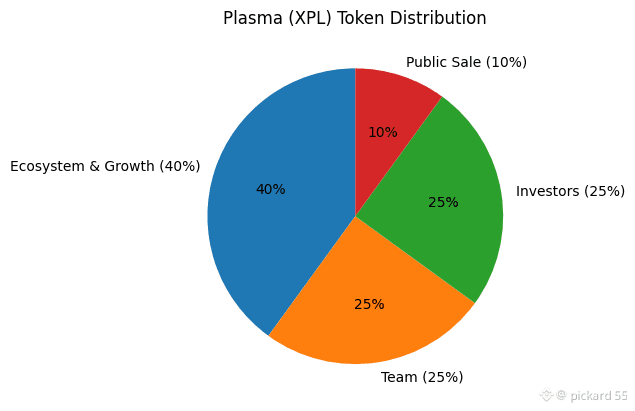
At mainnet beta launch, Plasma states an initial supply of 10,000,000,000 XPL, with programmatic increases tied to validator rewards described in their tokenomics sections. The distribution in Plasma’s docs is explicit and easy to summarize:
• Public sale: 10% (1,000,000,000 XPL). Non-US purchasers unlocked at mainnet beta launch; US purchasers subject to a 12-month lockup with full unlock on July 28, 2026. �
• Ecosystem and growth: 40% (4,000,000,000 XPL). 8% of total supply (800,000,000 XPL) immediately unlocked at mainnet beta for DeFi incentives, liquidity, exchange integrations, and early growth; the remaining 32% unlocks monthly over three years. �
• Team: 25% (2,500,000,000 XPL) with a one-year cliff for one-third, and the remaining two-thirds unlocking monthly over the following two years (fully unlocked three years after public launch). �
• Investors: 25% (2,500,000,000 XPL) with the same unlock schedule as team tokens (per Plasma docs). �
Plasma
Plasma
Plasma
Plasma
From Binance Research, there’s another useful lens: how much is actually tradable early, not just “circulating” in the broad sense. Binance Research lists the genesis supply as 10B and “circulating supply upon listing” as 1.8B (~18%), but it also discusses a “day 1 real float” around 10.25% of genesis supply, with 10% public sale and 0.25% user rewards/airdrop. That distinction matters because it affects liquidity, volatility, and market structure during early trading. �
Binance +1
On ecosystem, Plasma’s launch strategy is very “payments meets DeFi liquidity.” Plasma itself described seeding a very large amount of stablecoin liquidity at launch and deploying it across many DeFi partners to create immediate utility: savings products, deep USDT markets, and competitive borrow rates. In Plasma’s own announcement, it stated $2B in stablecoins active on day one and deployment across 100+ DeFi partners, naming examples like Aave, Ethena, Fluid, and Euler. The point is not the name-dropping; the point is that Plasma believes stablecoin payments and stablecoin liquidity reinforce each other. Deep liquidity reduces slippage and improves routing; lending and savings products keep stablecoins parked on-chain; and that creates a stable base for payments volume. �
Plasma
Binance Research also references pre-launch traction in terms of stablecoin commitments and wallet counts, and it frames Plasma as already a major USDT liquidity chain early. Even if you ignore the exact rank numbers, the strategy is clear: Plasma wants stablecoins to arrive with deep liquidity from day one so apps can build on reliable rails rather than empty blockspace. �
Binance
Roadmap is where the project shows what it thinks is hardest. The Binance Research roadmap section is unusually specific and breaks progress into quarters, which is helpful because it shows priorities moving from “launch stability” to “core features expansion” to “decentralization and compliance.”
For late 2025, the focus is operational stability (RPC, explorer, monitoring), transparency reporting after token generation, exchange listings and on/off-ramps (including USDT-on-Plasma withdrawals), and “day-1 deployments” with DeFi protocols, while preparing staking economics and a validator testnet. �
Binance
For early 2026, it moves into feature rollouts: custom gas tokens v1 on mainnet (fees in USDT via automated swap with guardrails), expanding zero-fee USDT transfers beyond initial pilots, and beginning low-frequency Bitcoin checkpointing as phase 1 of anchoring. It also calls out “payments corridors” with partners, which fits Plasma’s target markets narrative. �
Binance
By mid to late 2026, the roadmap leans into scaling and decentralization: widening zero-fee eligibility with analytics and rate limits, increasing Bitcoin anchoring cadence, validator decentralization phase 2, and deeper integrations with fintech APIs across corridors (SEA/LatAm/Africa are explicitly mentioned). Later it mentions throughput/latency upgrades (pipelining/parallelism tuning in PlasmaBFT and Reth upgrades), developer grants and SDKs, and a target to materially increase validator count and stake distribution, plus limited pilots for confidential transaction features (subject to audits). It also lists compliance and licensing work (including EU/UK progress and the CASP process where relevant). �
Binance
If you look at that roadmap as a story, Plasma is saying: first make the chain stable and liquid, then make the stablecoin UX genuinely smooth at scale, then harden security anchoring, then decentralize validators meaningfully, while staying aligned with the reality that payments touch regulation. �
Binance +1
Now the challenges, honestly, are exactly where Plasma’s “stablecoin-first” clarity becomes both a strength and a risk.
The first challenge is that stablecoins are not neutral software; they are issuer-linked assets that sit inside a changing regulatory landscape. Plasma’s own writing talks about alignment as stablecoin regulation matures worldwide, which is a reasonable stance, but it also means Plasma is building in a world where policy decisions can reshape access and distribution quickly. If your chain’s killer use case is USDT payments, your adoption is tightly tied to USDT’s distribution channels, compliance expectations, and issuer relationships. �
Plasma +1
The second challenge is sustainability and abuse resistance for gasless transfers. Plasma’s docs stress that sponsorship is controlled (verification, rate limits, observable spending) and that it sponsors only direct USDT transfers, not arbitrary contract calls. That tight scope is smart, but the moment something is “free,” people try to farm it. So Plasma has to continuously tune eligibility, rate-limits, and partner rollouts without destroying the very UX benefit that makes the feature valuable. �
Plasma +1
The third challenge is the stablecoin-first gas design itself. Letting users pay fees in USDT is great UX, but someone still must end up with the asset validators want, and the system needs clean economics. Binance Research describes an automated swap mechanism “while retaining XPL at the core,” and the roadmap shows custom gas tokens v1 and v2 rolling out with guardrails. That implies it is not trivial: you need liquidity, pricing safety, and protection against manipulation so fee conversion doesn’t become an attack surface. �
Binance +1
The fourth challenge is Bitcoin bridging and anchoring, which is always high-stakes engineering. Plasma’s Bitcoin bridge design includes verifier networks, attestations, and MPC signing, and it uses an omnichain token standard. That is ambitious. Even well-designed bridges become the “highest value target” in an ecosystem, and any weakness in verifier assumptions, signing thresholds, operational security, or implementation bugs can have outsized impact. Also, some third-party technical write-ups note that bridge components may roll out after initial mainnet beta, which means the most “Bitcoin-anchored” parts of the story need time to mature in production. �
Plasma +2
The fifth challenge is decentralization versus performance. Sub-second finality and payment-grade reliability often start with a more controlled validator set and carefully managed upgrades. But Plasma is explicitly selling neutrality and censorship resistance, which the market often associates with broad validator participation and transparent governance. Their roadmap explicitly calls out validator decentralization phases and a “decentralization scorecard,” which is good, but it also shows this is a journey, not an instant property. �
Binance +1
The sixth challenge is competition, and it comes from two sides at once. On one side, general-purpose EVM chains and L2s keep improving and also want stablecoin flow. On the other side, payment apps and fintech rails are extremely good at UX and distribution. Plasma’s best answer is its narrow focus: if it can truly make USDT transfers feel instant, cheap, and easy (even for users who only hold stablecoins), while giving developers a full EVM playground and institutions a credible security story, then it has a real wedge. Binance Research frames this wedge as removing fees/UX frictions and consolidating stablecoin flows through issuer, exchange, and payments integrations. �
Binance +1
If you want the deepest “big picture” interpretation, Plasma is trying to turn stablecoins from a popular asset into dependable infrastructure. The chain’s design choices—Reth for developer portability, PlasmaBFT for settlement speed, paymaster/relayer flows for gasless USDT transfers, stablecoin-first gas, and Bitcoin-related security anchoring—are all aligned to one thing: make stablecoin movement feel like normal payments, not like a crypto ritual. The hardest part is not writing the code; it is making the system robust under real-world load, real-world adversaries, and real-world regulation while still keeping the user experiPlasma is built around one simple observation: stablecoins already behave like “real money” for millions of people, but the blockchains that move them often still feel like “crypto rails.” You can have USDT in your wallet, yet your payment fails because you don’t have the right gas token. You can wait for confirmations that feel slow compared to a card swipe. You can deal with fee spikes that make small payments pointless. Plasma is a Layer 1 that tries to remove those frictions by designing the chain around stablecoin settlement from the start, not as an add-on. �
Binance +1
What Plasma is, in plain English, is an EVM-compatible Layer 1 optimized for stablecoin payments, especially USDT. “EVM-compatible” means developers can deploy Ethereum-style smart contracts with normal tooling, and Plasma’s execution layer is based on Reth (the Rust Ethereum client). “Optimized for payments” means the chain is built to finalize quickly, to handle high throughput, and to make stablecoin transfers feel simple for real users. Binance Research summarizes the design as Reth for execution, PlasmaBFT for sub-second finality, stablecoin-first gas (fees in USDT/BTC via an automated mechanism), and gasless USDT transfers. �
Binance
Why this matters is not academic; it’s operational. Stablecoins are used in high-adoption markets for saving in dollars, cross-border transfers, informal payroll, merchant payments, and exchange settlement. In those contexts, “UX friction” is not a minor inconvenience. It is the difference between a payment rail people trust and one they stop using. Plasma’s entire pitch is that if stablecoins are the product-market fit, the base layer should be designed so stablecoin usage does not require extra steps like “buy the gas token first” or “wait long enough that the merchant worries about reversals.” �
Binance +1
Plasma also aims at institutions, and institutions care about a different kind of “boring.” They want predictable finality, predictable fees, high uptime, and a security story they can explain to risk teams. Plasma leans into that by pairing a fast BFT consensus (PlasmaBFT) with a Bitcoin-anchoring / Bitcoin-bridge roadmap that is meant to strengthen neutrality and censorship resistance over time. Binance Academy and Binance Research both highlight Plasma’s payment focus plus the Bitcoin bridge angle as core parts of the system. �
Binance +1
Under the hood, Plasma is easiest to understand as three parts working together: execution, consensus, and “stablecoin-native” payment features.
On execution, Plasma runs an EVM environment using Reth. That matters because it lets Plasma inherit a massive developer ecosystem: Solidity contracts, Ethereum tooling, and the habits developers already have. You do not need a new programming model to build on Plasma, which is important because payment and DeFi ecosystems do not bootstrap from technology alone; they bootstrap from developers actually shipping products. Binance Academy explicitly describes the execution layer running on Reth while consensus provides sequencing and finality. �
Binance
On consensus, Plasma uses PlasmaBFT, which Plasma describes as a pipelined implementation of Fast HotStuff in Rust. HotStuff-style BFT consensus is built for quick finality with a leader-based structure, validators voting, quorum certificates, and safe leader changes. Plasma’s docs explain that PlasmaBFT keeps classic BFT safety while optimizing for lower latency and faster commits, which is exactly what you want if the chain’s “main job” is settlement. �
Plasma
Now the part that makes Plasma feel different to users is the stablecoin-native layer. Plasma is trying to make the most common action—sending stablecoins—work even for people who only hold stablecoins. One flagship feature is gasless USDT transfers via a relayer/paymaster design. Plasma’s documentation explains that the system sponsors only direct USDT transfers (scoped tightly on purpose), the paymaster is funded by the Plasma Foundation, gas is covered at the moment the transfer is sponsored, users do not need to hold XPL, and there are verification and rate-limit controls meant to reduce abuse. It also requires EIP-712 authorization signatures (EIP-3009 style authorization for USDT0 transfers) so the user can approve a transfer without submitting a normal gas-paying transaction themselves. �
Plasma +1
This “gasless” approach is not a magic free lunch. It is a design choice: Plasma is willing to subsidize a narrow set of transactions because those transactions are the heart of stablecoin adoption. That also explains why Plasma keeps repeating “only basic USDT transfers are gasless” while other actions still require gas, because a chain still needs a sustainable fee and security model for everything beyond simple transfers. Binance Academy describes this clearly: a paymaster covers gas for standard USDT transfers with eligibility and rate limits, while other transactions still require XPL fees to support validator rewards and network security. �
Binance
The other big user-facing idea is stablecoin-first gas (sometimes described as custom gas tokens). Plasma’s goal here is to allow fees to be paid in tokens people already hold—like USDT—rather than forcing every user to maintain a separate XPL balance just to move money. Binance Academy describes custom gas tokens as a built-in paymaster approach where apps can register ERC-20 tokens (including stablecoins), letting users pay fees in those assets. Binance Research adds the idea of paying fees in USDT/BTC via an automated swap mechanism “while retaining XPL at the core.” The principle is simple: you can still have a native token for security and incentives, but the payment UX can be stablecoin-native. �
Binance +1
The Bitcoin side is part security narrative, part product strategy. Plasma wants BTC liquidity and BTC trust to be usable in an EVM environment without relying on the classic “single custodian wrapped BTC” model. Plasma’s Bitcoin bridge documentation describes pBTC as a 1:1 BTC-backed token designed to interoperate across chains while keeping a verifiable link to the Bitcoin base layer. The described design combines onchain attestation by a verifier network (verifiers run Bitcoin full nodes and indexers), an MPC-based signing approach for withdrawals, and an omnichain token standard based on LayerZero’s OFT framework. In the flow described in the docs, users deposit BTC to a controlled address, verifiers confirm on Bitcoin, then pBTC is minted on Plasma after attestations. �
Plasma +1
It’s important to be realistic here: “trust-minimized” does not mean “trustless.” It means the system is trying to reduce trust in a single intermediary and spread verification and signing across multiple parties with explicit mechanisms. Plasma’s docs are open about the verifier network and MPC signing components, which is more complex than a simple custodian model, but is also the kind of complexity you accept if you want stronger neutrality and censorship resistance than a single wrapped-asset issuer can provide. �
Plasma +1
Tokenomics is where Plasma tries to balance two competing goals: keep the chain secure and sustainable, but do not force every stablecoin user to become an XPL holder. XPL is the native token. Plasma’s docs describe XPL as the token used to facilitate transactions and reward those who support the network by validating transactions. Binance Academy also describes XPL as used for transaction fees, validator rewards, and securing the network. �
Plasma +1
At mainnet beta launch, Plasma states an initial supply of 10,000,000,000 XPL, with programmatic increases tied to validator rewards described in their tokenomics sections. The distribution in Plasma’s docs is explicit and easy to summarize:
• Public sale: 10% (1,000,000,000 XPL). Non-US purchasers unlocked at mainnet beta launch; US purchasers subject to a 12-month lockup with full unlock on July 28, 2026. �
• Ecosystem and growth: 40% (4,000,000,000 XPL). 8% of total supply (800,000,000 XPL) immediately unlocked at mainnet beta for DeFi incentives, liquidity, exchange integrations, and early growth; the remaining 32% unlocks monthly over three years. �
• Team: 25% (2,500,000,000 XPL) with a one-year cliff for one-third, and the remaining two-thirds unlocking monthly over the following two years (fully unlocked three years after public launch). �
• Investors: 25% (2,500,000,000 XPL) with the same unlock schedule as team tokens (per Plasma docs). �
Plasma
Plasma
Plasma
Plasma
From Binance Research, there’s another useful lens: how much is actually tradable early, not just “circulating” in the broad sense. Binance Research lists the genesis supply as 10B and “circulating supply upon listing” as 1.8B (~18%), but it also discusses a “day 1 real float” around 10.25% of genesis supply, with 10% public sale and 0.25% user rewards/airdrop. That distinction matters because it affects liquidity, volatility, and market structure during early trading. �
Binance +1
On ecosystem, Plasma’s launch strategy is very “payments meets DeFi liquidity.” Plasma itself described seeding a very large amount of stablecoin liquidity at launch and deploying it across many DeFi partners to create immediate utility: savings products, deep USDT markets, and competitive borrow rates. In Plasma’s own announcement, it stated $2B in stablecoins active on day one and deployment across 100+ DeFi partners, naming examples like Aave, Ethena, Fluid, and Euler. The point is not the name-dropping; the point is that Plasma believes stablecoin payments and stablecoin liquidity reinforce each other. Deep liquidity reduces slippage and improves routing; lending and savings products keep stablecoins parked on-chain; and that creates a stable base for payments volume. �
Plasma
Binance Research also references pre-launch traction in terms of stablecoin commitments and wallet counts, and it frames Plasma as already a major USDT liquidity chain early. Even if you ignore the exact rank numbers, the strategy is clear: Plasma wants stablecoins to arrive with deep liquidity from day one so apps can build on reliable rails rather than empty blockspace. �
Binance
Roadmap is where the project shows what it thinks is hardest. The Binance Research roadmap section is unusually specific and breaks progress into quarters, which is helpful because it shows priorities moving from “launch stability” to “core features expansion” to “decentralization and compliance.”
For late 2025, the focus is operational stability (RPC, explorer, monitoring), transparency reporting after token generation, exchange listings and on/off-ramps (including USDT-on-Plasma withdrawals), and “day-1 deployments” with DeFi protocols, while preparing staking economics and a validator testnet. �
Binance
For early 2026, it moves into feature rollouts: custom gas tokens v1 on mainnet (fees in USDT via automated swap with guardrails), expanding zero-fee USDT transfers beyond initial pilots, and beginning low-frequency Bitcoin checkpointing as phase 1 of anchoring. It also calls out “payments corridors” with partners, which fits Plasma’s target markets narrative. �
Binance
By mid to late 2026, the roadmap leans into scaling and decentralization: widening zero-fee eligibility with analytics and rate limits, increasing Bitcoin anchoring cadence, validator decentralization phase 2, and deeper integrations with fintech APIs across corridors (SEA/LatAm/Africa are explicitly mentioned). Later it mentions throughput/latency upgrades (pipelining/parallelism tuning in PlasmaBFT and Reth upgrades), developer grants and SDKs, and a target to materially increase validator count and stake distribution, plus limited pilots for confidential transaction features (subject to audits). It also lists compliance and licensing work (including EU/UK progress and the CASP process where relevant). �
Binance
If you look at that roadmap as a story, Plasma is saying: first make the chain stable and liquid, then make the stablecoin UX genuinely smooth at scale, then harden security anchoring, then decentralize validators meaningfully, while staying aligned with the reality that payments touch regulation. �
Binance +1
Now the challenges, honestly, are exactly where Plasma’s “stablecoin-first” clarity becomes both a strength and a risk.
The first challenge is that stablecoins are not neutral software; they are issuer-linked assets that sit inside a changing regulatory landscape. Plasma’s own writing talks about alignment as stablecoin regulation matures worldwide, which is a reasonable stance, but it also means Plasma is building in a world where policy decisions can reshape access and distribution quickly. If your chain’s killer use case is USDT payments, your adoption is tightly tied to USDT’s distribution channels, compliance expectations, and issuer relationships. �
Plasma +1
The second challenge is sustainability and abuse resistance for gasless transfers. Plasma’s docs stress that sponsorship is controlled (verification, rate limits, observable spending) and that it sponsors only direct USDT transfers, not arbitrary contract calls. That tight scope is smart, but the moment something is “free,” people try to farm it. So Plasma has to continuously tune eligibility, rate-limits, and partner rollouts without destroying the very UX benefit that makes the feature valuable. �
Plasma +1
The third challenge is the stablecoin-first gas design itself. Letting users pay fees in USDT is great UX, but someone still must end up with the asset validators want, and the system needs clean economics. Binance Research describes an automated swap mechanism “while retaining XPL at the core,” and the roadmap shows custom gas tokens v1 and v2 rolling out with guardrails. That implies it is not trivial: you need liquidity, pricing safety, and protection against manipulation so fee conversion doesn’t become an attack surface. �
Binance +1
The fourth challenge is Bitcoin bridging and anchoring, which is always high-stakes engineering. Plasma’s Bitcoin bridge design includes verifier networks, attestations, and MPC signing, and it uses an omnichain token standard. That is ambitious. Even well-designed bridges become the “highest value target” in an ecosystem, and any weakness in verifier assumptions, signing thresholds, operational security, or implementation bugs can have outsized impact. Also, some third-party technical write-ups note that bridge components may roll out after initial mainnet beta, which means the most “Bitcoin-anchored” parts of the story need time to mature in production. �
Plasma +2
The fifth challenge is decentralization versus performance. Sub-second finality and payment-grade reliability often start with a more controlled validator set and carefully managed upgrades. But Plasma is explicitly selling neutrality and censorship resistance, which the market often associates with broad validator participation and transparent governance. Their roadmap explicitly calls out validator decentralization phases and a “decentralization scorecard,” which is good, but it also shows this is a journey, not an instant property. �
Binance +1
The sixth challenge is competition, and it comes from two sides at once. On one side, general-purpose EVM chains and L2s keep improving and also want stablecoin flow. On the other side, payment apps and fintech rails are extremely good at UX and distribution. Plasma’s best answer is its narrow focus: if it can truly make USDT transfers feel instant, cheap, and easy (even for users who only hold stablecoins), while giving developers a full EVM playground and institutions a credible security story, then it has a real wedge. Binance Research frames this wedge as removing fees/UX frictions and consolidating stablecoin flows through issuer, exchange, and payments integrations. �
Binance +1
If you want the deepest “big picture” interpretation, Plasma is trying to turn stablecoins from a popular asset into dependable infrastructure. The chain’s design choices—Reth for developer portability, PlasmaBFT for settlement speed, paymaster/relayer flows for gasless USDT transfers, stablecoin-first gas, and Bitcoin-related security anchoring—are all aligned to one thing: make stablecoin movement feel like normal payments, not like a crypto ritual. The hardest part is not writing the code; it is making the system robust under real-world load, real-world adversaries, and real-world regulation while still keeping the user experience simple enough that people actually adopt it. �
Binance +4ence simple enough that people actually adopt it. �