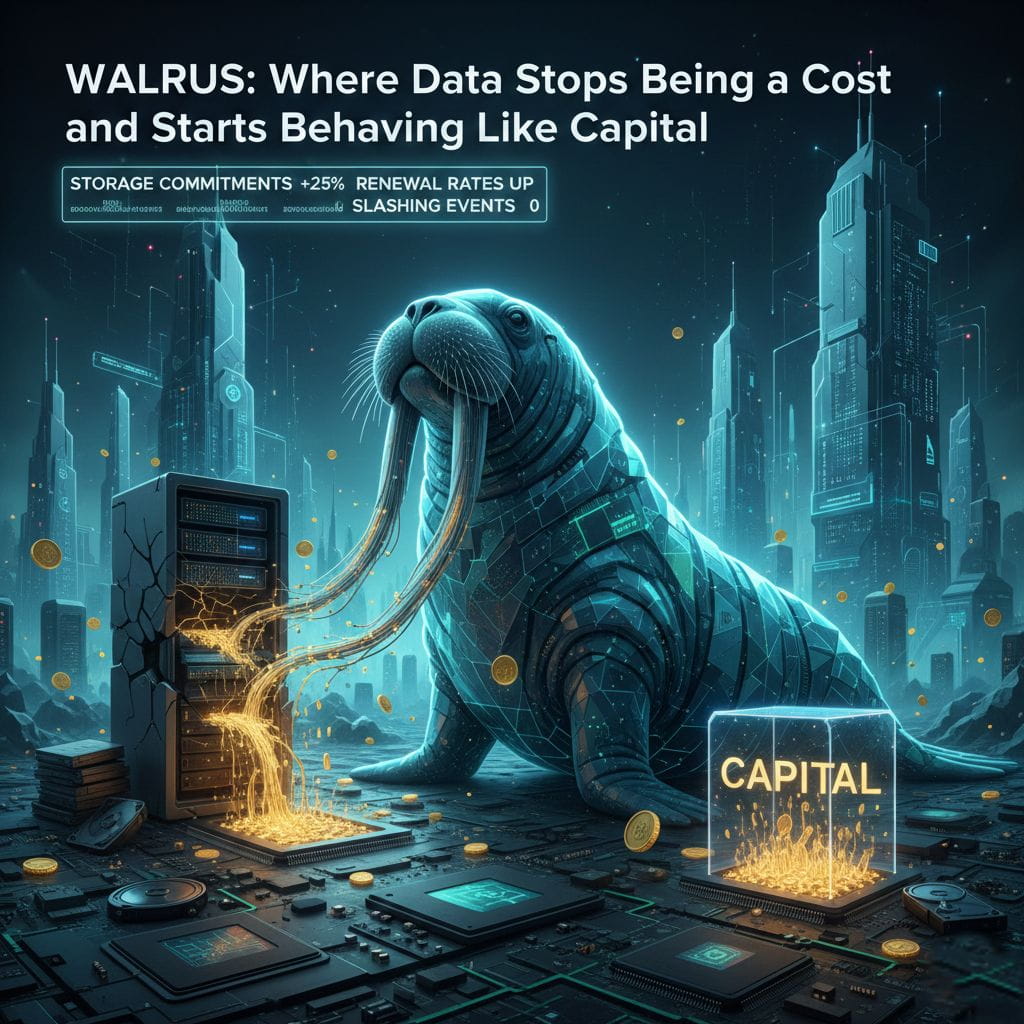
@Walrus 🦭/acc exists because the crypto stack quietly broke somewhere nobody wanted to look. Blockchains learned how to move value cheaply, Layer-2s learned how to compress execution, but datathe thing every application actually depends onremained treated like exhaust. Walrus is not fixing storage. It is correcting a structural mispricing of data inside crypto markets, and that distinction explains why builders and traders who actually watch on-chain behavior are paying attention now.
The dominant assumption for years was that “off-chain storage plus an on-chain hash” was good enough. In practice, that model collapsed under scale. NFT metadata went missing, GameFi economies broke when assets couldn’t be reliably served, and DeFi frontends quietly centralized because latency mattered more than ideology. Walrus starts from a different premise: data availability is not a side service, it is an economic primitive. Once you accept that, the architecture changes completely.
What makes Walrus structurally different is that storage is enforced, priced, and governed on-chain rather than socially assumed. Data blobs are not just stored; they are economically guaranteed through staking and slashing. This shifts storage from a “best effort” service into a market with explicit risk, yield, and accountability. That matters because crypto markets price guarantees far more efficiently than promises. Traders understand this intuitively; builders feel it when their apps break under load.
Erasure coding is often described as a technical optimization, but in Walrus it functions as a market mechanism. By splitting data into fragments that can be reconstructed without full replication, Walrus reduces capital inefficiency for storage operators while maintaining availability. This is not just cheaper storage; it changes operator behavior. Nodes no longer need to over-replicate to stay competitive, which lowers the minimum viable scale to participate. That increases decentralization not through ideology, but through margin compression.
Sui’s role here is misunderstood. Walrus is not “built on Sui” in the way most protocols are “built on” a chain. Sui acts as the coordination layer that enforces ownership, payments, and availability guarantees, while the data itself lives outside execution bottlenecks. This separation mirrors how modern financial markets separate clearing from settlement. Execution stays fast; guarantees stay credible. Most blockchains still conflate the two and pay for it in congestion or hidden centralization.
This design has immediate implications for DeFi mechanics. Data-heavy strategiesthink per-block analytics, oracle aggregation, or AI-driven trading agents—have been constrained not by computation but by reliable access to historical and real-time datasets. Walrus allows these datasets to exist as persistent, verifiable resources that can be referenced by contracts without dragging execution costs on-chain. That opens the door to strategy composability that does not depend on trusted off-chain servers quietly running the real logic.
GameFi exposes the problem even more clearly. In-game economies fail when assets are either mutable without accountability or immutable but unavailable. Walrus introduces the possibility of game state and asset data that is economically enforced but not execution-bound. Developers can design economies where scarcity, durability, and history are verifiable without bloating blockspace. That shifts game design away from speculative token loops and back toward systems where player behavior and data persistence actually matter.
Layer-2 scaling conversations are also quietly converging on this realization. Rollups have optimized execution, but data availability remains the choke point. Most current solutions treat DA as a bandwidth problem. Walrus treats it as a pricing problem. By turning availability into a staked service with penalties, it aligns operator incentives with user demand rather than abstract throughput metrics. If you were watching DA cost charts instead of TPS charts over the past year, you already saw where the pressure was building.
Oracle design is another overlooked angle. Oracles fail not because they can’t compute values, but because the underlying data pipelines are opaque and brittle. A storage layer where datasets themselves are verifiable, persistent, and economically backed reduces oracle attack surfaces dramatically. Instead of trusting feeds, protocols can reference data objects with known availability guarantees. That changes how risk is modeled in lending markets and derivatives, particularly for long-tail assets.
From a trader’s perspective, the interesting part is not the narrative but the flow. Storage demand is no longer correlated with hype cycles; it correlates with actual application usage. As capital rotates toward revenue-generating protocols and away from empty liquidity games, infrastructure that captures real usage becomes visible on-chain. Metrics like storage commitments, renewal rates, and slashing events will matter more than vanity TVL. Walrus produces those signals natively.
There is also a subtle shift in user behavior that Walrus aligns with. Users increasingly interact with crypto through applications that feel centralized but settle on-chain. The friction they tolerate is latency, not custody risk. Walrus meets that reality without pretending users will wait for ideological purity. It offers performance that matches expectations while keeping enforcement decentralized. That pragmatism is why builders migrate quietly before narratives catch up.
The risks are real and visible. Pricing storage correctly over long horizons is harder than pricing blockspace. If incentives drift, data guarantees weaken before anyone notices. Governance capture is another vector; whoever influences storage parameters influences the cost structure of entire ecosystems. But these risks exist whether acknowledged or not. Walrus at least exposes them to market discipline instead of burying them inside centralized providers.
The long-term impact is not that Walrus replaces existing storage networks, but that it reframes how crypto thinks about data. Once data is treated as a first-class economic resource, new financial instruments emerge naturally: data-backed lending, usage-indexed fees, even hedging against availability risk. None of this requires speculation; it requires infrastructure that enforces reality. Walrus is one of the first protocols designed with that enforcement in mind.