

Dusk Network is not trying to be “just another blockchain.” It is building something far more specific and far more valuable: an infrastructure layer where real financial assets can exist on-chain with both privacy and compliance built into the design. While most chains chase open transparency, Dusk is solving the problem that actually matters for real-world adoption—how to run regulated finance on blockchain without exposing users, institutions, and market strategies to the entire internet.
This is exactly why Dusk feels different. It is not built for quick trends. It is built for long-term financial reality. In traditional markets, assets are not only traded, they are governed. Ownership must be valid, issuance must be legal, transfers must follow jurisdiction rules, and certain actions must remain possible for issuers and regulators in lawful conditions. At the same time, those markets still require confidentiality. A public blockchain where every wallet balance and trade history is visible is not compatible with serious finance. Dusk recognizes this from the start, and instead of ignoring it, the network embraces it as its main mission.
The strongest signal of Dusk’s vision comes from the way it introduces foundational smart contracts as key pillars of the ecosystem. These are not “random dApp contracts.” They are the types of contracts that define how a blockchain can support a regulated economy. They are meant to become integral to long-term functionality and evolution of the network, acting as infrastructure components that future applications will rely on. In other words, Dusk does not want to support finance as a surface layer; it wants regulated asset operations to become a native capability of the chain itself.
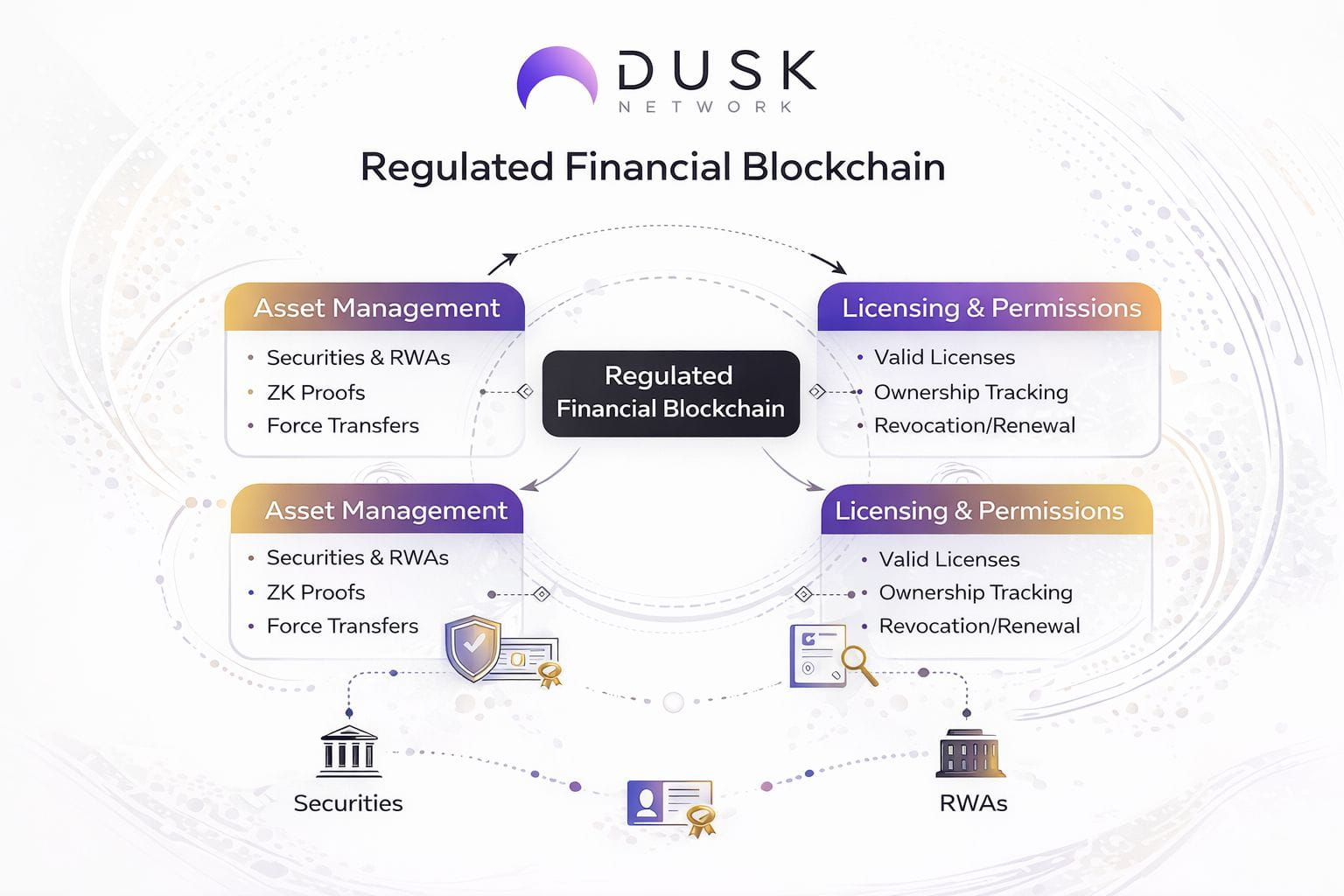
One foundational contract direction is centered on the management of real-world assets and securities. The ability to represent securities on-chain is not only about tokenizing something and calling it an asset. Securities require special logic: minting and burning need legitimacy checks; corporate actions such as dividends must be enforceable; and certain forced transfers must remain possible under lawful issuer requirements. That is a crucial point. Many crypto communities dislike the idea of forced transfers because they see it as “centralization.” But regulated finance cannot work without lawful enforcement mechanisms. If a court requires a transfer, or if certain securities must be recalled, the infrastructure must support it. Dusk does not hide from this truth—it designs for it.
At the same time, Dusk also protects privacy through advanced cryptographic proof systems. This is where the real innovation lives. The network aims to provide regulatory compliance without turning users into transparent targets. Instead of forcing full public disclosure, transactions can be validated through proof-based mechanisms. This means the chain can confirm legitimacy while still preserving confidentiality. That changes everything. It enables a market where institutions can operate without broadcasting their entire strategy and holdings, while regulators and auditors can still ensure the system stays lawful and trusted.
This balance between confidentiality and compliance is not only an “extra feature.” It is the bridge between crypto experimentation and real capital markets. Large investors, regulated brokers, and financial institutions cannot operate on a chain where every trade becomes public data. But they also cannot operate in an ecosystem that offers privacy with no enforceable rules. Dusk aims to be the chain that finally resolves this conflict.
The second foundational contract direction focuses on network permissions through a structured licensing system. This is another detail that separates Dusk from generic smart contract platforms. In many blockchains, participation is open for every action. That works for simple DeFi, but regulated environments work differently. Certain actions and privileges must be restricted to eligible participants. Licenses are how real markets operate—brokers are licensed, exchanges are licensed, and entities performing certain operations are authorized under clear frameworks.
A licensing-based contract in Dusk is designed to manage issuance and validation of these permissions. That includes allowing users to acquire licenses needed to perform certain operations, tracking the ownership and validity of each license, monitoring expiration, and supporting renewal or revocation. This transforms access control from an off-chain administrative process into an enforceable on-chain rule system. It also creates a more mature ecosystem because it enables Dusk to support real financial workflows without needing centralized gatekeepers.
And here is the deeper insight: licenses don’t automatically mean public identity exposure. Dusk’s design supports the concept of proving eligibility without revealing everything. That is the future of compliance. A user can prove they meet a requirement without publishing their entire identity profile. This is precisely what traditional systems cannot do efficiently, and what blockchain can do better—if it is engineered correctly.
When you connect these elements together, you start to see Dusk Network as a complete regulated-asset engine. It is not only about launching tokenized assets. It is about ensuring that the whole lifecycle of these assets can function: issuance, transfer validation, corporate actions, auditability, lawful enforcement, permissioned access, and compliance-ready operations. That is a full-stack financial vision.
The reason this matters is simple: the next era of blockchain adoption will not be driven only by retail speculation. It will be driven by real-world value coming on-chain—securities, funds, institutional instruments, and regulated market products. Every chain claims to be ready for that moment. But readiness is not a marketing statement; it is architecture. Dusk is intentionally building architecture that matches the realities of financial regulation while still providing the privacy and efficiency required for modern markets.
So when people talk about “blockchain for RWAs,” the real question becomes: which chain actually respects the constraints of real finance while still delivering crypto-native advantages? Dusk Network is positioning itself as that answer. It is designing a network where compliance is programmable, privacy is protected by cryptography, and permissions are enforceable without sacrificing decentralization principles.
That is what makes Dusk a serious project. It is not chasing noise. It is building rails that can carry real economic weight. And in a world where regulated finance is slowly moving toward tokenization and on-chain settlement, Dusk Network stands out as one of the few ecosystems preparing for what comes next—not with hype, but with deeply thought infrastructure.
