

Is Your Data Really Safe? How Walrus Redefines Cloud Security with “Red Stuff”
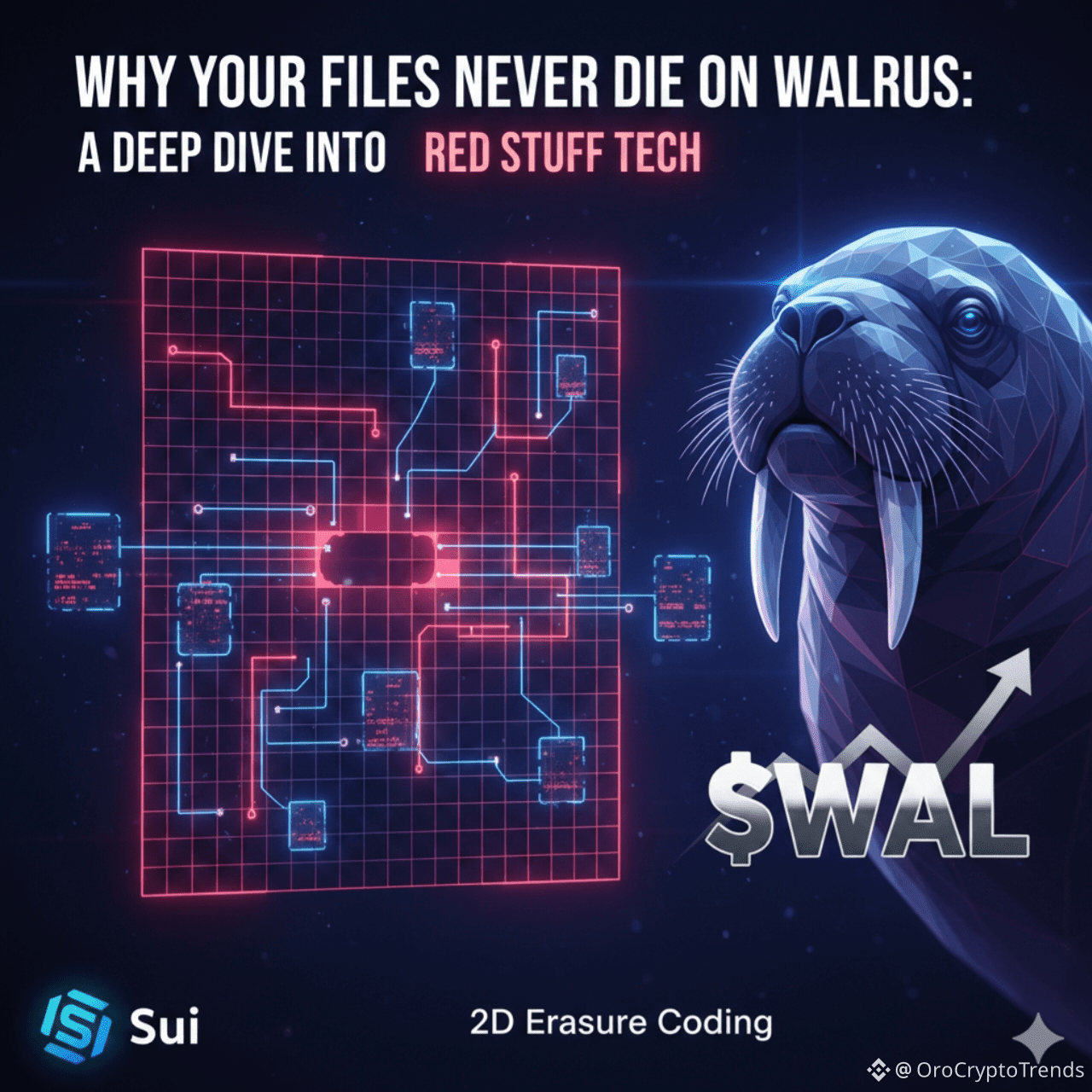
Cracking Open Walrus’s Secret Sauce: The Power of 2D Erasure Coding
How “Red Stuff” Sets a New Standard for Robust, Reliable, and Cost-Efficient Decentralized Storage
Let’s dive into the tech that powers Walrus (WAL)—making your data not only safer and self-healing but also more affordable than old-school storage.
Going Beyond Basic Backups
If you’ve used decentralized storage, you know that the biggest pain isn’t just hackers—it’s churn. Nodes go offline for all kinds of reasons, sometimes disappearing forever. Many systems like Filecoin or Arweave have their own methods for handling this, but Walrus has stepped up with something unique: a “secret weapon” called Red Stuff.
What Exactly Is the “Red Stuff” Algorithm?
Here’s the lowdown. Red Stuff is a next-generation, two-dimensional (2D) erasure coding system. Imagine your file as a square grid—think Sudoku, but instead of numbers, each cell holds a piece of your data.
- 1D Encoding (Old School): Most platforms cut files into strips and tack on extra “backup” pieces. If too many pieces are lost, you’re forced to re-download the entire file just to patch a small bit. It’s slow, costly, and can be a hassle for users.
- 2D Encoding (Walrus Innovation): Red Stuff slices your data both horizontally and vertically, turning it into a true grid. This allows the network to pinpoint missing parts with surgical precision and restore only what’s needed, quickly and efficiently.
Why “Red Stuff” Is a Game Changer
- Self-Healing in Real Time: When a storage node disappears, the network doesn’t panic. Instead, it swiftly detects which specific segment of the grid is gone and reconstructs just that piece. This self-healing process is incredibly bandwidth-light compared to older systems, making it ideal for active, frequently-accessed data.
- 4.5x Storage Efficiency: Traditional replication methods mean duplicating your files over and over—sometimes 10x or more—to guarantee durability. Red Stuff achieves ultra-reliable storage with just a 4.5x replication factor. That’s a massive leap in efficiency, especially for big files like 4K videos, scientific datasets, or AI model training data.
- Byzantine Fault Tolerance: Walrus is designed to be resilient even when some nodes act maliciously or try to hide data. Thanks to tight coordination with the Sui blockchain, Walrus can independently verify your data’s presence without ever relying on a single storage provider. This means you get tamper-proof, trustless storage, even in an adversarial environment.
What This Means for $WAL Holders
As the Walrus network expands, demand for storage “blobs” only grows. Red Stuff’s ultra-efficient, robust storage makes Walrus the platform of choice for:
- NFT Metadata: Your valuable digital art and collectibles won’t disappear into the void with a “404 Not Found.”
- AI Training Data: Massive, constantly-updated datasets are kept accessible and secure, ready for machine learning workloads.
- DApp Hosting: Launch and run entire websites, apps, and services directly from the decentralized web, with the reassurance of reliable storage.
FAQ
1. Is Walrus a better choice than Filecoin?
Filecoin excels at long-term “cold” storage—archiving data for years. Walrus, on the other hand, is optimized for “hot” storage—data you need instantly and often. Its tight Sui blockchain integration ensures fast access and seamless on-chain coordination, setting it apart for real-time applications.
2. How does the WAL token fit into all this?
WAL is the lifeblood of the Walrus network. You use WAL to pay for storage, and it’s also the reward for the nodes that power Red Stuff’s self-healing process. By staking WAL, users help secure the network and ensure honest participation from storage providers.
3. Can I delete my data on Walrus?
Absolutely. Unlike Arweave, which is designed for permanent, undeletable storage, Walrus lets you remove files whenever you want. This is essential for businesses that need to comply with data privacy laws like GDPR, or simply want more control over their digital footprint.
Additional Insights: Why Walrus’s Red Stuff Matters for the Future of Web3
As the decentralized web matures, the need for storage that balances speed, security, and affordability is exploding. Red Stuff’s approach to 2D erasure coding doesn’t just solve the problem of lost nodes—it radically reduces operating costs and energy usage. By minimizing redundant data transfers and allowing pinpoint repairs, it unlocks new possibilities for everything from decentralized media streaming to edge computing.
Moreover, Walrus’s integration with the Sui blockchain means storage events and file histories are transparently recorded on-chain. This opens the door for advanced automation, compliance tracking, and even new business models around data access and monetization.
Final Thoughts
Red Stuff signals a major evolution in Web3 storage. By solving the bandwidth and reliability headaches that have slowed decentralized storage adoption, Walrus is positioning itself as the “Hard Drive of the Decentralized Web.” Its combination of self-healing, efficiency, and compliance-friendly features could become the new normal as more dApps and enterprises move to Web3 infrastructure.
Action Tip: Watch the Sui ecosystem closely. As more projects adopt Walrus for high-demand media and app storage, track the number of “Active Blobs”—a real-time signal of the network’s growth and health. The more blobs, the more robust and valuable the Walrus network becomes.
Get an in-depth look at how Red Stuff and 2D erasure coding power the Walrus Protocol—unlocking fast, reliable, and secure decentralized storage.
Disclaimer: This is not financial advice. Crypto assets are volatile—always do your own research before investing or participating.
Walrus: Sui’s Bold Take on Decentralized Storage


