

Walrus in 5 Years: Where Things Could Go
Trying to figure out where Walrus ends up in five years isn’t really about guessing the price. It’s more about whether decentralized storage can really deliver, if utility tokens ever grow up, and whether these protocols can actually move past the hype. Walrus sits right at the intersection—data permanence, economic incentives, and real-world demand all pulling in different directions. The future? It’s all about how these parts fit, or don’t.

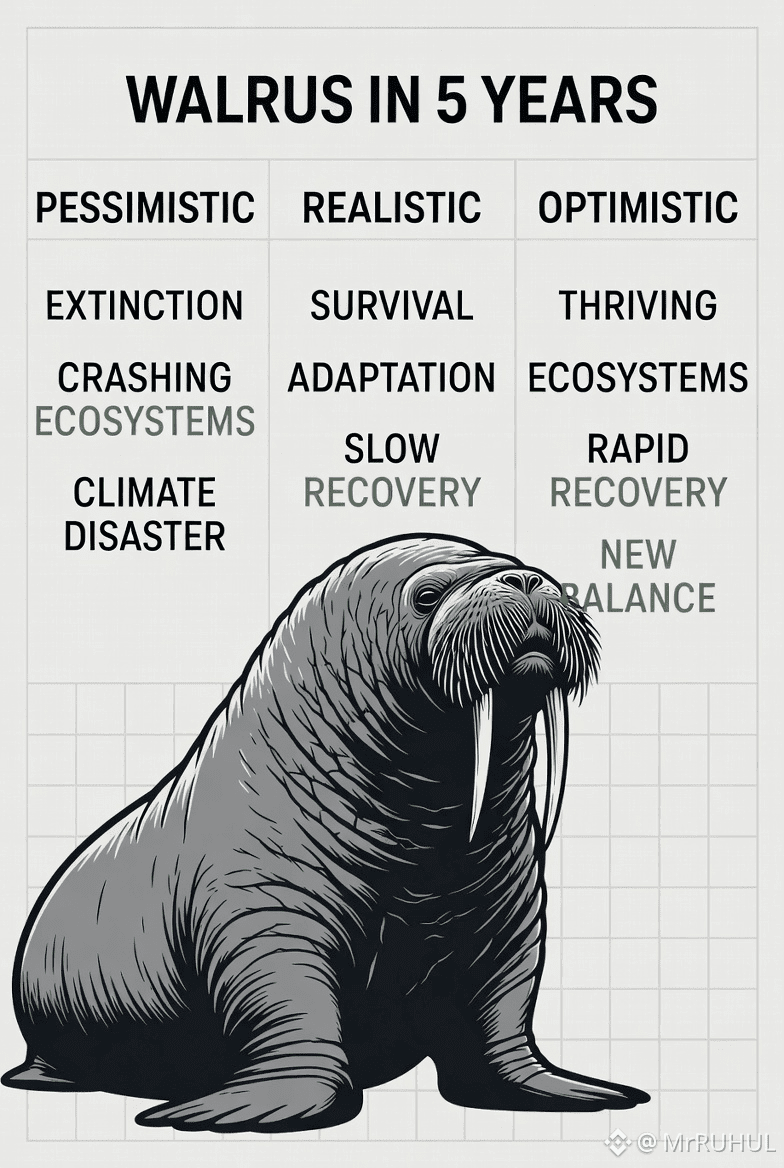
Instead of pretending there’s just one outcome, let’s be real: there are a few ways things could play out for Walrus.
1. Infrastructure Wins: Walrus as the Quiet Backbone
Here’s the best-case scenario—Walrus just becomes “boring,” in the best possible way.
Fast forward five years, and decentralized storage isn’t just something for crypto diehards. AI agents, onchain games, DePIN networks, regulators—they all need cheap, verifiable, and censorship-resistant storage. Walrus doesn’t chase trends or splashy headlines. It sticks to what it’s good at: being a reliable storage layer for data that needs to last and for costs you can actually predict.
In this world:
Walrus gets integrated into a bunch of L1s and L2s as the go-to storage option.
Developers don’t talk about Walrus; they just use it, like electricity.
Demand for WAL comes from actual use—storage, renewals, bandwidth—not just speculation.
Sure, there’s still some trading, but it’s not the main story.
The token economy matures. WAL tokens get locked up for storage guarantees, staking, or service commitments, so there’s less bouncing around. Price starts to reflect real network usage instead of trader mood swings.
This isn’t the kind of thing that goes viral. It’s infrastructure. Walrus doesn’t “win Twitter,” but it sticks around, cycle after cycle, because it just works.
2. Category Leader: Walrus Finds Its Lane
Now for the more ambitious version. Walrus doesn’t just fade into the background—it becomes the gold standard for its category.
Instead of trying to beat every other storage network, Walrus finds its specialty: big, long-term, economically secured datasets.
People start saying “Walrus” when they mean durable decentralized storage.
Enterprises, DAOs, and AI models trust it with their data.
WAL isn’t just a ticket in—it’s what coordinates the economy between users and storage providers.
Governance actually matters. People debate and vote on prices, redundancy, risk.
In this world, Walrus has real narrative power. It’s not just another protocol; it’s the reference point. WAL gets sticky because you can’t just swap it out for something else. It’s a ticket into a real, working economic network, not just another speculative coin.
3. Middle of the Road: Useful, but Overlooked
Honestly, this is probably the most likely scenario.
Five years on, Walrus works. It’s up, stable, has a solid base of apps. The tokenomics are straightforward, inflation’s in check, and the protocol weathers bear markets without much drama.
Growth? It’s slow and steady—not explosive.
Walrus never makes the headlines.
WAL stays undervalued compared to what it actually does, because the hype is somewhere else.
That’s how a lot of infrastructure protocols end up. Builders depend on them, speculators ignore them. Long-term holders might feel overlooked, but it’s sustainable. Returns come with real use, not hype cycles.
Walrus turns into something more like a steady utility stock than the next moonshot.
4. Fragmentation: Crowded and Squeezed
This one’s rough.
Say decentralized storage splits apart. Tons of protocols offer similar features and shower users with incentives. Margins vanish. Developers hedge their bets, spreading workloads across networks. Switching’s easy, and nobody feels loyal.
Now:
Walrus fights to keep any sort of niche.
WAL’s utility gets diluted by all the alternatives.
Token value depends less on real demand, more on how tightly the team controls emissions.
Walrus doesn’t die, but it’s just another choice. Survival means staying focused. Any gap between token incentives and real use becomes obvious fast.
5. The Toughest One: Stuck in Neutral
And finally, the scenario nobody wants.
Walrus works technically, but the economics just don’t add up. Usage never really grows enough to balance out emissions. Developers stick with centralized or hybrid storage. WAL gets trapped in a cycle of low demand and fading incentives.
What happens?
The network limps along, but growth stalls.
Token holders lose interest.
Development slows—not because the team can’t build, but because the market just isn’t there.@Walrus 🦭/acc #Walrus $WAL

