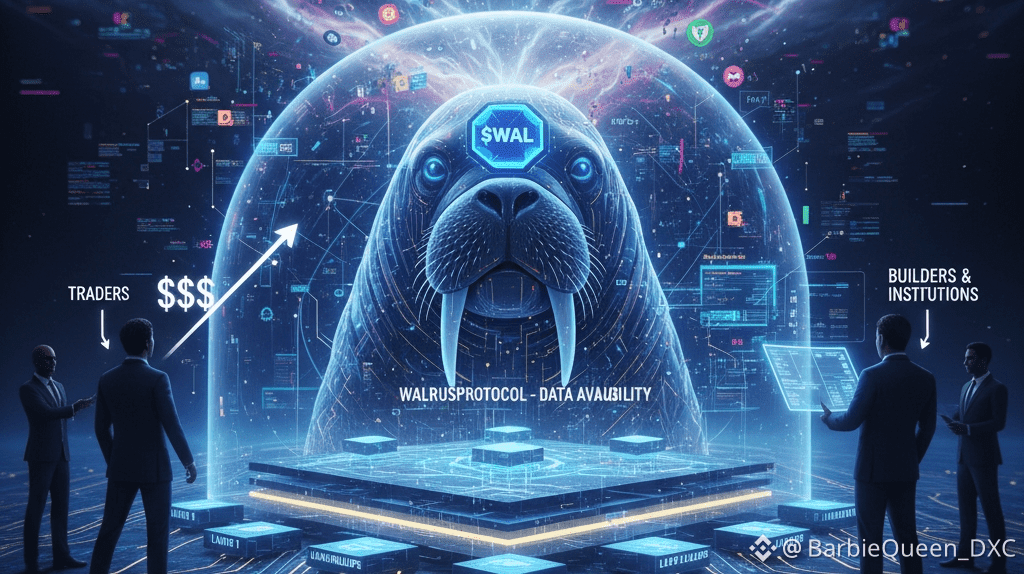
The Infrastructure Angle
The blockchain narrative is dominated by flashy topics: the latest memecoin frenzy, the race for the lowest transaction fees, or the breakthrough in smart contract design. Yet, beneath this surface-level drama, a more profound and decisive battle is being waged—a battle for the very foundation upon which all scalable, secure, and decentralized blockchains will be built. This is the battle for Data Availability (DA), and it’s here that projects like @walrusprotocol, with its token $WAL, are positioning themselves not just as participants, but as essential infrastructure architects.
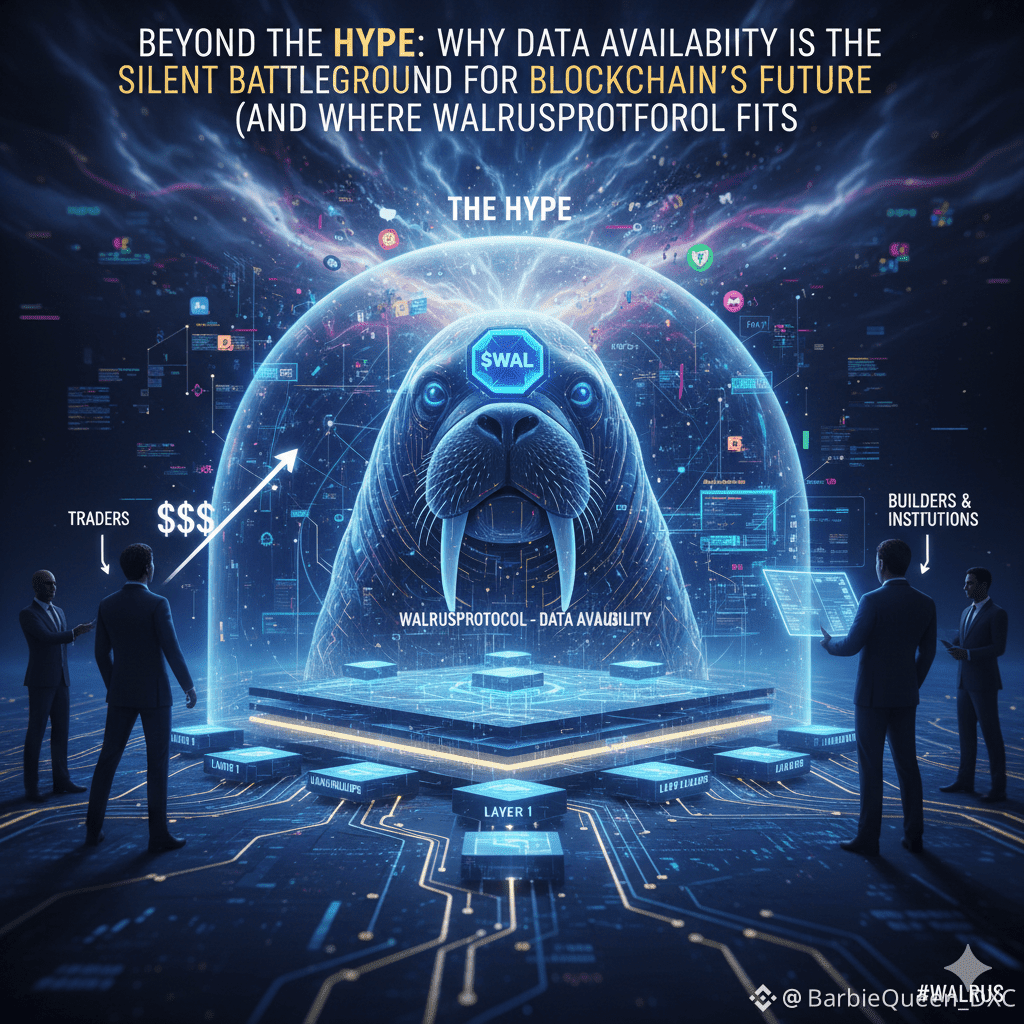
For the average user, "Data Availability" sounds like technical esoterica. But understanding it is understanding the core bottleneck of blockchain scalability. In simple terms, DA answers a critical question: How can a network ensure that all the data needed to verify a block is actually published and accessible to everyone, especially to those who aren't running a full node?
Why does this matter? Let’s consider the scaling trilemma: Security, Decentralization, Scalability. Early Layer 2 solutions (Rollups) promised scalability by executing transactions off-chain and posting only compressed data (or proofs) back to a Layer 1 like Ethereum. But this created a DA problem. If that crucial data isn’t reliably available, how can anyone verify the state is correct? A malicious operator could hide data, effectively stealing funds. Thus, secure, high-throughput, and cost-effective DA became the linchpin.
This is the multi-billion-dollar problem @walrusprotocol is tackling. $WAL isn’t merely a governance token for another smart contract platform; it’s designed to be the economic and security engine of a specialized DA layer. Walrus isn't trying to be the fastest execution environment; it aims to be the most reliable and efficient "library" where other chains post their transaction ledgers, ensuring anyone can audit them.
The professional investment thesis here is clear: Invest in the pickaxes, not just the gold miners. As the blockchain ecosystem modularizes—splitting into specialized layers for execution, settlement, consensus, and DA—the value accrual will flow to the layers that are most bottlenecked and offer the most fundamental utility. Execution layers (L2s) will proliferate and compete fiercely on speed and cost, potentially facing margin compression. The DA layer, however, is a natural oligopoly. It requires immense robustness, strong cryptoeconomic security (which provides), and deep technical moats.
@walrusprotocol’s approach appears to be building a DA solution that balances Ethereum-level security with the cost-effectiveness necessary for mass adoption. By potentially leveraging innovative cryptographic techniques like Data Availability Sampling (DAS)—where light nodes can statistically verify data is present without downloading the entire block—and erasure coding for redundancy, Walrus can offer a product that is both trust-minimized and scalable.
For builders and institutions, the implication is profound. Choosing a rollup stack now involves a critical DA decision. Opting for a high-security DA layer like Walrus can be a key differentiator, assuring users and auditors of the chain's integrity. The token, integral to staking, fee payment, and governance within this ecosystem, becomes a direct conduit to the value generated by this foundational service.
In conclusion, while the market chases the next high-throughput L2, the strategic investor and builder are looking one layer deeper. The future of a scalable, interconnected multi-chain world rests on a robust data availability backbone. @Walrus 🦭/acc is not just building another blockchain; it's building the ledger of ledgers, the foundational truth layer for the next generation of decentralized applications. Its success, and by extension the value of $WAL, will be inextricably linked to the success of the entire modular ecosystem it serves. #walrus $WAL @Walrus 🦭/acc