
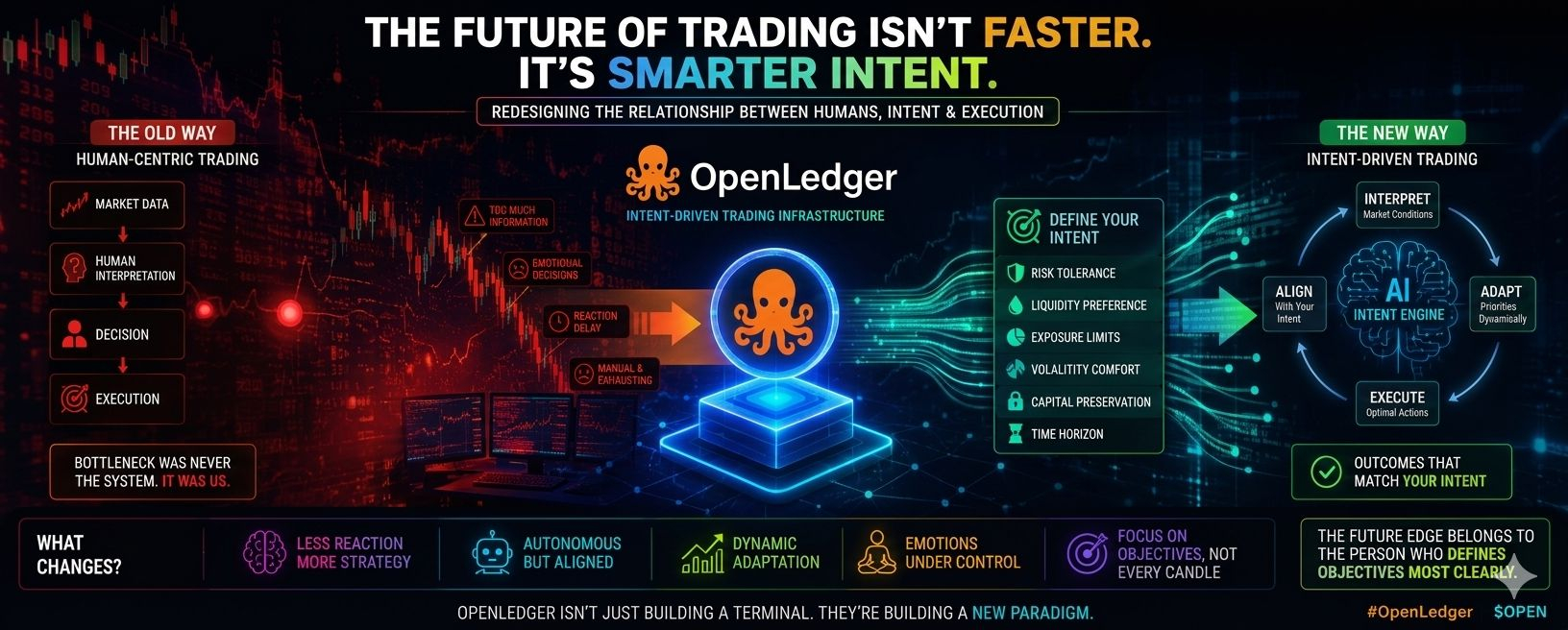

I have been thinking about @OpenLedger for days now and honestly… it completely changed how I look at crypto trading infrastructure.
For years we all assumed the biggest problem in trading was speed.
Faster execution. Faster dashboards. More indicators. Lower latency. More data everywhere.
But what if the real bottleneck was never the system?
What if it was us?
The deeper I looked into OpenLedger, the more I realized most trading terminals still follow the exact same structure they did years ago:
market data → human interpretation → decision → execution.
Even “AI trading” today mostly just assists that process. The AI scans charts, throws signals at you, maybe automates entries, but humans still spend hours manually translating chaos into decisions.
And honestly… I think that entire model is starting to break.
What makes OpenLedger interesting to me is that it doesn’t really feel like another trading dashboard. It feels more like a system built around intent itself.
That distinction sounds small until you really sit with it.
Because no trader operates with one simple objective.
Nobody just wants “max profit.”
You want upside while protecting downside. You want exposure without killing liquidity. You want growth while still sleeping peacefully during volatility spikes.
Traditional terminals force humans to manually balance all those contradictions in real time. And if we’re being real… that process gets mentally exhausting fast.
Especially in crypto where the market changes every five minutes and half the timeline is panic-posting candles like the world is ending 😭
What OpenLedger seems to be doing is moving that balancing layer into the system itself.
Instead of giving constant trade-by-trade instructions, you define broader priorities:
risk tolerance, liquidity preference, exposure limits, volatility comfort, capital preservation goals.
Then the system adapts dynamically as conditions change.
And this is where my brain kinda paused for a second…
Because intent-driven trading creates an entirely different type of risk.
In traditional trading, failure usually comes from humans making bad decisions: emotional entries, bad timing, overtrading, misreading narratives.
But in intent-based systems, execution can technically work perfectly while still drifting away from what the user expected emotionally.
That’s a HUGE difference.
Maybe volatility spikes and the system suddenly prioritizes preservation more aggressively. Maybe liquidity dries up so exposure gets reduced automatically. Maybe defensive positioning temporarily outweighs growth opportunities.
Technically the system is functioning correctly.
But psychologically? The user may feel like the system stopped understanding them.
And honestly I think this becomes one of the biggest AI infrastructure problems over the next few years:
not “how do we automate trading?”
but:
“how do autonomous systems consistently understand human intent?”
That’s way harder.
Because humans are inconsistent. Our risk tolerance changes with mood. Confidence changes after losses. People say they want low risk until they see someone posting 40x gains on the timeline
The deeper I think about it, the more I feel like systems such as OpenLedger could eventually change trader behavior completely.
Right now most traders associate control with constant supervision.
Watching candles nonstop. Refreshing positions every few minutes. Checking funding rates. Monitoring liquidity. Reacting to every move.
There’s almost an addiction to observation in crypto.
But maybe that behavior only exists because our interfaces were designed around manual coordination from the start.
If intent-driven systems evolve properly, traders may stop spending all day hunting setups manually.
The role shifts.
You stop micromanaging execution.
You start designing behavioral frameworks for autonomous systems to operate inside.
How much downside is acceptable? How much liquidity should remain accessible? What portfolio condition matters most over time? What risk profile feels safe today?
That’s a completely different skillset.
And honestly… I think that shift is much bigger than people realize right now.
Because the future edge in crypto may not belong to the fastest trader anymore.
It may belong to the person who defines objectives most clearly before the machine even starts executing.
And if that’s where this industry is heading…
then I genuinely don’t think OpenLedger is building “just another terminal.”
I think they might be redesigning the relationship between humans, intent, and execution itself.