
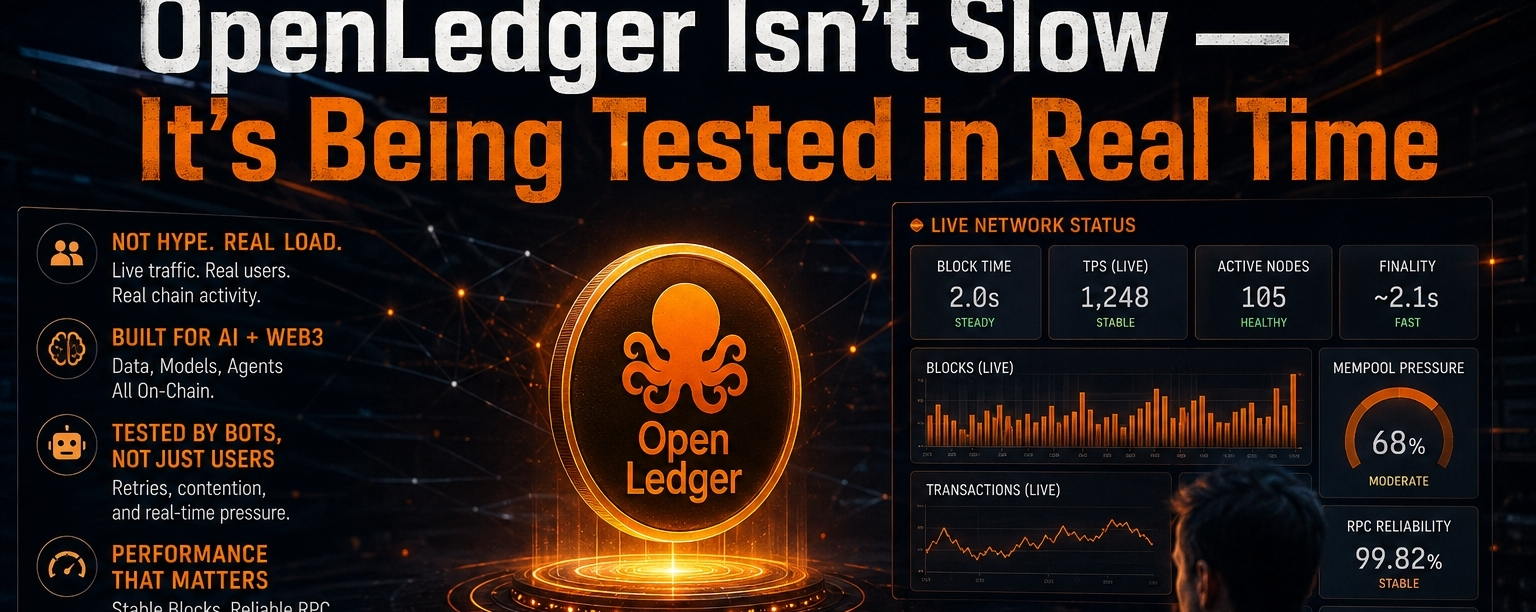
I’ve been watching OpenLedger quietly for a while now, not because the marketing is loud, but because the infrastructure side keeps raising a more interesting question in my head: what actually happens when this thing gets busy?
Not “announcement busy.” Not synthetic benchmark busy. Real activity. Real users. Real bots. Real pressure.
That’s usually where the truth starts leaking out.
I don’t really care about isolated TPS screenshots anymore. Every chain can look fast in a controlled environment. What I pay attention to now is smaller stuff how often RPC calls hesitate, whether wallets need refreshing twice during volatile moments, how quickly explorers reflect state changes when traffic spikes. Those tiny inconsistencies tell you more about a network than a polished dashboard ever will.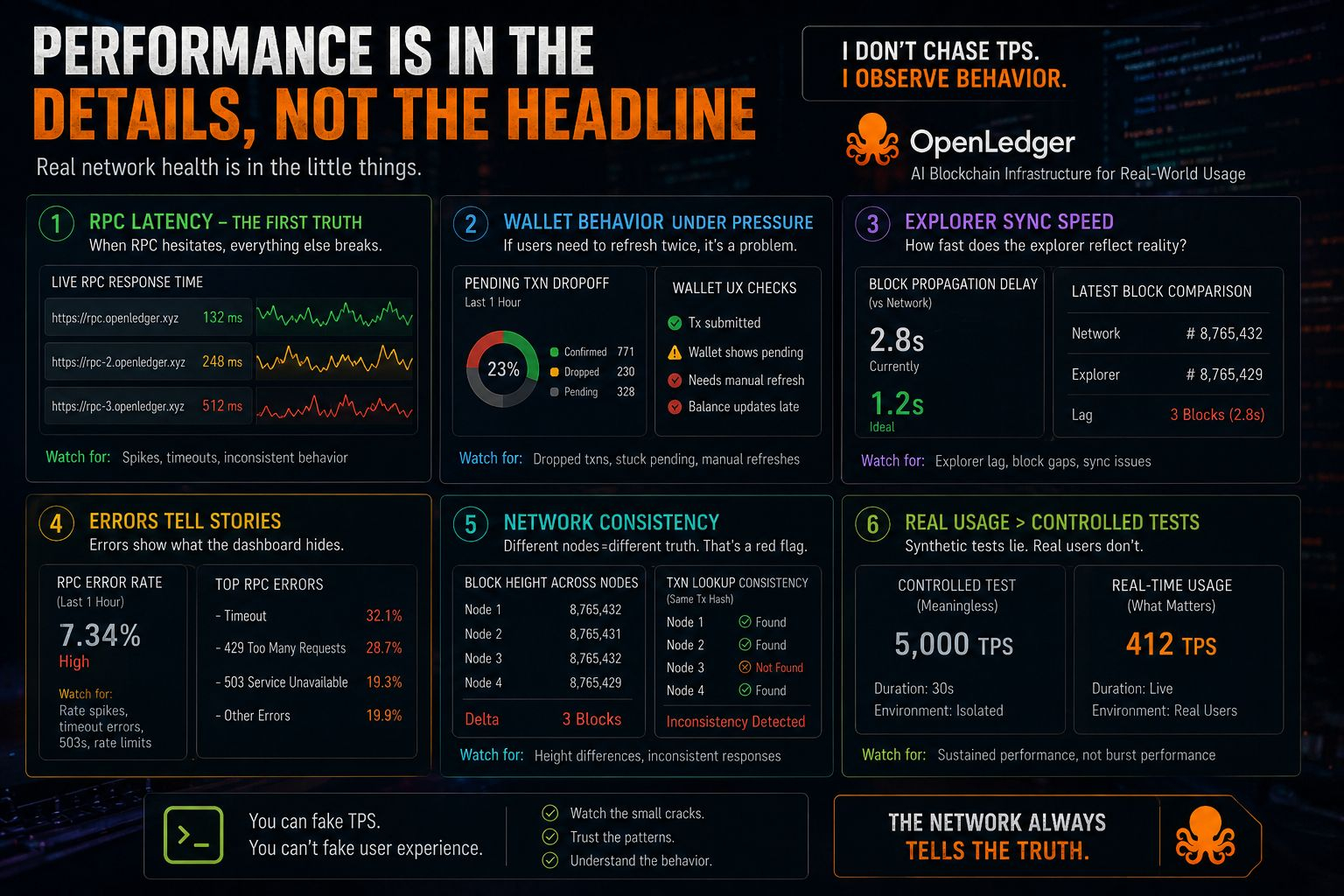
OpenLedger is trying to build around something heavier than simple transfers. That’s the part people keep skipping over. The network isn’t just talking about moving tokens around faster; it’s trying to create an economy around data, models, attribution, and AI agents. Once you start attaching financial value to inference and dataset ownership, the chain stops behaving like a normal lightweight execution layer.
The workload changes completely.
A lot of people still treat blockchain performance like a single-number competition, but live systems don’t work that way. Throughput is shaped by networking, validator communication, signature verification, execution scheduling, shared-state contention, mempool behavior all the ugly invisible mechanics underneath the surface.
And honestly, most chains don’t break where the whitepapers say they will.
They usually break around the edges first.
Indexers fall behind. RPC reliability gets inconsistent. Bots start retrying transactions aggressively. Priority fees suddenly matter more than expected. Users normalize small delays because “it still works.”
That’s why I’ve been more interested in OpenLedger’s live feel than its theoretical ceiling.
Right now the chain feels early, but not fake. There’s a difference. Some infrastructure surfaces still feel like they’re catching up to the pace of development, and honestly I’d rather see that than perfectly polished inactivity. Networks under real construction are supposed to feel uneven sometimes.
The interesting part is how OpenLedger positions AI activity directly inside the economic layer instead of keeping it abstract. Attribution systems sound elegant on paper reward contributors, trace model influence, connect outputs back to datasets but attribution creates state complexity fast. Every additional relationship adds overhead somewhere. Storage expands. Indexing gets harder. Reads become heavier. Coordination matters more.
And if the network actually succeeds in attracting automated agents instead of just speculation around the token, traffic patterns become much harsher than normal retail usage.
Humans are slow.
Agents are not.
Machines retry instantly. They optimize latency aggressively. They compete for ordering advantages the second there’s financial incentive to do it. Once enough automated behavior enters the system, execution stops being cooperative and starts becoming adversarial.
That’s where most infrastructure gets exposed.
The DeFi world already showed this years ago. Congestion rarely comes from everyone doing different things. It comes from everyone trying to touch the same state simultaneously. Liquidations. Oracle updates. Arbitrage opportunities. Shared liquidity pools. Hot contracts.
The same thing can happen here if AI-driven activity becomes meaningful.
And this is where architecture trade-offs start mattering more than branding.
OpenLedger leaning into Ethereum-compatible tooling makes sense. Familiar wallets, easier onboarding, recognizable infrastructure patterns all of that reduces friction for builders immediately. But every optimization comes with a cost somewhere else. Lower latency usually requires tighter operational assumptions underneath. Faster coordination often means more dependence on curated infrastructure quality. The smoother the experience becomes, the more carefully the network topology usually has to be managed behind the scenes.
People love pretending decentralization, speed, and operational efficiency all scale together naturally.
They don’t.
You can balance them well. You can engineer around some limitations. But eventually every network reveals what it prioritized when conditions become stressful.
That’s why I’m less interested in OpenLedger’s peak claims and more interested in how gracefully it handles imperfect conditions.
Can RPC reliability stay stable during bursts? Do wallets still feel responsive when contention increases? Does finality remain predictable once bots begin competing harder? Can indexers keep pace with attribution-heavy state growth?
Those questions matter more than promotional throughput numbers.
What I’ve noticed so far is that OpenLedger still feels like a network approaching its real test rather than one that has already survived it. And honestly, that’s fine. Most infrastructure only becomes understandable once it’s forced through uncomfortable conditions repeatedly.
Right now the chain feels structurally ambitious, slightly rough around the edges, and very aware that AI workloads behave differently from traditional crypto activity. That alone makes it more interesting than a lot of projects recycling generic “AI + blockchain” language without thinking through what machine-driven execution actually does to infrastructure.
Over the next few weeks, I’m mainly watching consistency.
Not hype cycles. Not token movement. Not influencer timelines.
Consistency.
I want to see whether explorer data stays synchronized during heavier activity windows. I want to see whether retries quietly become normalized behavior. I want to watch whether the infrastructure remains boring under stress, because boring infrastructure is usually good infrastructure.
And I’m especially watching whether attribution systems remain usable once scale arrives. It’s easy to track relationships cleanly at small volume. It becomes much harder once the graph starts expanding aggressively and every participant expects near real-time responsiveness.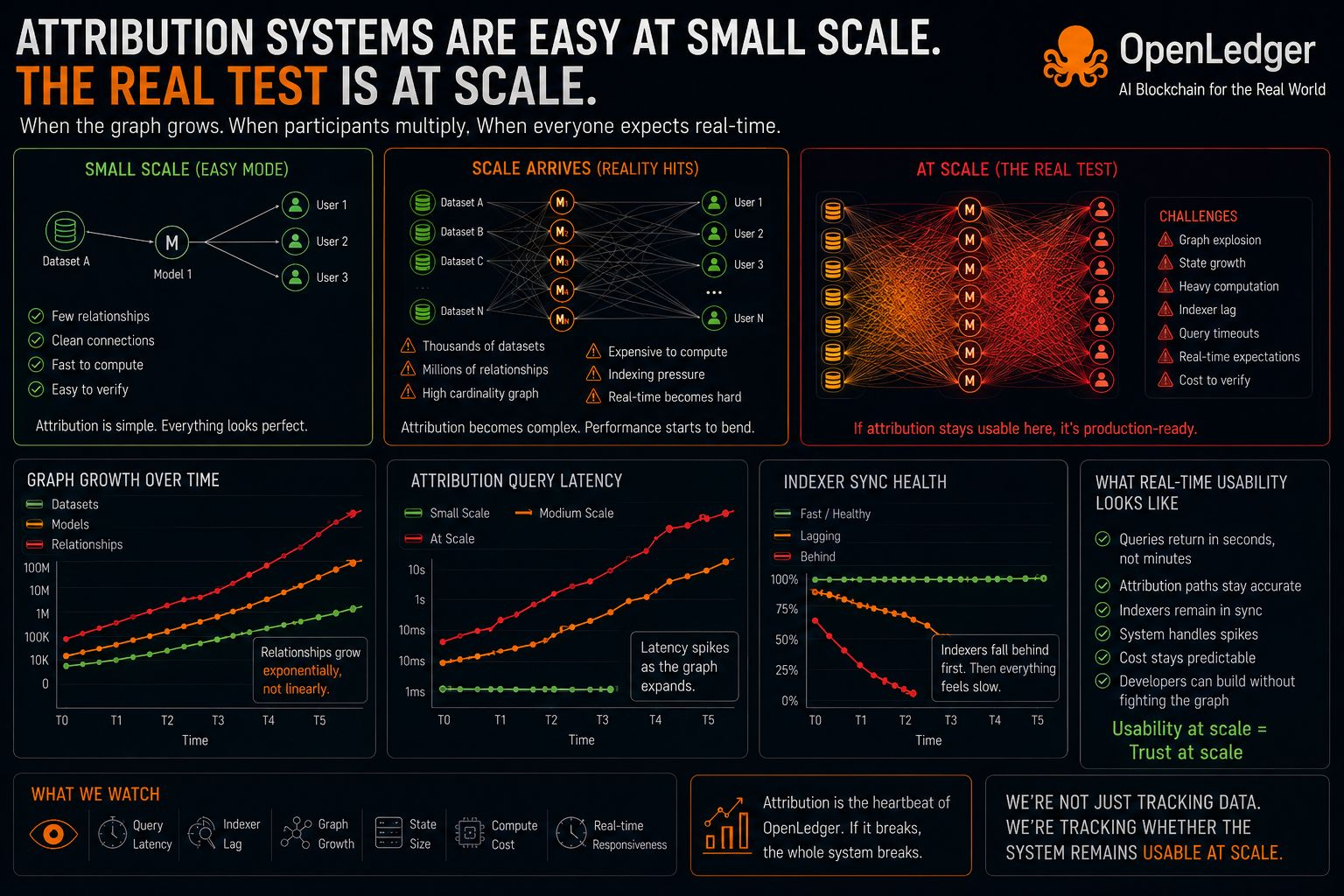
That’s the moment where theory collides with production reality.
And production reality is always less polite than the roadmap.$OPEN
