
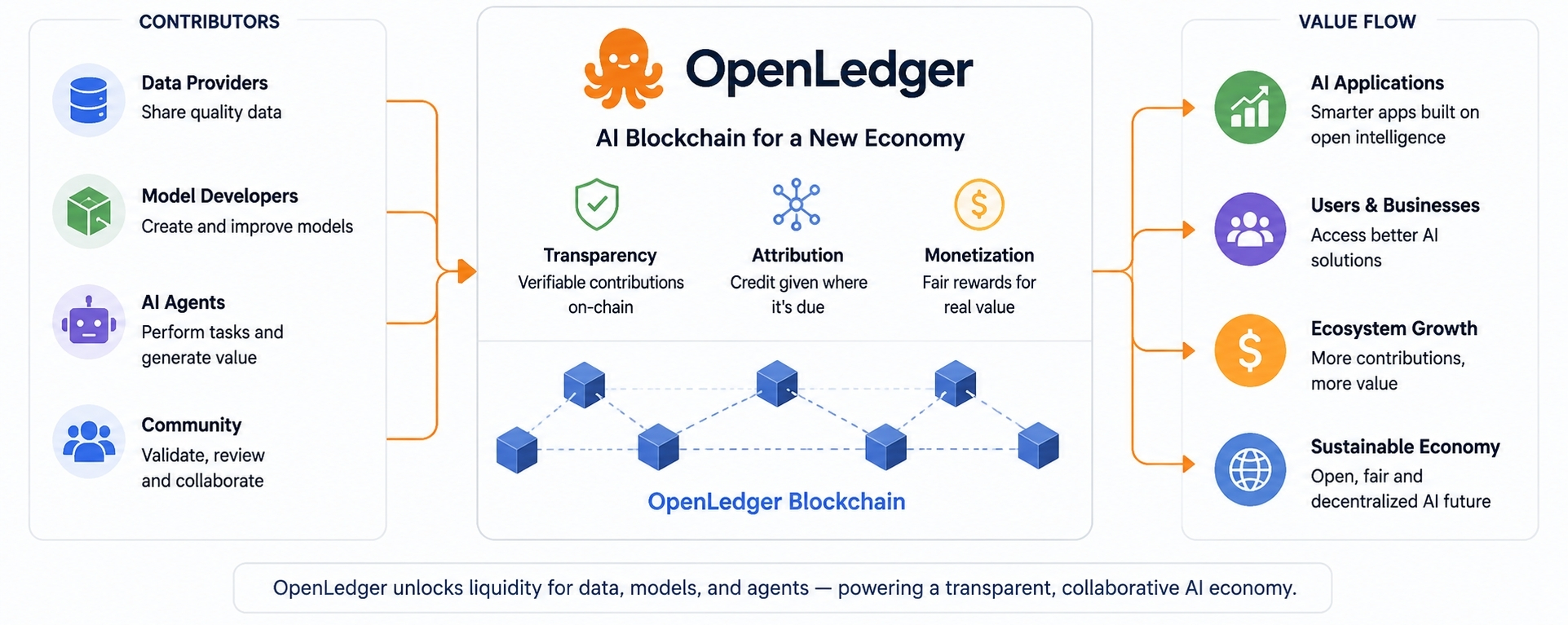
I’ve been thinking a lot about OpenLedger lately, and honestly, I didn’t expect it to stay in my mind this long. Most AI blockchain projects blur together after a while. They usually sound huge in theory but empty once you sit with them for more than a few minutes. A lot of noise, a lot of futuristic language, but very little that feels grounded in how people actually use technology or where value really comes from.
At first, I thought OpenLedger was going to be another version of that. The usual mix of AI, decentralization, ownership, agents, data economies — all the words the market likes hearing right now. But the more I looked at it, the more I realized the project is trying to approach something deeper than hype.
What really caught my attention was the idea behind ownership in AI.
Right now, almost everything connected to AI feels extremely centralized. A few companies control the models, the infrastructure, the data pipelines, and eventually the profits that come from all of it. Meanwhile, millions of people constantly contribute value without even realizing it. Every interaction online becomes useful somewhere. Every correction, prompt, search, preference, and behavior slowly feeds these systems.
The strange part is how normal this has become.
People are helping train intelligence every day, but almost nobody talks about who actually owns the outcome of that process. The more I thought about OpenLedger, the more it felt like the project was built around that exact imbalance.
Not necessarily as some revolutionary answer, but as an attempt to rethink the structure itself.
I used to assume the future of AI would mostly belong to whoever had the biggest computing power and the most money. And maybe that’s still partly true. But OpenLedger made me think more about the layer underneath that — the contributors, the data, the activity, the invisible participation that keeps these systems alive.
That’s the part most people ignore because it’s harder to measure.
What stood out to me wasn’t the blockchain itself. Honestly, blockchains alone don’t impress me anymore. Technology by itself means very little if there’s no real economic behavior underneath it. What interested me was the attempt to turn contribution into something visible and valuable instead of something quietly extracted in the background.
The project seems to treat data, AI models, and agents almost like living economic assets instead of closed products owned by a single company. And whether that fully works or not, I think the idea behind it reflects where AI is slowly heading.
Because the internet is changing.
We’re moving into a world where intelligence itself becomes part of the economy. Not just software, not just content, but actual machine intelligence constantly learning from human activity. And once that happens, ownership starts becoming a much bigger conversation than technology alone.
The deeper I went into OpenLedger, the less it felt like a typical crypto project to me. It started feeling more like infrastructure for a future that doesn’t fully exist yet. A system trying to answer questions that the AI industry still avoids.
Who should benefit when intelligence grows? Who gets rewarded for contributing value? How do you track participation fairly in systems built from millions of interactions?
Those are difficult questions, and honestly, I don’t think anyone has solved them properly yet.
That’s also why I still look at projects like this with caution. Open systems sound good until incentives enter the picture. Once money becomes attached to contribution, people naturally start gaming the system. Low-quality data floods in. Noise increases. Everyone wants rewards, but very few networks know how to measure genuine value accurately.
I think that’s the real challenge for OpenLedger.
Not marketing. Not partnerships. Not token price.
The real challenge is whether the network can actually identify meaningful intelligence in a world that’s becoming overloaded with synthetic content and automated behavior.
And that’s much harder than people realize.
Still, I can’t deny that the core idea feels relevant. AI is becoming one of the most powerful economic forces on the internet, but the ownership structure around it still looks very old. Extremely concentrated. Extremely closed. Projects like OpenLedger are basically questioning whether intelligence can become more open financially, not just technologically.
That distinction matters.
Because decentralization isn’t meaningful if people only participate symbolically. Real participation means contributors share in the value being created, not just the narrative around it.
I think that’s why the project stayed interesting to me longer than most AI crypto ideas do. It isn’t simply trying to attach a token to AI. It’s trying to build an economy around contribution itself.
Maybe it works. Maybe it doesn’t.
There’s still a huge gap between ambitious ideas and systems that function at scale in the real world. Crypto has a history of moving faster than reality. I don’t ignore that when I look at OpenLedger.
But I also think the project is touching something important before most people fully recognize it.
AI is no longer just about smarter models. It’s becoming about who owns the intelligence layer of the internet itself.
And the more I think about that, the more projects like OpenLedger start feeling less speculative and more like early attempts at solving a problem that’s only going to become bigger from here.