

Most people will look at OpenLedger and place it in the same crowded corner as every other AI blockchain project.
I think that misses the point.
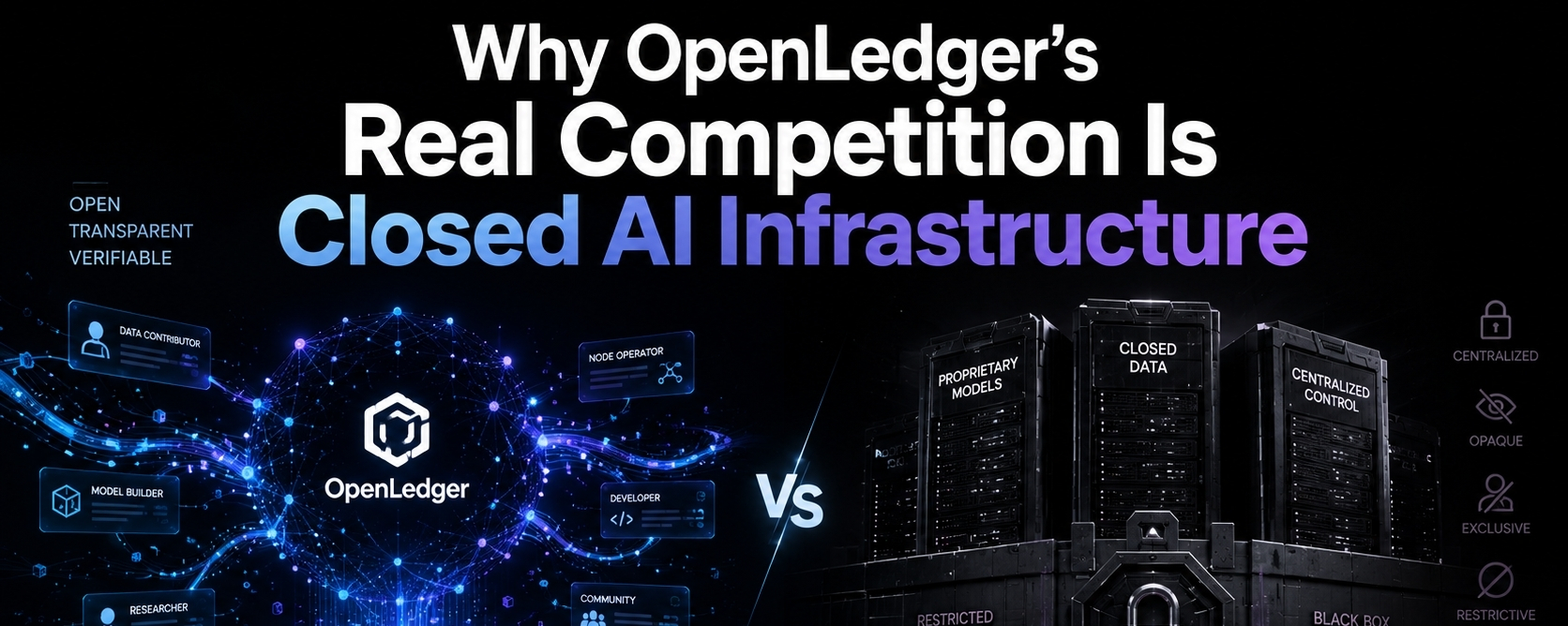
OpenLedger is not just competing with other crypto-AI networks. Its real opponent is much bigger and much quieter: closed AI infrastructure.
The private datasets. The locked model pipelines. The invisible training process. The platforms that absorb user behavior, expert knowledge, and public data, then turn all of it into proprietary intelligence.
That is the real battlefield.
OpenLedger is not trying to win by simply saying, “We also have AI.” Its stronger argument is different: if AI is going to become part of every industry, then the value behind AI should not remain trapped inside black boxes.
People often criticize closed AI because we cannot fully see how the models work. That is true, but the deeper issue is economic.
Closed AI systems work like sealed factories.
Data goes in. Models improve. Outputs are sold. Revenue flows upward.
But the people who contributed useful data, built niche models, trained domain-specific systems, or added knowledge to the network often disappear from the value chain.
Their contribution helps create the product, but they do not keep a real claim on the future value it generates.
That is where OpenLedger becomes interesting.
Its Proof of Attribution idea is not just about showing where data came from. The bigger idea is to connect contribution with reward. If a dataset, model, or agent helps produce useful AI output, that contribution should be traceable and monetizable.
That sounds simple, but it challenges one of the biggest assumptions in AI today: that intelligence should be owned by the platform, not shared across the people and systems that helped create it.
The way I see it, OpenLedger is less like a basic AI marketplace and more like a royalty system for intelligence.
A normal marketplace lets people list models or datasets.
OpenLedger is aiming for something deeper: a structure where data, fine-tuned models, LoRA adapters, agents, and applications can all become part of an economic loop.
That matters because the future of AI probably will not be one giant model answering everything. It will be many specialized systems trained for specific industries, communities, languages, workflows, and use cases.
A legal dataset. A DeFi agent. A medical research model. A regional language assistant. A trading intelligence layer. A customer support model trained on a company’s own knowledge base.
Each one has different contributors behind it. OpenLedger’s thesis is that those contributors should not be erased after the model is created.
That is a very different view from closed AI platforms, where everything gets absorbed into one private system.
OpenLedger wants to turn AI into a supply chain with memory.
Closed AI infrastructure is powerful because it is easy.
A company does not want to think about attribution, provenance, model ownership, or contributor rewards. It wants an API that works. It wants fast inference, clean dashboards, predictable costs, and enterprise support.
That is the hard truth OpenLedger has to face.
Open infrastructure does not win because it sounds fair. It wins only when it becomes usable.
This is why OpenLedger’s tools around Datanets, Model Factory, OpenLoRA, Open Chat, and AI Studio matter. They are not just side products. They are the bridge between the idea and the actual user.
Because if attribution feels complicated, only idealists will care.
But if attribution happens quietly in the background while developers build, train, deploy, and monetize AI systems, then it becomes infrastructure.
That is the difference between a nice narrative and a working network.
What makes OpenLedger more relevant is that its recent ecosystem direction is not limited to “data monetization.”
The project is moving toward a broader theme: verifiable AI activity.
That includes rights-cleared AI training, automatic creator payments, and AI agents that can operate with on-chain accountability. These are not small ideas. They point toward a future where AI systems are not only intelligent, but also auditable.
This matters because AI agents are moving into areas where trust is not optional.
If an AI agent makes a financial decision, who can verify what happened?
If a model uses licensed IP, who gets paid?
If a dataset improves an output, how is that contribution recognized?
If an autonomous system acts on-chain, where is the proof?
Closed AI can give answers internally, but users are still asked to trust the platform.
OpenLedger is trying to create a system where the proof does not live behind a company wall.
That is a meaningful difference.
The OPEN token should not be viewed only through price movement. The more important question is whether it becomes necessary inside the actual network economy.
Its utility is tied to gas, inference fees, model building, staking, governance, and rewards for data contributors. That gives it a clear role on paper.
But the real test is practical.
Does model usage create demand?
Do contributors receive meaningful rewards?
Do developers pay to build and deploy?
Do agents generate on-chain activity?
Do Datanets become useful enough that people actually want to participate?
That is what will separate OpenLedger from projects that only attach AI language to a token.
A strong AI network should produce real economic events: model registrations, inference calls, dataset rewards, staking activity, app deployments, and agent execution.
If those events grow, OPEN becomes more than a speculative asset. It becomes settlement fuel for an AI economy.
The OpenLedger buyback program can easily be read as price support. But I think the more interesting angle is accountability.
If enterprise revenue is being connected back to the token economy, then the market gets something to observe. It is not just a claim in a roadmap. It becomes a visible financial action.
That matters because one of the weaknesses of closed AI infrastructure is that value flows are hidden. Users see the product, but they do not see how contributors, data sources, or infrastructure participants are rewarded.
OpenLedger has the chance to do the opposite.
The stronger version of this project is not one that simply says, “We have enterprise adoption.” It is one where enterprise usage leaves traces across the network.
That is how trust becomes measurable.
OpenLedger’s staking system also needs to be viewed carefully.
In many crypto projects, staking becomes a simple yield feature. Users lock tokens, earn rewards, and move on.
For OpenLedger, staking should ideally represent something more serious: long-term alignment with the AI economy being built.
If the network is handling model execution, attribution, data rewards, and agent activity, then staking should support the credibility and sustainability of that system.
The real question is not just “what is the APY?”
The better question is: are stakers helping secure and coordinate a network where AI contributions can be verified, rewarded, and reused?
That is the kind of staking utility that would actually fit OpenLedger’s larger mission.
Closed AI companies have massive advantages. They have capital, compute, distribution, talent, and enterprise relationships.
OpenLedger is not going to beat them by spending more money on data centers.
Its opportunity is different.
Closed AI is strong at performance.
OpenLedger is trying to be strong at provenance.
Closed AI is strong at control.
OpenLedger is trying to be strong at contribution.
Closed AI is strong at ownership.
OpenLedger is trying to be strong at attribution.
That difference becomes more important as AI moves beyond simple chatbots.
When AI is writing code, trading assets, using licensed content, powering apps, supporting businesses, or acting as an autonomous agent, people will start asking harder questions.
Where did this output come from?
Who contributed to it?
Who deserves payment?
Can the action be verified?
Can the model’s economic history be traced?
Closed systems can answer some of those questions privately.
OpenLedger wants to answer them publicly.
OpenLedger’s strongest narrative is not “AI on blockchain.”
That phrase has become too easy to ignore.
The stronger narrative is this: AI needs an economic memory.
As intelligence becomes more valuable, the systems behind it need to remember who contributed, what was used, how value moved, and why rewards were distributed.
That is where OpenLedger’s real opportunity sits.
It is not trying to make AI more mysterious. It is trying to make AI more accountable.
Of course, the project still has to prove a lot. It needs real developers, real datasets, real model usage, real enterprise demand, and token utility that exists beyond incentives. The idea is strong, but execution will decide everything.
Still, the framing is important.
Closed AI turns intelligence into a private product.
OpenLedger is trying to turn intelligence into a shared economic network.
And if that works, the competition is not just between blockchains. It is between two different futures for AI.
One future says intelligence belongs to the platform.
The other says intelligence should remember everyone who helped create it.
