
Something has been shifting quietly in the background of the AI industry, and it is starting to get loud.
The lawsuits are piling up. Authors, broadcasters, visual artists, YouTubers. Companies like Adobe, Apple, Meta, OpenAI, and Google are all facing legal action from people whose data helped build AI systems that now compete against them. The core complaint is almost always the same: billions of dollars extracted from creative work, forum posts, annotations, and published content, with nothing flowing back to the people who originally produced it.
That is not a small legal nuisance. It is a structural problem that the AI industry has been avoiding since the beginning.
And here is what makes it interesting from a blockchain perspective. A fix does not only require better law. It requires better infrastructure for tracking contribution in the first place. You cannot pay people fairly for something you never recorded. Courts cannot enforce attribution that was never designed to be measurable. That is exactly the gap OpenLedger is trying to close.
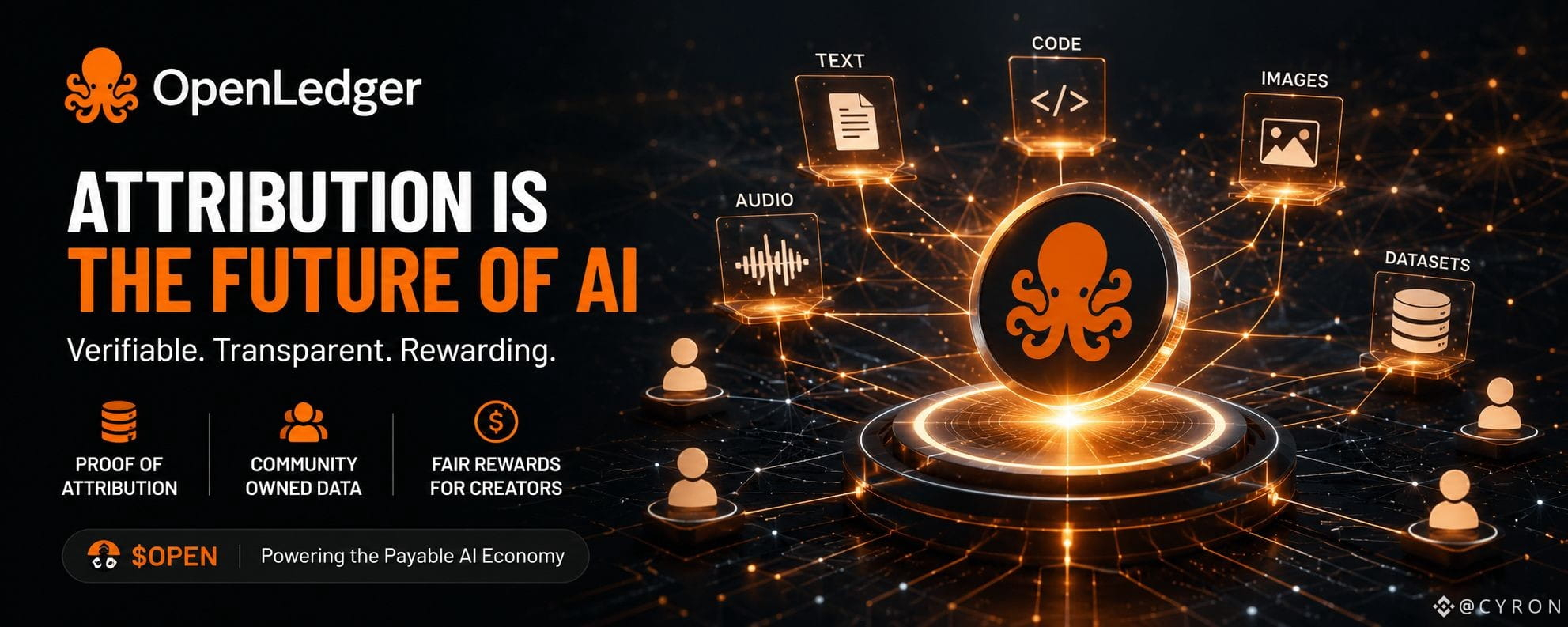
The project's Proof of Attribution system is built to do something most AI pipelines have never attempted. It records which data influenced which model output, on chain and in a way that does not disappear. Every inference produces a traceable record. Every contributor gets a connection to the value their work helped generate. The mechanism uses influence function approximations for smaller models and suffix array based token attribution for large language models, meaning it checks outputs against training data to detect actual influence rather than just guessing.
That is more precise than most attribution systems in any industry, not just crypto.
The market context makes this more urgent, not less. $OPEN is currently trading around $0.21, with a fully diluted valuation near $216 million and a max supply of one billion tokens. About 220 to 290 million tokens are in circulation depending on the data source, which already tells you something about where trust gaps still exist at the market data layer. The all time high was $1.82. The token is still more than 80 percent below that. For anyone looking at this project through a pure price chart, the picture looks discouraging.
But price and infrastructure do not always move together, especially early.
What matters more right now is whether the problem OpenLedger is solving becomes unavoidable. And the evidence from the legal environment in 2026 suggests it already is. Courts in the US and Europe are actively reviewing how AI companies sourced training data. Dozens of active cases are working through discovery. South Korean broadcasters approached OpenAI directly to negotiate licenses and were turned away. Authors, musicians, and coders are watching each ruling to understand whether their contributions will ever carry economic weight.
That pressure creates a real demand signal for what OpenLedger calls Payable AI. The idea is simpler than it sounds. If a dataset improves a model, and if the improvement is provable on chain, then the people who contributed that dataset should receive a portion of the value that inference generates. The same way a content creator on a platform earns from views, except the contribution here is training data rather than a video.
The $OPEN token sits in the middle of all three layers. It powers gas fees across the chain. It flows as rewards to data contributors through the attribution mechanism. It governs decisions about how the protocol evolves. The economics only become self sustaining when real model usage creates real demand for the token, which is still the part that has not been proven at scale.
That is the honest version of the situation.
OpenLedger's tooling is functional. Datanets for community owned data. ModelFactory for no code model building. OpenLoRA for deployment. The OP Stack rollup with EigenDA for data availability. The EVM compatibility that lets developers build without relearning everything. The seed round came from Polychain and Borderless Capital, with notable angels including the co founder of Polygon and the former CTO of Coinbase. None of that guarantees adoption, but it is a serious construction, not a pitch deck with an empty repo behind it.
The real question is timing. Attribution infrastructure matters most when ignoring attribution becomes costly. In 2026, that cost is rising faster than most people expected. Legal pressure, regulatory scrutiny, public trust in AI falling sharply, and a creative class that is increasingly organized and litigious. The window where AI companies could treat data as free may be closing faster than the industry would prefer.
@OpenLedger is not betting on hype. It is betting that accounting for contribution becomes required infrastructure before the next generation of AI products ships.
That bet is either early or exactly on time. The difference between those two depends on execution
