
OpenLedger Could Become a Major Player in the Decentralized AI Revolution
Artificial intelligence is evolving faster than ever, but one problem continues to dominate the industry — centralization. Today, a handful of tech giants control most AI models, datasets, and computing infrastructure. While billions of users contribute data every day, very few actually benefit from the value their data creates. This is the exact issue OpenLedger is trying to solve.
OpenLedger is an emerging AI-focused blockchain ecosystem designed to bring transparency, ownership, and monetization to the world of artificial intelligence. Instead of allowing large corporations to dominate the AI economy, OpenLedger introduces a decentralized model where contributors, developers, and communities can all participate and earn rewards.
The project is gaining attention because it combines two of the fastest-growing sectors in technology: blockchain and AI. While many crypto projects simply add “AI” to their branding, OpenLedger is building infrastructure specifically designed for AI development, data attribution, and decentralized machine learning.
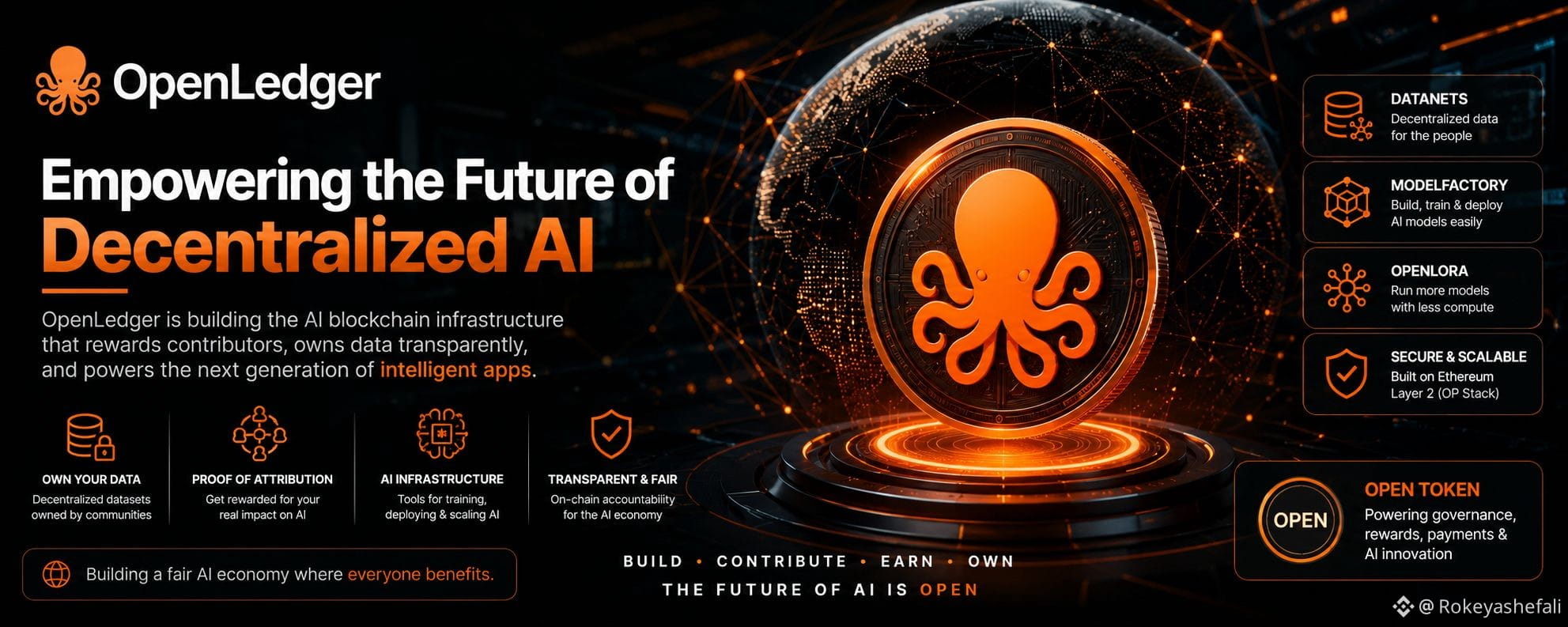
One of the biggest features that separates OpenLedger from traditional AI platforms is its “Proof of Attribution” system. This mechanism tracks how data contributes to AI model performance and rewards contributors accordingly. In simple terms, if your dataset helps improve an AI model, the blockchain records your contribution and ensures you receive compensation. This creates a more fair and transparent AI economy compared to centralized systems where users provide valuable data for free.
Another important innovation inside the ecosystem is the concept of “Datanets.” These are decentralized datasets managed by communities rather than corporations. Contributors can upload, organize, and monetize data while maintaining transparency over how that data is used. As AI continues to grow globally, high-quality data is becoming one of the most valuable digital resources, and OpenLedger wants to give ownership back to the people creating it.
The platform also introduces tools like ModelFactory and OpenLoRA, which are designed to simplify AI model deployment while reducing infrastructure costs. This could help smaller developers and startups compete in an industry that is currently dominated by companies with massive computing power and billion-dollar budgets.
OpenLedger operates on an Ethereum-connected Layer 2 infrastructure, aiming to provide lower transaction costs and better scalability for AI-related operations. The ecosystem is powered by the OPEN token, which is used for governance, transaction fees, rewards, and AI services across the network.
Recently, the project has started attracting strong interest from both crypto traders and AI enthusiasts. Many analysts believe decentralized AI could become one of the biggest narratives of the next crypto cycle, and OpenLedger is positioning itself directly at the center of that trend. Community discussions around the project continue growing as more people recognize the long-term potential of combining blockchain technology with artificial intelligence.
However, like every early-stage crypto project, OpenLedger still faces challenges. Adoption, ecosystem growth, partnerships, and real-world utility will determine whether the platform can compete against established centralized AI companies. The AI industry moves extremely fast, and only projects with strong execution and innovation will survive long term.
Still, OpenLedger’s vision stands out because it focuses on creating a fair AI economy where contributors are rewarded instead of exploited. If decentralized AI becomes mainstream in the coming years, projects like OpenLedger could play a major role in shaping the future of how AI models are trained, governed, and monetized.
For now, OpenLedger remains one of the more interesting projects to watch in the growing intersection between AI and blockchain technology.