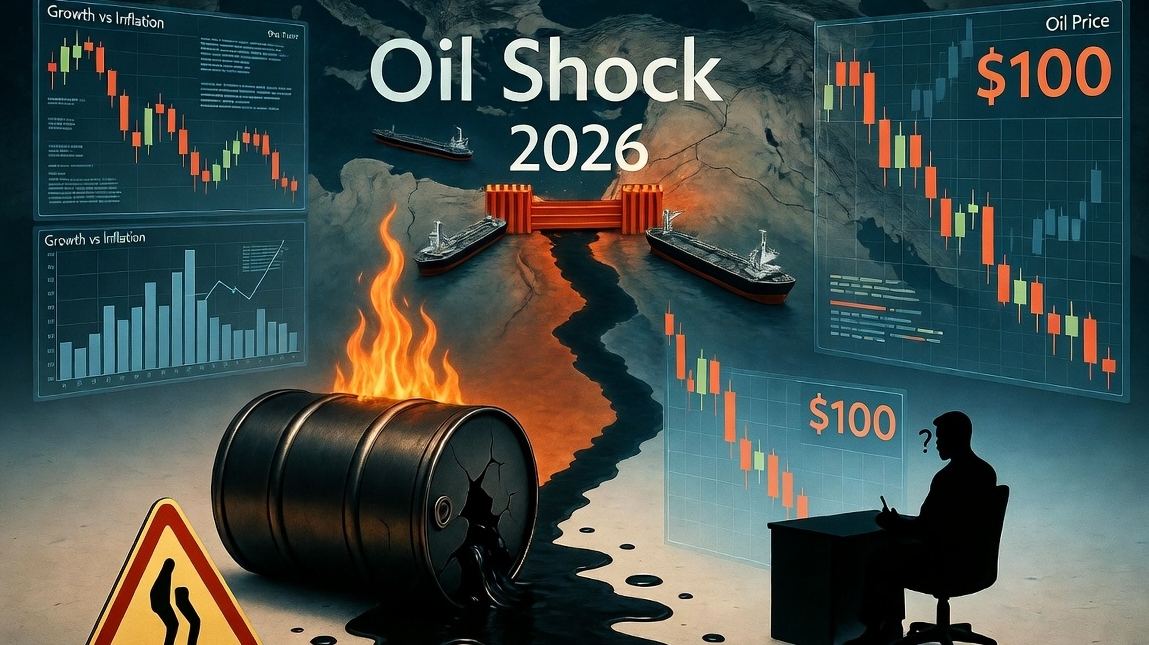
A shock is forming… but the most dangerous thing isn’t the rising oil price itself.
It’s that the market may be completely misunderstanding the nature of this shock.
A recent CNBC analysis issues a familiar warning: the 1970s could be repeating. Surging oil prices, supply disruptions in the Strait of Hormuz, and an energy shock that could spiral into inflation, recession, and a crisis of confidence.
President Donald Trump sees it differently. He believes the worst is already behind us — gasoline prices will rise only temporarily and will quickly fall once shipping routes reopen.
However, current data tells a more complex story.
Oil has already breached $100 per barrel. Average U.S. gasoline prices have surpassed $4 per gallon, reaching over $6 in some states. Nearly 20% of global oil flows are now under threat. The impact is even sharper elsewhere: jet fuel prices have surged 96%, and natural gas prices in Asia have jumped 43%. Strategic reserves are steadily depleting, and according to IEA chief Fatih Birol, oil shortages could worsen significantly in the coming months.
The traditional narrative seems straightforward:
Rising energy prices → returning inflation → Fed forced to tighten → economic slowdown.
CNBC is right to sound the alarm — if this shock persists.
But the market may be mispricing the sequence of risks.
Today’s America is not the America of the 1970s. The United States is now one of the world’s largest oil producers. While this doesn’t eliminate the shock, it greatly reduces the country’s vulnerability.
This time, the shock is mainly about disrupted flows, not a prolonged structural shortage. If the Strait of Hormuz reopens, supply could recover faster than many expect.
More importantly, consumer behavior has changed.
When energy prices rise, consumers now cut spending almost immediately. This creates a counter-effect: falling demand helps ease inflationary pressure naturally.
This is the crucial point.
Fed Chair Jerome Powell recently said rate hikes are not on the table for now. But the real story lies in what he’s actually concerned about.
He is no longer primarily focused on inflation.
He is worried about growth.
He fears the energy shock will cause consumers to pull back spending, slowing the economy before inflation has time to surge again.
This creates a difficult paradox for the Fed.
The Fed claims it reacts to data. Yet right now, it appears to be acting on forward-looking risks. In other words, the Fed is trying to get ahead of the curve.
And it finds itself caught in the middle:
Tighten too much → risk choking economic growth
Do nothing → risk letting inflation return if oil prices keep climbing
But there’s an even more important layer many are missing: liquidity.
If growth slows sharply, the Fed will find it extremely difficult to tighten policy.
If it doesn’t tighten, liquidity won’t be drained aggressively from the system.
In a worse scenario, the Fed might even be forced to ease again.
This completely changes the market narrative.
This is no longer a classic inflation shock.
It could be a growth shock disguised as an inflation shock.
And that means:
Inflation may not explode first.
Instead, economic growth will slow first, and only then will the rest of the cycle unfold.
CNBC is correct to warn about the risks if the disruption drags on.
But in the short term, the market may be looking in the wrong direction.
The real question isn’t when the war will end.
It’s when the Strait of Hormuz will reopen — and whether the global economy can withstand this shock before that happens.