
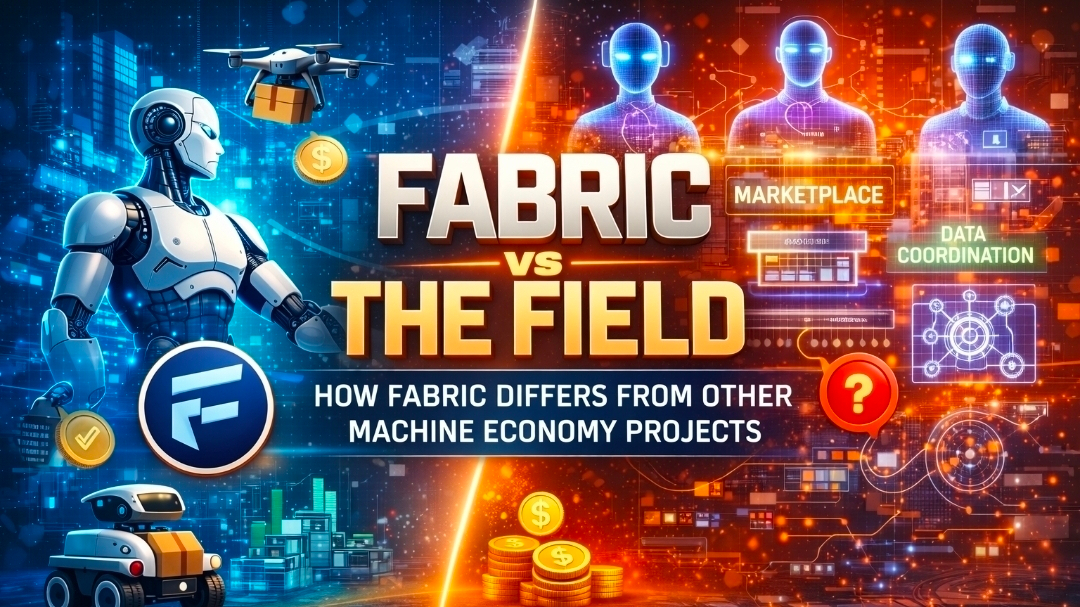
The idea of a “machine economy” is becoming popular. AI agents negotiating tasks, robots completing jobs, and automated systems exchanging value on-chain. But after reading through several projects in this space, I noticed something interesting: most focus on digital coordination. Fabric seems focused on the real world.
That difference matters more than it sounds.
Many machine-economy projects revolve around software agents. They help AI systems communicate, trade data, or execute tasks inside digital environments. It’s useful infrastructure but it mostly lives in the virtual layer.
Fabric takes a different starting point. It assumes that machines operating in the physical world delivery robots, drones, autonomous vehicles will eventually need a shared economic and verification framework.
And physical systems are messy.
A robot might report that a delivery is complete, but another system might record a delay or failure. Sensors produce imperfect information. Networks drop packets. Environments change. In these conditions, simple task logs aren’t enough.
Fabric’s approach tries to address this gap.
Instead of focusing only on AI coordination, Fabric builds infrastructure where machines have verifiable identities, task histories, and economic settlement mechanisms. Work isn’t just reported it becomes evidence the network can evaluate.
That’s the part I find compelling.
In many blockchain projects, the token or marketplace is the headline feature. Fabric flips that order. The core idea is trustable machine activity a framework where robots can prove what they did, networks can validate it, and economic rewards can settle automatically.
Only then does the token layer make sense.
This architecture could become important as robotics networks scale. If thousands of autonomous systems begin interacting across companies and environments, coordination alone won’t be enough. The network will also need verification, accountability, and economic alignment.
Fabric appears to be building for that reality.
Whether the machine economy grows slowly or faster than expected, one thing is clear: robots won’t just need intelligence. They’ll need infrastructure that lets them coordinate, prove work, and transact value with other machines.
That’s the layer Fabric is trying to build.
And in a space crowded with AI narratives, focusing on verifiable machine activity might be the most practical path forward.
@Fabric Foundation #ROBO $ROBO
